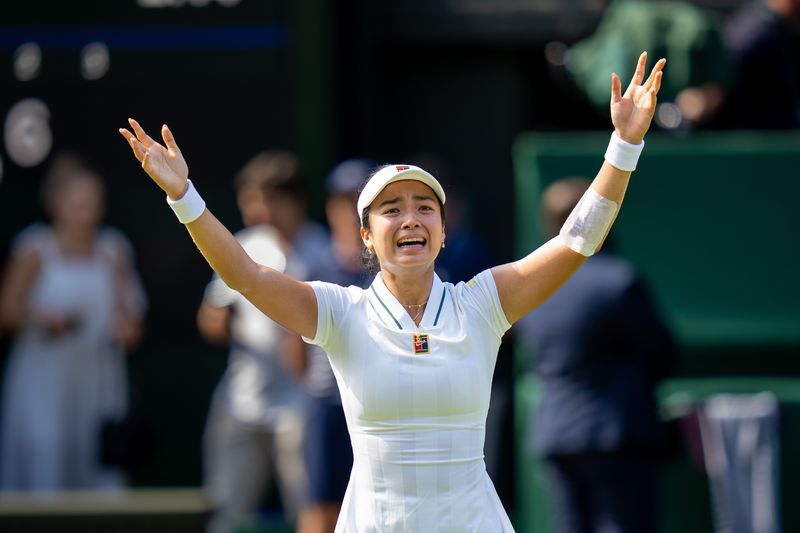
Alexandra Eala proved too composed and fearless for Polish defending champion Iga Swiatek on Saturday at Wimbledon, dismantling the third seed 7-6(9) 6-2 to reach the fourth round and claim the biggest victory of her career. The 29th-seeded Filipino, competing in her home Grand Slam hopes to extend her remarkable run, neutralised Swiatek's powerful game through intelligent court positioning and an unwavering mental approach under pressure.
The opening set provided a theatrical showcase of contrasting styles and temperament. Eala and Swiatek engaged in an epic tiebreak lasting nearly 90 minutes, with the match suspended briefly due to weather before resuming. The Filipino saved a set point when Swiatek netted a forehand, a moment that visibly frustrated the Polish competitor who reacted sarcastically to her entourage in the stands. Eala's composure throughout this crucial passage set the tone for the remainder of the encounter, and once she captured the opening set through the tiebreak, Swiatek found no answers to her opponent's rhythm and movement. The second set became a procession as Eala accelerated her pace and constructed points methodically, winning 6-2 to advance decisively.
Eala's victory assumes particular significance within Southeast Asian tennis circles. The 21-year-old has become the first player from the Philippines to penetrate the fourth round of any Grand Slam tournament, a barrier that seemed insurmountable for Filipino tennis until this fortnight. Her inspiration runs deep: she grew up training daily after school with her brother and grandfather, and she carries a message in Tagalog etched on her competition cap reading "once it grows, it cannot be stopped." Speaking to an emotionally engaged Centre Court audience, she reflected on these humble origins, emphasising that her success represents not merely personal achievement but vindication of years of sacrifice and dedication by her family and nation. Her pathway through Wimbledon's draw thus transcends sport, embodying possibilities for tennis development across the broader Southeast Asian region.
Swiatek's loss represents a significant regression for the Polish competitor, who has struggled for consistency at Grand Slam tournaments despite her dominance on clay. The 2022 Wimbledon champion acknowledged post-match that her usual tactical approaches proved ineffective against Eala's composed execution. Speaking to reporters, Swiatek indicated frustration with her recent results trajectory, stating that her obsessive focus on outcomes had rendered her mentally exhausted and that she intended to refocus her mindset away from results-oriented thinking. This admission suggests deeper concerns about her mental wellbeing beyond this particular defeat, raising questions about whether the pressure of defending titles and maintaining rankings is taking a psychological toll on elite competitors navigating the punishing Grand Slam calendar.
The women's draw experienced additional upheaval when second seed Elena Rybakina fell to Belgian challenger Elise Mertens in a performance that revealed concerning inconsistency. Rybakina, who captured the Australian Open title earlier this year and won Wimbledon in 2022, surrendered her first set narrowly through a tiebreak before capitulating completely in the second, losing 7-6(4) 6-1. The heavy defeat eliminated her from contention for the world number one ranking, which she could have claimed through a quarter-final appearance. Mertens, reaching the last 16 for the fourth occasion in her career, demonstrated superior adaptability on grass surfaces, particularly once she seized the first-set tiebreak. Rybakina's failure to maintain competitive intensity across both sets reflects the vulnerability of top-seeded players when facing opponents comfortable performing at Wimbledon's unique demands.
American players dominated much of Saturday's action, delivering several memorable performances on their nation's 250th Independence Day. Madison Keys, seeded 26th and riding momentum from winning the Eastbourne title the previous week, orchestrated an upset victory over sixth-seeded Amanda Anisimova in an all-American encounter, prevailing 3-6 6-2 6-3. Keys' aggressive approach and confidence on grass proved decisive once she captured the second set, breaking Anisimova's rhythm irretrievably. Qualifier Ashlyn Krueger added further American success by dismissing Ukrainian opponent Daria Snigur 6-3 6-2, though 23rd seed Emma Navarro disappointed by exiting to Marta Kostyuk through three sets. Eight American women competed throughout Saturday's schedule, providing substance to the day's patriotic celebration.
Serena Williams' withdrawal from her eagerly-anticipated doubles partnership with sister Venus cast a shadow across American hopes. The legendary competitor, returning to Wimbledon after a four-year absence, had already surrendered her singles campaign to Maya Joint but had anticipated competing with Venus in doubles. An injury necessitated her withdrawal, prompting Williams to convey her disappointment via social media, describing herself as "heartbroken" at being forced to abandon the doubles project. Her return to competitive tennis at Wimbledon represented a significant storyline and her premature exit highlights the physical demands placed upon athletes attempting comebacks after extended layoffs, particularly in a compressed doubles schedule alongside singles competition.
The men's draw proved considerably more stable, with seeded players generally consolidating their positions. Alexander Zverev, newly crowned French Open champion and second seed at Wimbledon, progressed efficiently against American Marcos Giron 6-2 7-6(4) 6-4, maintaining his impressive start without serious complications. With defending champion Jannik Sinner already advancing, Italian tennis harboured hopes of placing four men in the last 16 for the first time since the 1947 French Open. Flavio Cobolli, the ninth seed and recent French Open runner-up, orchestrated an extraordinary comeback from a 6-0 first-set deficit against Russia's Karen Khachanov, eventually prevailing 0-6 7-6(4) 6-7(5) 6-2 6-2 through five demanding sets. Such reversals remain extraordinarily rare even at the professional level, testament to Cobolli's mental resilience and tactical adjustments across the match's duration.
Alex de Minaur of Australia advanced methodically by defeating American qualifier Zachary Svajda 6-2 5-7 6-2 6-4, setting up a confrontation with Cobolli in the next round. Lorenzo Sonego could not extend the Italian surge, falling to American sixth seed Taylor Fritz 4-6 6-3 6-4 7-6(5) despite beginning the contest promisingly. Matteo Berrettini, a former Wimbledon runner-up, remained engaged in late-evening Centre Court competition against Bulgarian Grigor Dimitrov, with broader Italian revival prospects contingent upon his performance.
Eala's remarkable trajectory will test itself against 13th seed Jasmine Paolini, the 2024 French Open runner-up who demonstrated commanding form by dismantling Greek opponent Maria Sakkari 6-1 6-2. Paolini's recent elevation among the elite reflects her consistency across multiple surfaces and her hunger to convert her major titles into consistent Grand Slam performance. That encounter looms as a significant examination of whether Eala's current momentum and composure represent sustainable tournament-level performance or whether the Filipino will encounter the reality of competing against established top-ten competitors in successive rounds.

