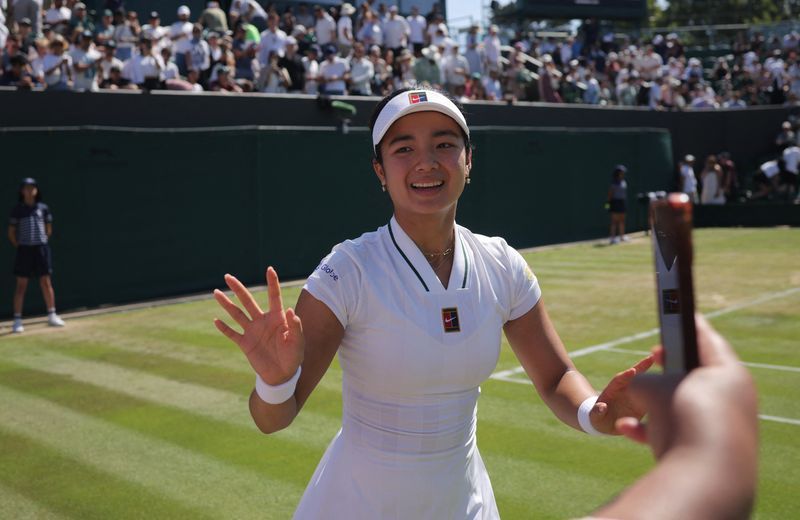
In a milestone moment for Philippine tennis, Alexandra Eala achieved what no player from her country had accomplished before when she defeated Australia's Maya Joint on Thursday to secure a spot in the third round of Wimbledon. The 21-year-old from Quezon City rallied from a sluggish opening set to claim a commanding 3-6 6-2 6-0 victory at the All England Club, cementing her place in the tournament's next stage and writing a significant chapter in her nation's sporting history.
Eala's journey to this breakthrough resonates beyond the tennis courts of London. Emblazoned on the back of her sun visor during the match was a Tagalog phrase — "Kapag lumago, hindi na hihinto" — which translates to "once it grows, it cannot be stopped." The sentiment proved remarkably fitting given her match performance, transforming a difficult first set into an increasingly dominant display across the subsequent two frames. Her recovery from that initial setback against Williams' first-round conqueror demonstrated the mental resilience and adaptability that has defined her rise through the professional rankings.
Now seeded 29th at Wimbledon, Eala faces an imposing challenge in the third round when she confronts Poland's Iga Swiatek, the defending Grand Slam champion and six-time winner of major tournaments. Few players her age would approach such an encounter without considerable trepidation, yet Eala conveyed a mixture of realistic humility and quiet confidence in her post-match remarks. She acknowledged the formidable task ahead while simultaneously suggesting she possesses the capability to trouble even a champion of Swiatek's calibre, a perspective grounded in her recent performances on grass courts rather than mere optimism.
The cultural significance of Eala's achievement extends well beyond tournament statistics. The 21-year-old has made deliberate efforts to honour her Filipino heritage throughout her professional career, with her sponsor Nike collaborating to incorporate national symbolism into her competitive kit. Most notably, the slogan adorning her visor represents a conscious choice to carry her identity onto the world's most prestigious sporting stages. During her Wimbledon debut the previous year, Nike had supplied her with a custom hair tie featuring the sampaguita, the national flower of the Philippines, a touching gesture that merged commercial sponsorship with cultural representation.
For Eala, competing in the colours and symbols of her nation carries profound emotional weight. She has articulated how important it remains to carry visible reminders of her cultural heritage while performing at the highest levels of international sport. The act of wearing her country's symbols is not merely ornamental but represents a direct connection to her identity and serves as a daily affirmation of the values and background that have shaped her journey. This approach to representation reflects a broader trend among young athletes from developing nations who view international platforms as opportunities to elevate their countries' profiles while remaining authentic to their origins.
Eala's trajectory through professional tennis has been steadily ascending. She broke into the top 50 rankings during the previous calendar year and has sustained that upward momentum throughout the current season. Most impressively, she appears to have discovered a particular comfort zone on grass surfaces, the surface upon which Wimbledon is contested. This specialisation was recently underscored by her title victory at Birmingham last month, followed by a semi-final appearance in Berlin, demonstrating consistent excellence across Europe's premier grass-court tournaments in the lead-up to the Championships.
The timing of Eala's breakthrough carries additional significance within the context of Philippine sports. She remains the sole representative from the Philippines competing in the main draw at Wimbledon this year, positioning her as the sole bearer of her nation's hopes and aspirations at the tournament. This singular responsibility might burden some athletes, yet Eala appears to have embraced it as a source of motivation rather than pressure. The emotional weight of representing 115 million compatriots appears to energise rather than constrain her performances.
Eala's approach to her achievement maintains a grounded perspective. While she recognised the historical importance of becoming the first Philippine player to reach a Grand Slam third round, she was careful to contextualise this within her personal athletic development. She framed the milestone not as a final destination but as one step within a longer career trajectory encompassing both individual goals and broader national aspirations. This maturity in perspective suggests an athlete capable of managing the expectations that inevitably accompany historic achievements, focusing instead on incremental improvements and continued advancement.
The intersection of personal identity and international representation has increasingly shaped Eala's competitive career. She consciously rejects the notion of performing a version of herself disconnected from her values and heritage, instead choosing to integrate her Filipino identity throughout her professional endeavours. This authenticity extends from her choice of training location — the renowned Rafa Nadal Academy in Mallorca — to the symbolism she displays on court, demonstrating a balanced approach to globalisation and personal grounding that resonates with emerging athletes from Southeast Asia and beyond.
Looking forward, Eala's clash with Swiatek represents far more than a tennis match between two players of different generations and experience levels. It constitutes a test of whether her recent grass-court mastery and breakthrough confidence can translate into victories against the sport's elite competitors. The matchup will provide insight into whether her historic third-round appearance represents a temporary achievement or the beginning of sustained excellence at Grand Slam level. For Philippine tennis, the implications of this contest extend well beyond the result, potentially influencing the trajectory of the sport within the country and inspiring future generations to pursue professional tennis at the highest levels of international competition.

