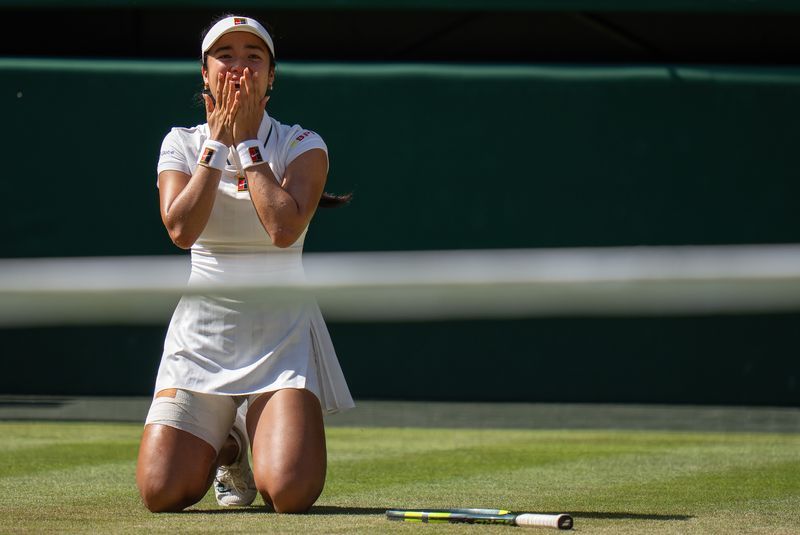
Alexandra Eala's demolition of world champion Iga Swiatek on Centre Court at Wimbledon on Saturday represents more than a personal milestone for the 21-year-old Filipino. It signals a potentially transformative moment for tennis in Southeast Asia, where the sport has long laboured in the shadow of boxing's dominance and the outsized achievements of figures like Manny Pacquiao. By reaching the Round of 16 at a Grand Slam for the first time, Eala has validated a vision that extends far beyond her own trophy cabinet—one of inspiring a generation to pursue excellence in a sport that has rarely captured the region's sporting imagination.
Eala's ascent through professional tennis has been nothing short of meteoric, yet her journey remains grounded in an unusual philosophical maturity. Rather than bask solely in the euphoria of vanquishing one of the game's most dominant contemporary players, she reflexively considers her platform's broader implications. In the immediate aftermath of her victory, Eala articulated a nuanced vision of mentorship that distinguishes between mere replication and genuine inspiration. She spoke deliberately about not wanting young girls back home to view her as a template to reproduce, but rather as evidence that individual pathways to success remain available to those willing to chart their own course. This distinction may seem subtle, yet it carries profound weight in a sports culture often defined by the tyranny of singular role models.
The Philippine sporting landscape has historically revolved around Pacquiao's towering presence, a boxer whose global championships and cross-cultural celebrity have established an almost impossible standard for athletic achievement. For decades, this reality has somewhat constrained how young Filipinos envision their own sporting possibilities, creating a gravitational pull toward boxing while other disciplines remained peripheral to national consciousness. Eala's emergence on tennis's grandest stages potentially redistributes this attention, opening conceptual space for athletes in different sports to imagine themselves as worthy of national celebration. Her charisma, articulate demeanour, and genuine accessibility to crowds have amplified this effect, transforming her from a mere competitor into something closer to a cultural ambassador for alternative sporting excellence.
During her post-match press conference, Eala expanded on her philosophy with particular emphasis on authenticity and self-reflection. She acknowledged that her expanded visibility has prompted personal evolution, forcing her to consider constantly how her conduct and words might resonate with observers who view her as representative of possibility. Yet rather than allowing this weight to become paralyzing, she has framed it as catalyst for growth—an external accountability structure that has pushed her toward becoming what she terms the best version of herself. This psychological resilience, the capacity to transform public scrutiny from burden into motivation, distinguishes her from many contemporaries who struggle under the pressure of outsized expectations.
Eala's capacity to compartmentalise emotions while maintaining competitive hunger emerged vividly in her candid reflections on her immediate response to defeating Swiatek. She allowed herself visible tears of joy, an unguarded display of emotion that humanised her achievement while reinforcing its genuine significance. Yet she was equally insistent that this emotional release should not be misinterpreted as satisfaction or contentment with her accomplishments. Rather, she positioned tears as a natural and appropriate response to a particular milestone, not as a surrender to complacency. This emotional intelligence—the ability to celebrate while simultaneously preparing for the next challenge—reflects a maturity often absent in athletes her age.
The 29th seed now confronts 2024 runner-up Jasmine Paolini in the Round of 16, a fixture that will test whether her breakthrough against Swiatek represents the emergence of a sustained contender or a singular exceptional performance. Eala's characterisation of her competitive mindset offers insight into how she navigates this uncertainty. She describes a natural psychological mechanism by which her body registers the approaching next match and gradually recalibrates from celebratory mode into competitive focus. Rather than viewing this transition as something requiring conscious training, she presents it as almost instinctive—yet paradoxically, she also acknowledges that the skill itself merits deliberate cultivation. This seeming contradiction actually reflects sophisticated athletic psychology: the recognition that natural dispositions can be refined and strengthened through conscious effort.
For Malaysian and Southeast Asian sports observers, Eala's trajectory carries particular resonance. The region's tennis infrastructure remains underdeveloped compared to established tennis nations, and elite opportunities for regional players remain scarce. Yet Eala's success demonstrates that geographic disadvantage need not be insurmountable, that players from outside traditional tennis strongholds can compete and prevail at the sport's highest levels. Her presence at Wimbledon, drawing substantial crowds who have followed her through multiple Grand Slams, suggests that tennis may be experiencing a genuine growth trajectory in popularity across Southeast Asia. This could have cascading effects for grassroots development, amateur participation, and investment in regional tennis infrastructure.
Eala's broader cultural significance extends beyond athletics into questions of national identity and representation. In the Philippines and across Southeast Asia, young women frequently encounter limited narratives regarding what professional achievement looks like. Eala's combination of sporting excellence, media fluency, and genuine likability presents an alternative archetype—one that privileges authenticity over manufactured persona, intellectual engagement over empty celebrity. Her explicit messaging about individual pathways and self-determination carries ideological weight in contexts where conformity and established hierarchies often constrain younger generations' sense of possibility.
As Eala prepares for subsequent rounds at Wimbledon, the broader implications of her presence at tennis's highest levels will continue unfolding. Should she advance further, the ripple effects through Southeast Asian sporting consciousness will amplify accordingly. Yet even her current achievement—reaching the Round of 16 and defeating a world champion—has already shifted something in how the region's young athletes imagine their own potential. She has demonstrated that excellence in individual sports remains achievable for those willing to combine talent, discipline, and the courage to forge unconventional paths. In doing so, she has become something more valuable than a mere champion: she has become proof of possibility.

