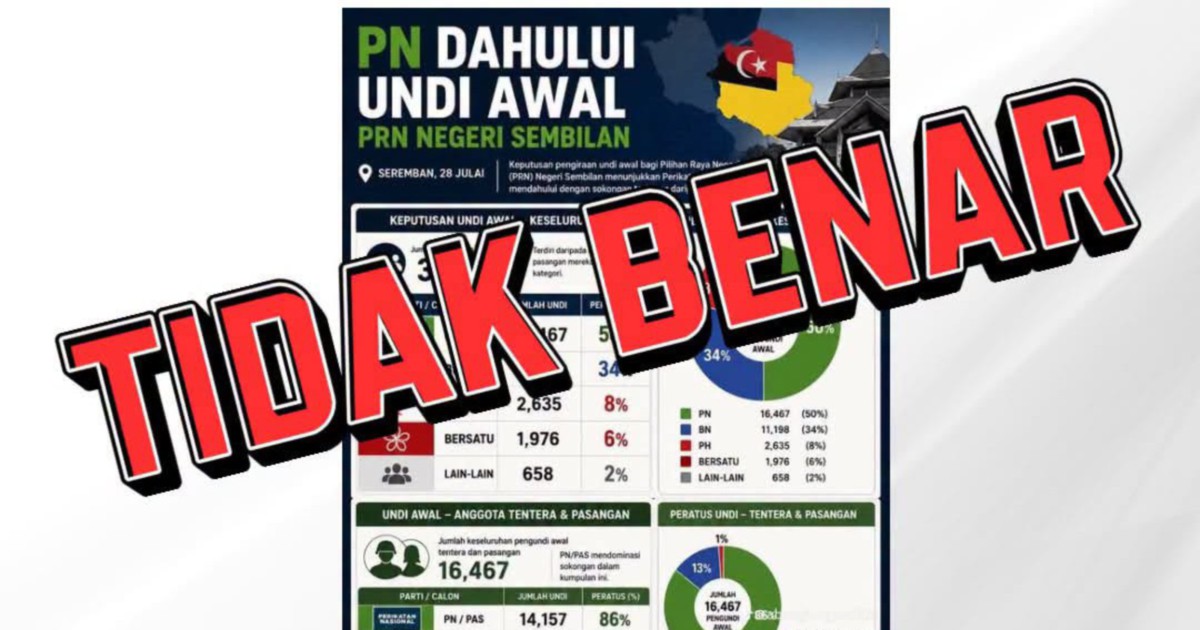
The Election Commission announced today that the tallying of advance votes cast for the 16th Negeri Sembilan state election will commence at 5pm on Saturday, establishing a clear timeline for one of the most closely watched phases of the election process. The timing represents a standard procedure established by the EC to manage the counting process efficiently across all parliamentary and state-level polling stations in the state. This announcement came from Seremban, the state capital, signalling that preparations for the electoral exercise remain on track despite heightened public interest in the results.
The early voting process has become increasingly significant in Malaysian elections, as it allows civil servants, healthcare workers, security personnel, and other essential workers to cast their ballots in advance of the main election day. In Negeri Sembilan, which has 36 state assembly seats distributed across diverse constituencies ranging from urban centres to rural areas, the early vote count often provides preliminary indicators of electoral sentiment before official results are declared. The Saturday counting session will process votes collected from registered early voters across the state, giving election observers and analysts their first data point in tracking the momentum of competing coalitions.
Simultaneously, the EC moved to counter misinformation that has proliferated across social media platforms claiming premature leads for Perikatan Nasional in the Negeri Sembilan contest. These viral claims, which have circulated widely among Malaysian voters seeking advance information about electoral performance, are entirely false and lack any basis in official EC data or procedures. The commission's swift denial reflects growing concerns about electoral-related disinformation, particularly during sensitive periods when voters may be influenced by unverified claims spread through messaging applications and social media networks.
The Negeri Sembilan state election represents a significant contest in Malaysia's current political landscape, with the outcome carrying implications extending beyond the state's borders. The coalition that forms government in Seremban will influence the balance of power within broader Malaysian politics, potentially affecting Kuala Lumpur's federal dynamics and regional stability in the central belt. Multiple coalitions—including Pakatan Harapan, Barisan Nasional, and Perikatan Nasional—have mobilised considerable resources to contest the 36 seats, recognising the state's strategic importance in the competitive party landscape.
The spread of false electoral claims before official results represents a troubling pattern that has characterised recent Malaysian elections. Bad-faith actors have repeatedly sought to shape voter behaviour and public perception by releasing fabricated tallies, premature victory declarations, or misleading representations of polling data. These disinformation campaigns exploit the legitimate desire of voters to understand electoral outcomes and exploit the lag between early voting and main election procedures. The EC's proactive stance in identifying and contradicting false narratives demonstrates recognition that electoral integrity depends not only on securing the physical voting process but also on countering information warfare.
For Malaysian voters in Negeri Sembilan and observers nationwide, the early vote count scheduled for Saturday evening will provide the first glimpse of the state's electoral direction. The results from advance voters often differ in composition from main election voters due to the specific demographics of early voters—typically government employees and uniformed personnel concentrated in particular constituencies. This distinction means early vote counts offer contextual insight rather than definitive predictions, yet they have proven valuable for political analysts and media seeking to understand emerging patterns. The EC's firm timing announcement of 5pm ensures that news organisations and interested parties can plan coverage and analysis accordingly.
The official counting procedures are designed to maximise transparency and public confidence in the electoral process. Polling agents representing various political parties attend the counting sessions to observe proceedings firsthand, maintain records, and file objections if irregularities occur. This representative monitoring system, while sometimes contentious, generally receives bipartisan acceptance as a safeguard against manipulation. The Saturday early vote count will proceed under these established protocols, with representatives from competing coalitions present to witness the tallying of advance ballots cast by eligible early voters throughout Negeri Sembilan.
Beyond the immediate timing and debunking of false claims, the EC's announcement reflects the commission's responsibility to manage public information throughout the electoral cycle. As custodian of Malaysia's voting procedures and results, the EC must balance transparency with security, clarity with caution, and timeliness with accuracy. The decision to publicly correct viral misinformation represents an important function in an era where election authorities worldwide face increasing pressure to combat disinformation campaigns. Malaysian voters deserve confidence that the figures eventually declared represent genuine expressions of the electorate's will rather than manipulated narratives or fabricated tallies.
Political analysts examining the Negeri Sembilan contest have noted that the state represents genuinely competitive terrain where multiple coalitions harbour realistic hopes of securing government formation. Unlike some Malaysian states where one coalition dominates or results appear predetermined, Negeri Sembilan's 36 seats remain genuinely contested across diverse constituencies with varying demographic and economic profiles. Urban areas around Seremban and Kuala Lumpur's southern suburbs display different political tendencies than rural Jelebu or Johol constituencies, creating complex electoral mathematics that no single coalition can take for granted. These dynamics mean that early vote patterns may carry particular significance in signalling which coalition's campaign strategies are resonating most effectively.
The EC's emphasis on accurate timing and verified information serves multiple stakeholders beyond mere technical requirements. Media organisations require certainty about when counting begins to plan broadcasting and news cycles appropriately. Political parties need clear timelines for organising supporters and preparing statements for different electoral scenarios. International observers monitoring the election require transparent information about procedures and timelines to assess the conduct and credibility of the overall process. Malaysian voters themselves benefit from clear, official information that displaces the speculation and rumour that inevitably proliferate in electoral periods characterised by uncertainty.
As Saturday approaches and the state election enters its critical final phases, the combination of the EC's clear procedural announcement and its decisive counteraction against disinformation signals institutional commitment to managed, credible electoral administration. While Malaysian elections remain genuinely contested affairs where multiple outcomes remain possible, the framework of transparent procedures and verified official information helps ensure that whichever coalition emerges victorious in Negeri Sembilan, the result reflects authentic voter preference rather than manipulation or misinformation. This foundation of procedural integrity and information reliability becomes increasingly important as Malaysia navigates a complex political period where competitive elections have become regular features of the national landscape.

