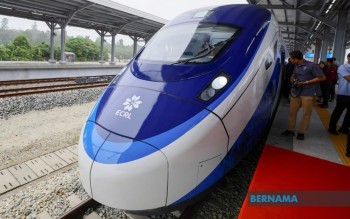
Malaysia's transformative East Coast Rail Link (ECRL) infrastructure project represents far more than a transportation upgrade—it is being positioned as a catalyst for economic restructuring across the nation's eastern corridor. According to Datuk Mohd Shahar Abdullah, Deputy Minister of Economy and Member of Parliament for Paya Besar, the initiative will fundamentally reshape market dynamics for local entrepreneurs by facilitating direct access to previously unreachable consumer bases while simultaneously reducing operational friction through modernised logistics networks.
The ECRL traverses four states with distinct economic profiles: Pahang, Terengganu, Kelantan, and Selangor. This geographic span creates an integrated economic zone where entrepreneurs can leverage the rail corridor's efficiency gains to scale operations without proportional increases in distribution costs. The project's architecture emphasises what Mohd Shahar termed transit-oriented development, cargo-oriented development, and industrial parks—three complementary frameworks designed to generate cascading commercial benefits throughout the supply chain. These aren't incidental features but foundational pillars that will anchor everything from warehouse operations to last-mile delivery services.
The anticipated supply chain expansion encompasses multiple layers of economic activity. Construction, operations, and maintenance of the ECRL itself will generate immediate employment and procurement opportunities for contractors and material suppliers. Beyond this direct impact, the infrastructure's completion will unlock secondary markets: logistics operators requiring new distribution hubs, industrial manufacturers seeking proximate transportation access, and service providers catering to the expanded commercial ecosystem. For small and medium enterprises already operating in traditional sectors, this represents a structural shift in their competitive environment—one that rewards adaptation but penalises complacency.
Price competitiveness emerges as a critical advantage flowing from lower logistics costs. Mohd Shahar illustrated this through production scaling: enterprises currently manufacturing 10,000 units annually might expand to 20,000 units with access to broader markets and reduced per-unit transportation expenses. This multiplication effect compounds across the supply chain. When a batik producer in Kelantan can economically serve customers in Selangor without prohibitive freight charges, the entire batik ecosystem—from retailers to wholesalers to export agents—gains competitive breathing room. The ECRL essentially democratises market access by removing geographic penalty clauses that previously protected local monopolies or regional champions.
Delivery time compression equally reshapes business operations. Shorter transit periods between production and customer means inventory holding costs decline, working capital cycles accelerate, and responsiveness to demand fluctuations improves. For perishable goods like food products or time-sensitive manufacturing, these efficiency gains translate directly to viability. Entrepreneurs operating with thin margins—common among Malaysian SMEs—suddenly find operations that were previously marginal becoming sustainable. The rail link thus functions as an implicit subsidy for efficiency-driven business models, rewarding those operating closest to optimal capacity.
Tourism represents an often-overlooked growth vector. The ECRL's improved passenger connectivity will inevitably increase visitor flows to East Coast attractions, from Pahang's natural reserves to Kelantan's cultural heritage sites. This tourist influx cascades through local economies: handicraft merchants, food vendors, and boutique manufacturers gain exposure to customers with higher spending power than traditional domestic markets. Batik artisans, for instance, benefit from both volume increases and pricing power. Foreign tourists purchasing authentic Malaysian crafts represent a premium market segment that justifies higher prices and quality standards compared to domestic bulk buyers.
However, realising these benefits requires entrepreneurial adaptation beyond passive infrastructure access. Mohd Shahar explicitly cautioned that business success depends upon embracing technological integration and abandoning purely traditional operational models. This distinction proves crucial: the ECRL creates opportunity, but opportunity without technological capability merely generates frustration. Entrepreneurs must invest in digital inventory management, e-commerce platforms, cold chain logistics for perishables, and data analytics to optimise their expanded market operations. The infrastructure investment carries an implicit expectation that private enterprise will match public sector commitment with corresponding private investment in modernisation.
The project's construction timeline underscores its imminence. As of April, the overall ECRL mega-project had achieved 93.66 percent completion, with the Pahang segment reaching 97.33 percent. December completion represents the horizon within which entrepreneurs must prepare. This compressed timeframe creates urgency: those beginning adaptation efforts now will position themselves to capture first-mover advantages when the corridor opens. Conversely, entrepreneurs delaying preparation risk finding premium opportunities already occupied by faster-moving competitors.
Regional dynamics also warrant consideration. The ECRL's completion affects Malaysia's broader Southeast Asian positioning. More efficient movement of goods through the eastern corridor enhances Malaysia's competitive position in regional trade networks. Entrepreneurs with cross-border ambitions—selling to Thailand, Vietnam, or beyond—gain a strategic advantage. Conversely, the corridor invites competition from other ASEAN producers who suddenly enjoy equivalent market access to Malaysian entrepreneurs' traditional customer bases. The infrastructure is therefore simultaneously an offensive opportunity and a defensive necessity.
For Malaysian policymakers and economic observers, the ECRL represents infrastructure investment philosophy in action: public capital deployed to correct market failures (high logistics costs) that constrain private enterprise. The project's success ultimately depends upon whether entrepreneurs effectively harness the opportunities created. If adoption occurs broadly, the East Coast will experience genuine structural economic transformation. If adoption remains confined to larger enterprises with existing capital and technological capability, the project risks becoming an underutilised asset. The coming months will reveal whether Malaysia's entrepreneur ecosystem possesses both the capital and the vision to match infrastructure investment with corresponding business innovation.

