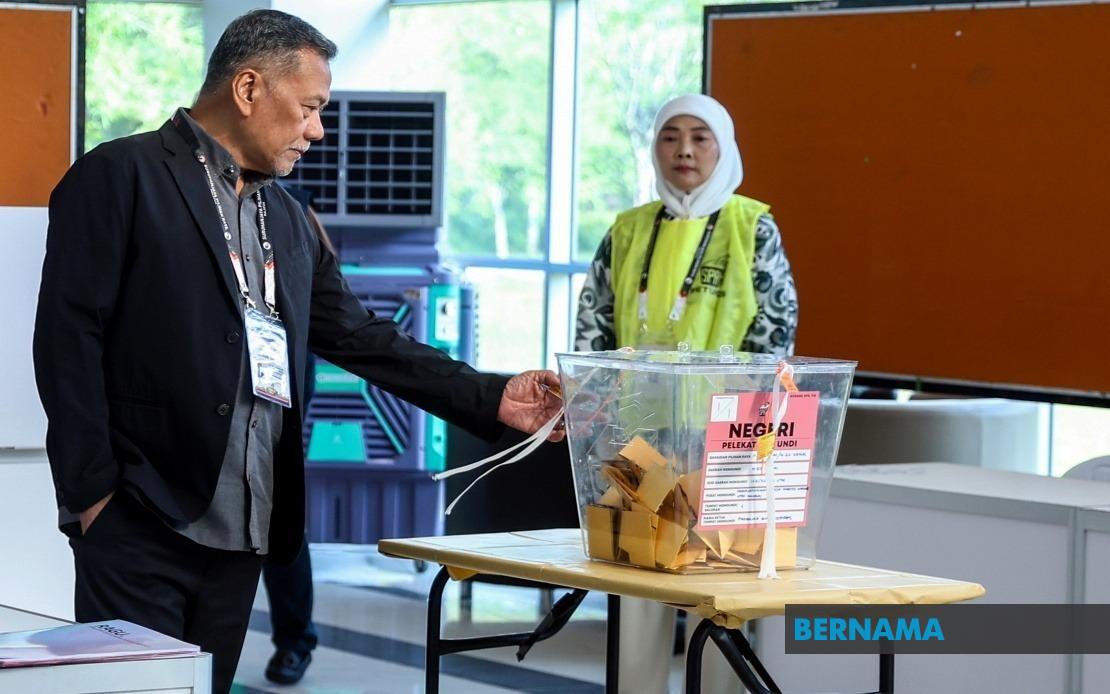
Election Commission chairman Datuk Seri Ramlan Harun made unannounced inspections at four separate polling venues across Johor Bahru during the 16th state election, conducting an on-the-ground assessment of voting procedures and operational standards across multiple constituencies. The oversight visit, which commenced in the late morning, reflected the commission's commitment to direct monitoring of electoral integrity and logistical efficiency on polling day.
Ramlan's first stop took him to the Dewan Raya Taman Ungku Tun Aminah in the Skudai constituency at approximately 8.50 am, where election officials were managing seven distinct polling streams. The venue selection provided insight into how the commission distributes voter traffic across multiple simultaneous voting operations, a critical factor in preventing bottlenecks and maintaining voting queue times within acceptable limits. The Skudai constituency, one of Johor's significant electoral battlegrounds, would have experienced considerable voter turnout by mid-morning on election day.
From Skudai, Ramlan proceeded northward to the Raja Zarith Sofiah Library located within the campus of Universiti Teknologi Malaysia (UTM) to observe the Senai constituency's voting arrangements. This particular polling centre operated with a more modest setup of two polling streams, reflecting demographic differences and expected voter distribution in the UTM area. The choice of a university facility as a polling centre carries particular significance for electoral accessibility, as it facilitates voting among student populations and staff members whose daytime schedules might otherwise prevent participation.
The chairman then travelled to Sekolah Agama Taman Bukit Mewah in the Kempas constituency, where six polling streams were in operation. Religious school facilities have become increasingly common polling locations across Malaysia, offering neutral ground with adequate physical infrastructure while reflecting the role of community institutions in supporting democratic processes. The Kempas centre's configuration suggested moderate expected turnout for that particular electoral division.
Ramlan concluded his inspection circuit at Sekolah Menengah Kebangsaan Bandar Uda Utama serving the Perling constituency, which maintained the largest operational scale among the four sites with nine distinct polling streams. The number of concurrent voting streams at each centre provides a useful barometer of anticipated voter demand and logistical planning by the Election Commission. The progression from smaller to larger operations suggested a strategic sequencing of the inspection route.
At each venue, Ramlan engaged directly with election officials overseeing the voting process, requesting detailed briefings on operational procedures, voter flow management, and any emerging issues requiring immediate attention. This hands-on engagement model allows senior commission leadership to identify problems before they escalate and to provide real-time guidance to ground-level staff. The chairman's presence itself serves as a quality assurance mechanism, signalling to election workers the importance of maintaining procedural standards and adherence to electoral guidelines.
Beyond the voting mechanics, the chairman's inspections explicitly included assessment of physical facilities and amenities provided to both voters and election personnel. Adequate seating areas, clear signage, accessible voting booths for individuals with mobility limitations, and comfortable work areas for election staff all contribute to the overall quality of the electoral experience. These environmental factors can significantly influence voter willingness to participate and the morale of election day workers managing extended shifts.
For Malaysian observers and international monitors tracking the 16th Johor state election, the visibility of senior Election Commission officials conducting day-of inspections reinforces perceptions of institutional oversight and commitment to electoral standards. In the Southeast Asian context, where election administration quality remains a significant indicator of democratic governance, such direct supervisory presence by senior officials carries weight beyond the specific operational issues being addressed.
The scheduled press conference following the inspection tour offered an opportunity for the chairman to publicly communicate his observations regarding voting procedures and facility standards. Such briefings shape media narratives around the election's administrative competence and contribute to broader public confidence in the integrity of the electoral process. The transparent dissemination of information about election management, particularly through senior officials speaking to their direct observations, remains a cornerstone of electoral credibility in Malaysia's political system.
The Johor state election, as the 16th such contest under the state's electoral framework, represents a continuation of established democratic processes in one of Malaysia's largest and most politically significant states. The rotation of electoral contests across Malaysia's constituent states keeps political competition dynamic while distributing attention and resources across different regional power structures. Johor's particular importance to national politics, combined with its geographical proximity to Singapore and economic significance as a commercial and industrial hub, ensures that state elections there receive scrutiny from multiple stakeholder groups including business interests, civil society organisations, and neighbouring regional authorities.

