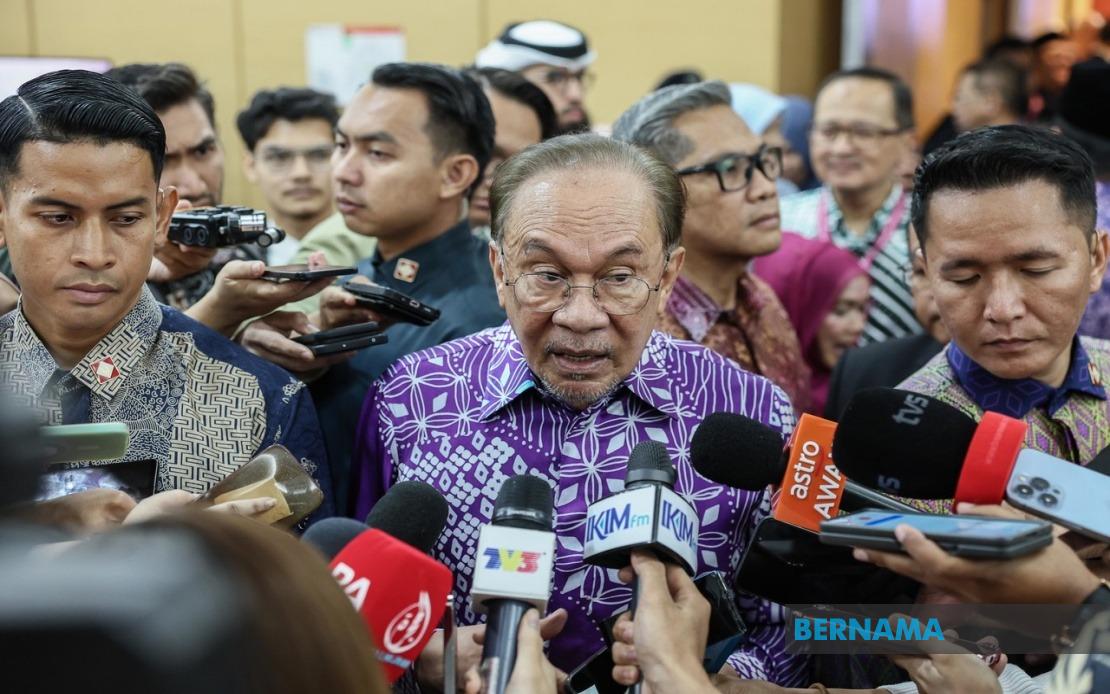
Prime Minister Datuk Seri Anwar Ibrahim has issued a significant call for Malaysia to fundamentally reframe how it measures and pursues economic progress, arguing that the nation's development agenda must place human welfare and moral purpose at its centre rather than treating economic indicators as an end goal. Speaking at the Humane Economy Global Discourse 2026 in Kuala Lumpur, Anwar articulated a vision of prosperity that reconnects financial advancement with ethical considerations and societal well-being—a statement that carries particular weight as Malaysia navigates technological disruption and global economic uncertainty.
The Prime Minister's intervention reflects growing international discourse around the limitations of traditional economic measures. Across developed and developing nations alike, policymakers are increasingly questioning whether GDP growth, investment inflows and technological adoption adequately capture societal progress if they occur without corresponding improvements in living standards, social cohesion or individual dignity. Anwar's framing positions Malaysia within this global conversation whilst anchoring the discussion in locally resonant values around humanity and purpose.
At the heart of his address lies a challenge to the assumption that Malaysia's competitiveness depends on pursuing technological advancement and foreign investment at all costs. Rather, Anwar contends that the nation can maintain its economic dynamism whilst ensuring that growth serves people rather than subordinating people to economic imperatives. This distinction matters considerably for policymakers tasked with attracting investment in artificial intelligence, renewable energy, advanced manufacturing and biotechnology—sectors Anwar identified as defining the next era of global economic transformation.
The inclusion of Minister in the Prime Minister's Department (Religious Affairs) Dr Zulkifli Hasan at the event signals institutional commitment to integrating ethical and spiritual dimensions into economic policymaking. The presence of Forum Ekonomi Manusiawi chairman Prof Datuk Dr Saadiah Mohamad underscores how this discourse bridges academic expertise, governmental responsibility and civil society engagement. Together, these figures suggest the Malaysian government views the "humane economy" framework not as peripheral philosophy but as central to national strategic thinking.
For Malaysia specifically, this repositioning carries implications across multiple policy domains. In labour-intensive sectors where automation threatens livelihoods, a genuine commitment to human-centred economic growth would require deliberate investment in retraining and social support rather than allowing technological displacement to proceed unmanaged. In sectors attracting foreign direct investment—particularly in technology and manufacturing—balancing competitiveness with worker dignity and environmental sustainability becomes not an optional add-on but foundational to the development model.
The emphasis on moral purpose also addresses a tension increasingly visible across Southeast Asia. Nations in the region have achieved significant GDP growth over recent decades, yet wealth gains have often distributed unevenly, leaving substantial populations behind and generating political instability. Anwar's framing suggests that Malaysia's stability and long-term prosperity depend on ensuring that economic expansion tangibly improves conditions for ordinary citizens rather than concentrating benefits among elites or allowing inequality to widen unchecked.
Regional competitors and investment partners will likely interpret Anwar's remarks as signalling Malaysia's intention to develop according to distinct values whilst remaining open to global capital and technology flows. This positioning potentially appeals to multinational firms increasingly conscious of reputational and regulatory risks associated with operations that disregard labour standards, environmental impact or community welfare. Conversely, it may signal limits on purely extractive economic relationships where host nations receive minimal long-term benefit beyond initial project revenues.
The timing of this discourse—at a dedicated global conference on the humane economy—suggests Malaysia is attempting to shape international conversations around development rather than merely responding to external frameworks. By hosting this dialogue and articulating its own vision, Malaysia can potentially influence how emerging economies approach the artificial intelligence revolution, renewable energy transition and digital transformation. Such thought leadership carries soft power value beyond the immediate economic implications.
Implementing this philosophy operationally presents substantial challenges. Regulatory frameworks, trade agreements, tax policies and budgetary allocations all shape whether economic growth genuinely translates to improved human dignity or merely enriches a narrow segment. Moving from rhetorical commitment to systematic integration requires consistent policy choices that sometimes conflict with short-term growth maximisation. Whether Malaysia's government will sustain this orientation through difficult trade-offs remains to be seen.
The underlying principle Anwar articulated—that economies are instruments serving human flourishing rather than ends in themselves—represents a philosophical reorientation away from pure technocratic growth models. For Malaysian readers and policymakers, this framing offers vocabulary and intellectual resources for discussing what kind of prosperity matters. As artificial intelligence, automation and digital disruption reshape work, opportunity and community across the region, this conversation about humanity and purpose may prove as consequential as the technology itself.

