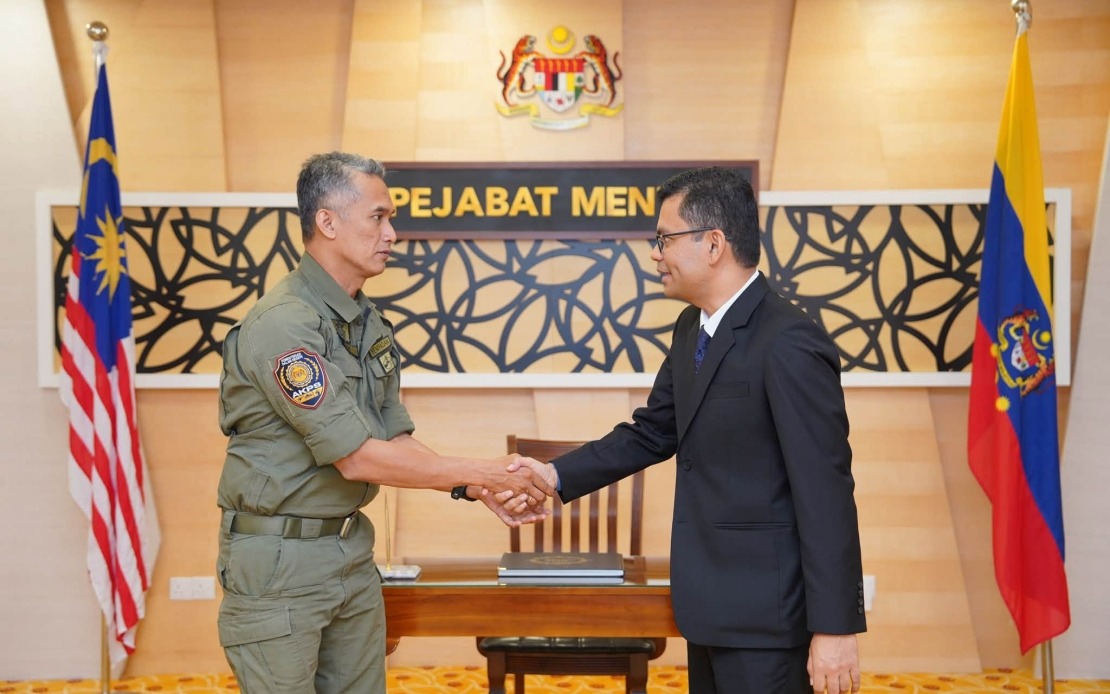
Malaysia's Economy Ministry and the Malaysian Border Control and Protection Agency (AKPS) have begun collaborative discussions on securing adequate development budgets to modernise and reinforce the country's border infrastructure and operational systems. The talks took place in Putrajaya when AKPS director-general Datuk Seri Mohd Shuhaily Mohd Zain visited Economy Minister Akmal Nasrullah Mohd Nasir, signalling early coordination between two key government bodies tasked with economic management and border security.
The discussions represent an important convergence of economic and security priorities for Malaysia. Both agencies recognise that effective border management directly influences trade facilitation, competitiveness, and the overall health of the nation's economy. The Economy Ministry's involvement underscores that strengthening border operations is not purely a security matter but a cornerstone of economic resilience. Efficient entry points and streamlined border processes reduce transaction costs for businesses, improve supply chain reliability, and enhance Malaysia's attractiveness as a regional trade hub.
Central to the talks were four interconnected pillars of border strengthening: infrastructure modernisation, technological adoption, strategic asset development, and operational capacity enhancement. This multi-faceted approach reflects a sophisticated understanding that Malaysia's border challenges require more than simply adding personnel or constructing new facilities. Instead, the agencies are pursuing a comprehensive transformation that integrates physical improvements with digital systems and human resource development.
The timing of these discussions carries particular significance given that AKPS only commenced full operations on January 1, 2025. The agency represents a major institutional consolidation, bringing together border enforcement functions previously scattered across six separate government bodies. The Immigration Department, Royal Malaysian Customs Department, Malaysian Quarantine and Inspection Services Department, Health Ministry, Department of Wildlife and National Parks, and Road Transport Department have now unified their border operations under AKPS's umbrella. This structural reorganisation creates both opportunities and challenges as the new agency seeks to establish itself, coordinate between formerly separate departments, and implement coherent border policies.
The Economy Ministry's explicit endorsement of AKPS's development agenda carries weight in Malaysia's budgeting and planning cycles. By framing border strengthening as essential to economic growth rather than a mere administrative expense, the Economy Ministry has positioned the investment as foundational to national competitiveness. The ministry's statement that structured development planning will "support smoother trade, improve the efficiency of the country's entry points, enhance border security and contribute to more resilient and sustainable economic growth" provides the economic rationale that typically drives government resource allocation.
For Malaysian readers and businesses engaged in trade, this collaborative approach has practical implications. Smoother border processes mean faster clearance times for goods, reduced waiting periods at ports and land crossings, and greater predictability in supply chain operations. These improvements particularly benefit companies in manufacturing, logistics, agriculture, and export sectors that depend on rapid movement of goods across Malaysia's frontiers with Thailand, Brunei, and Indonesia. Enhanced efficiency at entry points also strengthens Malaysia's position in regional trade networks and potentially attracts foreign investment to sectors dependent on reliable logistics infrastructure.
AKPS director-general Mohd Shuhaily has articulated the agency's strategic focus as two-pronged: strengthening institutional integrity and improving operational efficiency while the organisation develops its longer-term vision. The agency is simultaneously crafting a comprehensive strategic direction and multi-year development plan while managing the immediate demands of coordinating six formerly autonomous agencies. This parallel undertaking—managing present operations while planning future transformation—represents a significant management challenge, particularly regarding human resource integration and capability building.
The technology dimension of the strategy reveals how Malaysia intends to compete internationally on border management sophistication. AKPS is prioritising what officials call "smart border technology," encompassing integrated biometric systems for passenger processing, automated cargo scanning capabilities, and real-time data integration powered by artificial intelligence. These systems represent the contemporary standard for advanced border agencies globally, allowing governments to balance security objectives with trade facilitation. Integrated biometric systems enable faster identity verification, automated cargo scanning reduces inspection delays while maintaining security, and AI-powered data integration identifies risks and patterns that human operators might miss.
For Southeast Asia more broadly, Malaysia's border modernisation efforts carry regional implications. As one of the region's largest economies and an important trade corridor, Malaysia's border efficiency affects neighbouring economies and regional supply chains. Improved Malaysian border operations create positive spillover effects throughout the Association of Southeast Asian Nations, as goods move more smoothly through a critical regional node. Conversely, border bottlenecks in any major economy create friction throughout the region.
The collaborative engagement between the Economy Ministry and AKPS also suggests that Malaysia is approaching border management as an integrated challenge requiring sustained investment and interagency coordination. The fact that the Economy Ministry is explicitly discussing AKPS's development budgets indicates that border infrastructure and technology funding will receive priority consideration during government resource allocation processes. This institutional support will be crucial as AKPS seeks to consolidate the six predecessor agencies and implement its modernisation agenda.
Looking forward, the success of this border strengthening initiative depends on several factors beyond budget allocation. Effective change management will be essential as six separate organizational cultures and procedures integrate into unified AKPS systems. Staff training and capacity building must ensure that all personnel—whether originally from Immigration, Customs, or other agencies—operate according to consistent AKPS standards. Technology implementation must proceed in phases to avoid disrupting border operations during transition periods. Regional cooperation with Thailand, Brunei, and Indonesia on integrated border systems could amplify benefits, though each neighbour has distinct institutional structures and priorities.
The partnership between the Economy Ministry and AKPS represents a broader shift in how governments conceptualise border management—not as a purely security function but as essential infrastructure for economic performance. Malaysia's willingness to invest in border modernisation demonstrates recognition that contemporary commerce demands seamless cross-border movement of goods and people. As regional trade intensifies and supply chains become increasingly complex, border efficiency directly translates to economic competitiveness. The conversations between these two agencies will likely shape Malaysia's border landscape for years ahead.

