The East Coast Rail Link (ECRL) is positioned to deliver substantial economic benefits to Malaysia over the coming decades, with government projections indicating a cumulative contribution of RM80 to RM90 billion to the nation's gross domestic product by 2047. Speaking recently in Kuantan, Deputy Economy Minister Datuk Mohd Shahar Abdullah outlined how the RM50.27 billion infrastructure megaproject extends far beyond its primary function as a transportation corridor, functioning instead as a comprehensive economic development catalyst that will reshape investment patterns and employment opportunities across the east coast region.
The anticipated economic returns depend heavily on the successful implementation of 21 Economic Accelerator Projects strategically positioned along the ECRL route. These initiatives have been carefully designed to leverage the rail infrastructure as a foundation for broader industrial and commercial growth. Rather than allowing the rail line to operate in isolation, policymakers envision an integrated ecosystem where logistics, manufacturing, and service sectors flourish in tandem with improved transport connectivity. This approach reflects a shift away from viewing transport infrastructure as merely connecting point A to point B, instead recognizing how physical networks can anchor broader regional transformation.
Three major logistics hubs have been identified as critical nodes within this development strategy. Pasir Puteh in Kelantan will feature a 213-acre facility, while Kemaman in Terengganu and Temerloh in Pahang will operate on 68-acre and 50-acre sites respectively. These hubs will serve as consolidation and distribution centers, potentially attracting supply chain investments from both domestic and international companies seeking to optimize operations across Peninsular Malaysia. The designation of these specific locations reflects analysis of geographic positioning, existing industrial capacity, and connectivity requirements.
Mohd Shahar emphasized that the project aligns with the government's MADANI Economy framework, which prioritizes sustainable growth and equitable development. The ECRL represents an attempt to rebalance economic activity that has historically concentrated along the western corridor, where established ports and industrial zones have captured the bulk of manufacturing and logistics investment. By anchoring new economic accelerator projects to the ECRL, the government seeks to demonstrate that east coast locations can compete effectively for regional and international business investment.
A concrete example of this development strategy is the Perodua logistics hub being constructed in Paya Besar, Kuantan. The first phase of this facility is scheduled for completion by 2029, positioning Malaysia's national automotive manufacturer to optimize its supply chain and distribution network. Such anchor tenants lend credibility to the broader development narrative and attract secondary investments in supporting services and industries. Perodua's commitment signals confidence in the ECRL's viability and provides a template for other major corporations considering relocation or expansion along the corridor.
Mohd Shahar, who represents Paya Besar as a Member of Parliament, positioned the ECRL as complementary to rather than competitive with existing international maritime shipping routes. This framing is strategically important for regional economies and trading partners who might otherwise view the new rail corridor as a threat to their port operations. Instead, the messaging emphasizes how the ECRL integrates with Malaysia's existing logistics infrastructure, creating a more efficient and resilient network. This perspective is particularly relevant for Southeast Asian countries concerned about how new transport corridors affect regional trade flows and port utilization rates.
The infrastructure project targets a significant gap in Malaysia's transport network. The east coast has historically relied heavily on road transport, which faces capacity constraints during peak periods and incurs higher operational costs compared to rail freight. By introducing modern electric rail services, the ECRL offers shippers lower per-unit transportation costs, greater capacity, and potentially more reliable scheduling. These operational advantages should generate demand among manufacturers, agricultural producers, and logisticians operating across the east coast and seeking competitive advantages in regional and global supply chains.
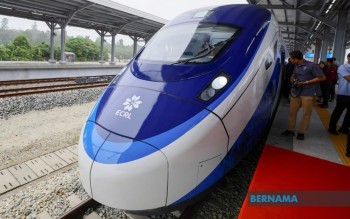
The scale of the ECRL investment reflects confidence in long-term economic fundamentals. The 665-kilometre project incorporates 11 six-car electric multiple unit train sets designated for passenger services and 12 electric locomotives dedicated to cargo operations. This dual focus on passengers and freight addresses both immediate demand for improved transportation connectivity and longer-term requirements for moving goods efficiently. The electrification of rolling stock demonstrates environmental consciousness and reduces operational fuel costs over the infrastructure's lifetime, factors increasingly important for attracting multinational corporations pursuing sustainability objectives.
Construction timelines indicate the project is advancing toward operational readiness. The RM50.27 billion initiative is scheduled for completion in December 2026, with operations commencing in January 2027. This phasing allows approximately 18 months for commissioning, staff training, and final system optimization before full service launch. The implementation schedule reflects careful project management, though delays are not uncommon for megaprojects of this scale and complexity across Southeast Asia.
The ECRL development strategy also reflects principles embedded in the 13th Malaysia Plan, which employs the Malaysia Development Composite Index and MyRMK system to direct public investment toward areas demonstrating high development potential and greatest need. This evidence-based allocation methodology aims to maximize returns on government spending and ensure resources reach communities positioned to benefit most substantially from infrastructure investment. The framework suggests that east coast communities have been identified as having significant underutilized potential, making ECRL investment a rational response to regional development imbalances.
For Malaysian readers and regional observers, the ECRL represents a strategic bet on geographic diversification of economic activity. Rather than accepting concentration of investment in established western corridor locations, the government is deliberately channeling resources toward expanding productive capacity in less developed areas. Success will depend on whether the 21 Economic Accelerator Projects can attract sufficient investment and generate employment opportunities that improve living standards for east coast populations. Failure to activate these projects meaningfully would leave the ECRL operating below potential, serving primarily as a passenger transport facility without the broader economic transformation that justifies its substantial public investment. The coming years will reveal whether the ambitious projections of RM80 to RM90 billion in cumulative GDP contribution represent realistic expectations or aspirational thinking.

