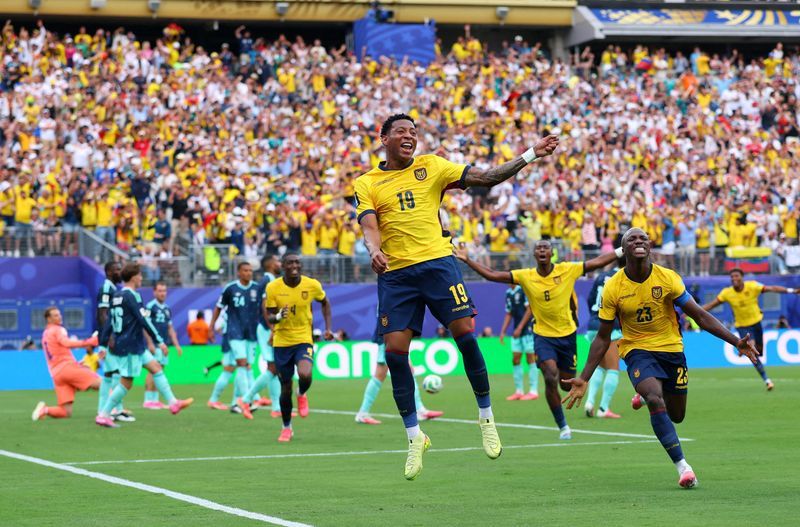
Ecuador pulled off one of the tournament's most improbable turnarounds on Thursday evening, defeating already-qualified Germany 2-1 at the Meadowlands Stadium in East Rutherford, New Jersey, to dramatically rescue their World Cup campaign in their final group match. The South American side had entered the contest facing potential elimination after disappointing results against Ivory Coast and Curacao, making this victory not merely important but essential to their survival. Their qualification as one of the best eight third-placed teams represents a remarkable recovery from what appeared to be a group stage exit just 90 minutes earlier.
Germany's early dominance seemed to confirm the predicted script when Leroy Sane opened the scoring in just the second minute, marking his first international goal in his 15th appearance at major tournaments. The goal came after Florian Wirtz spotted Sane with a clever pass following a quick throw-in, allowing the winger to finish left-footed from inside the area. However, Ecuador's protests that Aleksandar Pavlovic had committed a foul with a raised foot on Pedro Vite in the build-up went unheeded as referee Tori Penso allowed the goal to stand, an early controversial decision that would prove immaterial to the final outcome.
What followed was an extraordinary demonstration of mental resilience from Ecuador, who had carried an unwelcome statistical burden into this fixture. The team had failed to find the back of the net throughout the tournament despite 39 previous attempts—an unusual struggle for any competitive side that raised obvious tactical and psychological concerns. Yet Nilson Angulo ended that painful drought just seven minutes after Germany's opener, curling a delicate finish from the edge of the box past goalkeeper Manuel Neuer, who appeared slow to react to the danger. The goal ignited the yellow-clad Ecuador supporters who filled the sold-out stadium, transforming the atmosphere and psychologically shifting the match's momentum.
The second half provided further drama when referee Penso awarded Germany a penalty after Kai Havertz appeared to be tripped by Joel Ordonez in the box, following Felix Nmecha's lead pass. Yet a VAR review intervened to overturn the decision, with the referee identifying a prior foul by Germany in the build-up. This intervention arguably proved decisive, as it denied Germany the chance to extend their advantage and further demoralised Ecuador when they most needed confidence. Tactically, Germany's vulnerabilities in defence became increasingly evident as the match progressed, foreshadowing their defensive issues that would surface throughout the tournament.
Ecuador capitalised on their opponent's brittleness through Gonzalo Plata's winning goal in the 78th minute, a finish that sparked euphoric scenes among the Ecuadorian contingent. Plata reacted quickest after substitute Kevin Rodriguez flicked a corner kick toward the near post, allowing the forward to stab the ball past Neuer and secure their knockout stage berth. The moment vindicated Ecuador's second-half tactical adjustments and their refusal to accept defeat despite the mounting pressure and their historical scoring difficulties in this competition.
Germany's performance, whilst ultimately successful in topping Group E with six points, revealed defensive deficiencies that coach Julian Nagelsmann would need to address in knockout football. The team had conceded in all three group matches—a concerning pattern that suggested deeper structural problems in their backline. Despite finishing as group winners ahead of Ivory Coast on goal difference (following the Ivorians' 2-0 victory over Curaçao), Germany's inability to maintain clean sheets indicated vulnerability against organised opponents. Their streak of 12 successive victories came to an end, puncturing any sense of invincibility as they progressed through the tournament.
Ecuador's qualification carries particular significance for South American representation in the knockout stage and provides a compelling narrative about resilience under adversity. The side, managed under desperate circumstances, defied expectations and odds that seemed insurmountable given their failure to score across multiple matches. Their ability to produce such a complete second-half performance—combining attacking intent with improved defensive discipline—suggests they may prove more dangerous opponents than their group stage statistics initially suggested. For Malaysian and Southeast Asian football followers, Ecuador's comeback also illustrates how major tournaments can produce unexpected results that defy conventional wisdom and pre-match predictions.
The match also highlighted the increasing role of VAR technology in shaping tournament outcomes, with the penalty overturn potentially altering the match's trajectory entirely. Had the penalty stood and Germany converted, the psychological impact might have overwhelmed Ecuador's comeback momentum. Instead, the correct application of the video review system allowed the match to develop on competitive terms, rewarding Ecuador's tactical adjustments and superior second-half intensity. This underscores how modern football matches increasingly depend not merely on player performance but also on technological interventions and officiating consistency.
Looking forward, Ecuador advance as surprise qualifiers facing stronger opposition in the knockout stage, where their impressive display against Germany may provide a foundation for further progress. Germany, meanwhile, must address their defensive vulnerabilities before confronting more dangerous attacking threats in the tournament's later stages. The result stands as testament to the unpredictability of football at the highest level and the importance of maintaining focus and intensity for the full 90 minutes regardless of early setbacks.

