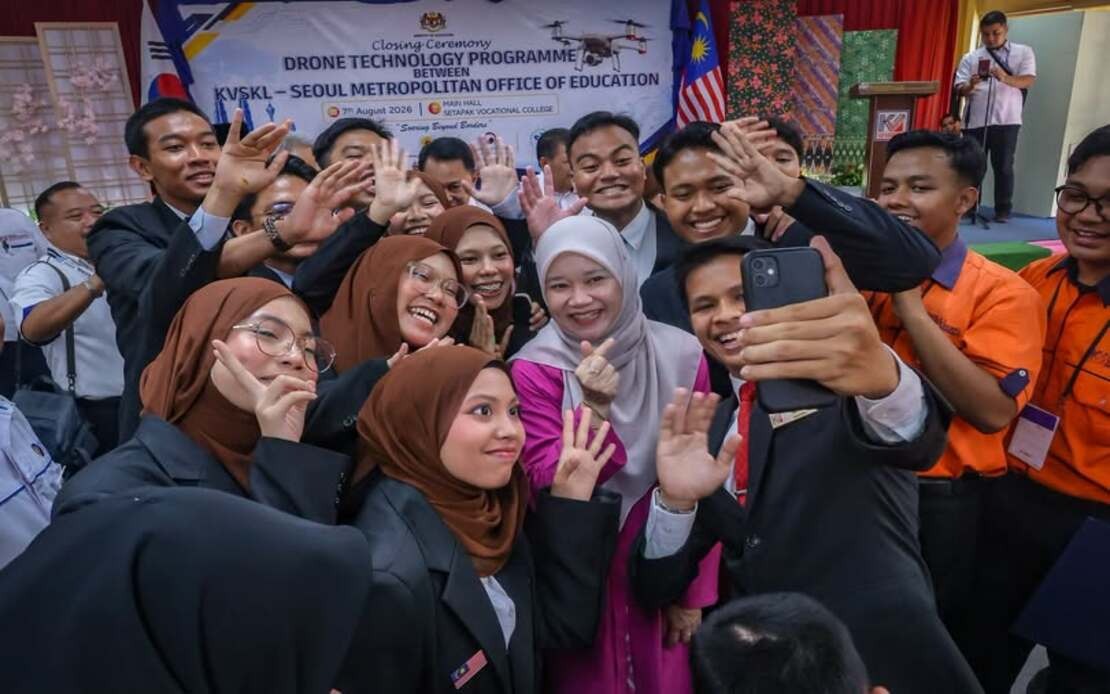
Education Minister Fadhlina Sidek has set an ambitious challenge for students at Setapak Vocational College, asking them to channel emerging drone technology toward solving a tangible security problem on their own campus. The initiative, unveiled during a collaboration programme with the Seoul Metropolitan Office of Education, represents a shift in how Malaysian vocational institutions approach learning—transforming theoretical knowledge into practical problem-solving that addresses immediate institutional needs.
Students have been given a one-month timeframe to conduct research, develop solutions, and present their proposals directly to the minister. The compressed timeline reflects a deliberate pedagogical choice: by setting a real deadline and a high-profile audience, the challenge forces students to move beyond passive learning and engage in the kind of design thinking and innovation that employers increasingly demand. This approach bridges the gap between classroom instruction and workplace readiness, a persistent challenge in technical education across the region.
The initiative emerged during a formal exchange programme between Setapak Vocational College and the Seoul Metropolitan Office of Education, with South Korean Ambassador to Malaysia Yeo Seung-bae present at the launch. South Korea's reputation for technological innovation and its advanced vocational education system made it a fitting partner for such an initiative. The programme centres on knowledge transfer in robotics and drone technology, leveraging South Korean expertise to enhance Malaysia's technical curriculum and inspire students to think beyond conventional applications.
Fadhlina observed students engaged in hands-on demonstrations involving drones and robotics, witnessing both successes and failures. She emphasized that the learning process itself—persisting through mistakes and iterating toward solutions—matters more than achieving immediate results. This philosophy aligns with modern pedagogical approaches that value resilience and adaptive thinking over rote competency. Her public acknowledgement of failure as part of learning sends a valuable signal to students, particularly in cultures where mistakes carry social stigma.
The minister's underlying argument rests on a critical observation about Malaysia's economic trajectory. Robotics, artificial intelligence, and drone technology are no longer distant future concerns but integral components of contemporary workplaces across manufacturing, agriculture, logistics, and public administration. Malaysian graduates entering technical fields must possess not only operational skills with these technologies but also the creativity to apply them to local contexts and challenges. A vocational graduate who can merely operate a drone differs substantially from one who can conceptualise how drones solve specific problems within Malaysian environments.
Campus security, the challenge's focus area, represents an ideal test case for this kind of applied innovation. Malaysian educational institutions face genuine security considerations ranging from perimeter monitoring to rapid response to incidents. Drones offer potential advantages—aerial surveillance capabilities, rapid deployment, reduced human exposure to risk—but require thoughtful integration with existing security protocols and privacy considerations. By tasking students with this challenge, the ministry implicitly validates their capacity to contribute meaningfully to institutional problem-solving.
The collaboration also reflects Malaysia's positioning within broader Southeast Asian technology development. As the region seeks to reduce dependence on imported technological solutions and build indigenous innovation capacity, vocational colleges serve as critical pipelines for technically skilled workers who can adapt global technologies to local conditions. By connecting students directly with South Korean expertise and demonstrating international recognition of their potential, the programme elevates vocational education's status and appeal to students who might otherwise view it as a lesser alternative to university pathways.
Fadhlina's emphasis on thinking beyond the technology itself—moving from "how do I operate this" to "what problem does this solve"—reflects a maturation of technology education approaches. Many developing nations focus primarily on technical proficiency, producing graduates who execute predetermined tasks competently but struggle with novel applications. Malaysian vocational education increasingly aims to develop graduates capable of independent thinking, project management, and entrepreneurial innovation. This challenge at Setapak represents that broader ambition in microcosm.
The one-month timeline also carries implicit messages about urgency and relevance. Unlike extended research projects that students may perceive as disconnected from practical reality, this compressed timeframe creates genuine pressure to identify viable solutions quickly. Students must rapidly identify existing technologies and approaches, assess feasibility within their constraints, and communicate findings compellingly. These are precisely the skills demanded in fast-moving industries where innovation cycles accelerate continuously.
For Malaysian readers, this initiative offers several broader implications. First, it demonstrates that vocational education remains dynamic and responsive to contemporary needs, countering persistent perceptions of technical training as static or outdated. Second, it illustrates how international partnerships can elevate educational standards without requiring Malaysian institutions to abandon their distinctive identity or contexts. Third, it signals ministerial commitment to developing problem-solving capacity rather than mere credential-holding among graduates entering Malaysia's workforce.
The success of this challenge will likely depend on institutional support, access to technology resources, and mentorship quality available to participating students. If proposals emerge that are both innovative and implementable, Setapak could establish a model that other vocational colleges replicate. If outcomes prove underwhelming, the initiative still delivers value through exposure to design thinking methodologies and international collaboration, expanding students' horizons beyond routine technical instruction.
Ultimately, Fadhlina's challenge reflects confidence in vocational students' capabilities and recognition that Malaysia's competitive advantage increasingly depends on graduates who can innovate, not merely execute. By positioning Setapak students as problem-solvers with agency, the ministry sends a message that technical education cultivates thinking professionals capable of contributing to institutional and national challenges. The drone security proposals that emerge over the coming month will likely matter less than the demonstrable shift in how Malaysian vocational education frames its purpose and its students' potential.

