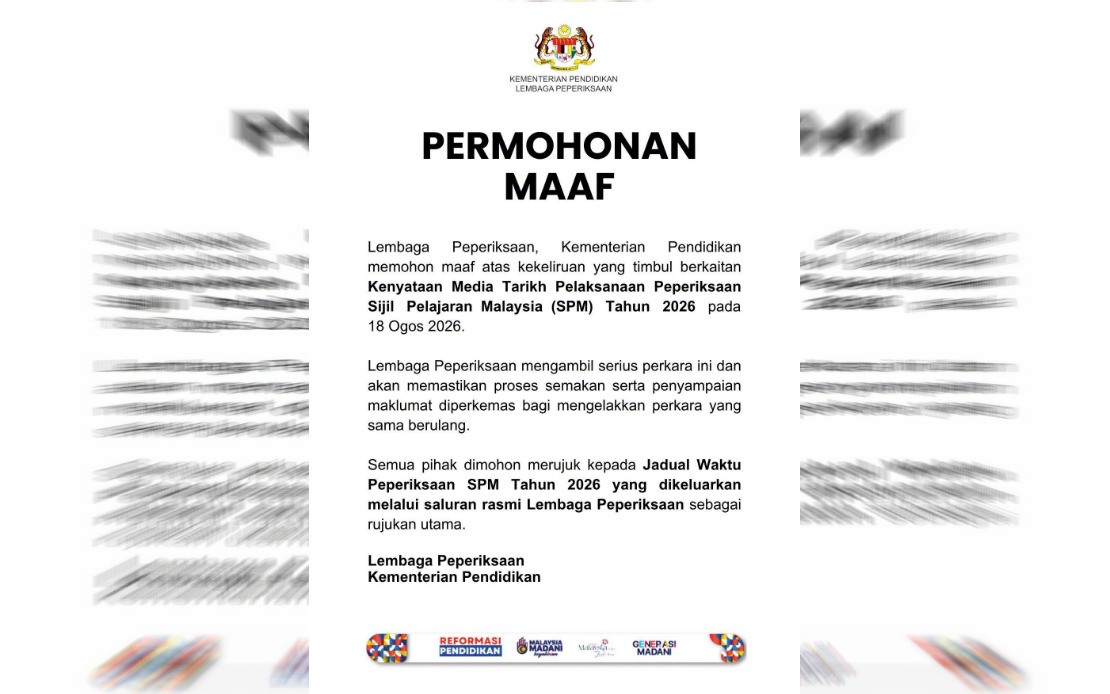
Malaysia's Examination Board under the Ministry of Education has publicly apologised for the confusion created by conflicting information released regarding the implementation dates for the 2026 Sijil Pelajaran Malaysia (SPM) examination. The apology came one day after the initial press release sparked uncertainty among stakeholders, prompting the board to issue a clarification statement addressing the misstep and outlining steps to prevent similar incidents.
The examination authority has acknowledged that the matter warrants serious attention and has committed to implementing enhanced review mechanisms and information dissemination procedures. This undertaking signals recognition within the ministry that clear communication regarding critical examination schedules is fundamental to maintaining public confidence in Malaysia's education system, particularly given the scale of candidates affected and the stakes involved for students planning their academic futures.
To resolve the confusion and establish a single authoritative reference point, the Examination Board has instructed all parties to rely exclusively on the official 2026 SPM Examination Timetable distributed through its designated communication channels. This directive aims to eliminate contradictory information circulating from secondary sources and ensures that students, parents, educators, and schools receive consistent guidance as they prepare for the national examination.
The scale of this examination cycle underscores why administrative clarity matters significantly. Approximately 420,879 candidates have registered to participate in the 2026 SPM examination, which will be administered across 3,334 examination centers distributed throughout the country. These figures reflect the comprehensive reach of Malaysia's secondary education assessment system and the logistical complexity involved in coordinating such a large-scale national undertaking.
The 2026 SPM examination is scheduled to commence on November 23 and conclude on December 17, a five-week window during which tens of thousands of candidates will sit for papers across multiple subjects and streams. This examination period represents a critical milestone for Malaysian secondary school students, determining their entry pathways into tertiary education and vocational training programs.
For Malaysian parents and students, the clarification serves as a reminder of the importance of verifying information through official channels rather than relying on secondary reports or informal networks. Educational timelines are subject to periodic adjustments based on curriculum changes, calendar considerations, and administrative necessities, making direct consultation with the ministry's formal announcements essential practice.
The incident reflects broader challenges that large government agencies face in managing information flow during digital communication environments. The rapid spread of press releases across multiple platforms and media outlets can amplify inconsistencies if initial guidance contains errors or requires urgent correction. The Examination Board's commitment to streamlined review processes suggests recognition that enhanced internal quality control will benefit the thousands of institutions and hundreds of thousands of individuals depending on these critical announcements.
Regionally, Malaysia's examination system remains a benchmark within Southeast Asia for its structured approach to secondary education assessment. Clear and consistent communication regarding examination schedules reinforces the system's credibility internationally and domestically, influencing perceptions among participating students and their families about institutional reliability.
For schools and educators preparing students for the 2026 examination, the official timetable confirmation provides the definitive planning document needed to structure revision schedules, allocate teaching resources, and coordinate with examination centers. Schools managing multiple subject streams and diverse student cohorts require precisely this type of authoritative guidance to avoid curriculum planning disruptions.
Going forward, the ministry's commitment to streamlined information delivery processes may include implementing additional approval stages before public releases, establishing clearer communication protocols between different ministry departments, and perhaps developing more robust internal fact-checking systems. Such measures would help prevent recurrence of similar incidents that create confusion at critical junctures in the academic calendar.
The apology also demonstrates institutional accountability, a principle increasingly expected by Malaysian stakeholders who participate in government services. When administrative errors occur, transparent acknowledgment and commitment to corrective action help maintain the legitimacy of educational institutions in the eyes of the public they serve.

