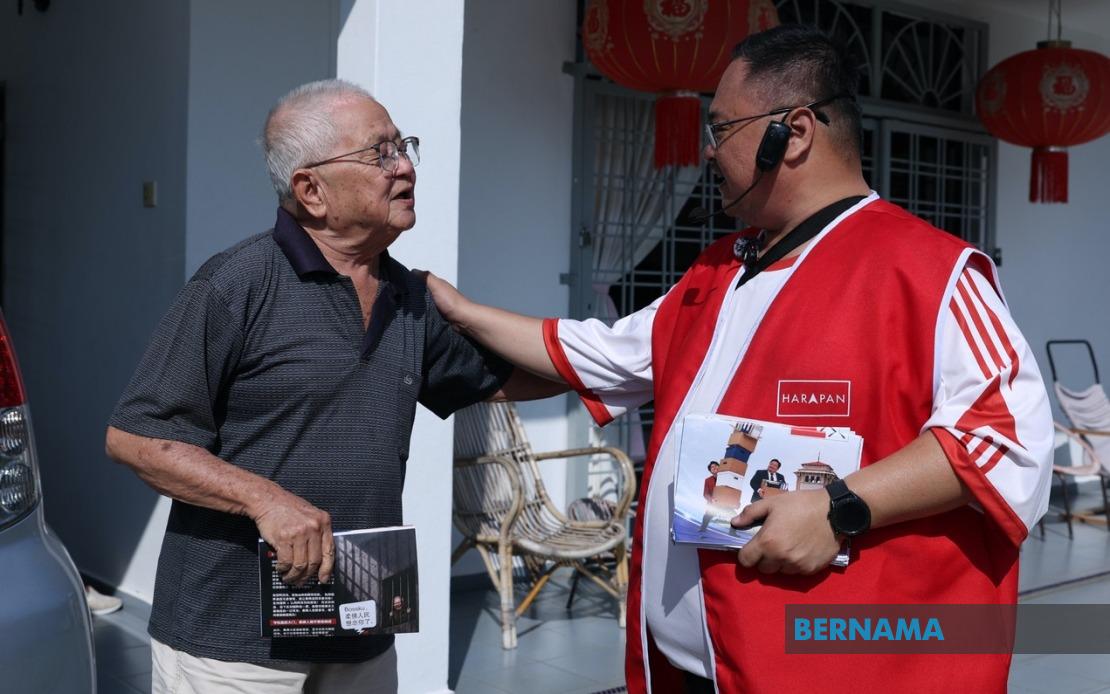
Ee Chin Li, the sitting Tangkak assemblyman, is making a decisive push to secure his fourth consecutive term by anchoring his campaign on a singular, tangible promise: the completion of the Tangkak New District Administrative Centre, a project that has languished on the drawing board for years despite its gazetted status. Speaking during a door-to-door campaign swing through Taman Ria this week, the 44-year-old Pakatan Harapan candidate laid out an ambitious yet focused development vision designed to finally transform the lives of rural constituents who have long endured administrative inconvenience and economic neglect.
The proposed administrative centre occupies an 80.9-hectare site and represents far more than mere infrastructure investment. For residents scattered across Tangkak district, the current reality demands arduous journeys to neighbouring Muar or Jasin in Melaka just to access routine government services—a burden that underscores the lopsided development patterns afflicting the northern and central regions of Johor state. Ee frames the project as corrective intervention, aligning with PH chairman Datuk Seri Anwar Ibrahim's broader vision of rebalancing growth across the state rather than concentrating investment in already-developed areas. The integrated development scheme encompasses three interconnected components: a government administrative complex to consolidate scattered offices, a commercial hub to generate local economic activity, and affordable housing to support working-class families seeking reasonable accommodation close to employment opportunities.
Ee's candidacy rests substantially on his track record of electoral consistency. A University of Taipei graduate who joined the Democratic Action Party in 2001, he first claimed the Tangkak seat in the 13th General Election in 2013 and has retained it twice since, though his grip on the constituency has tightened considerably. Most recently, in the preceding state election, he scraped through with merely 372 votes in a five-way contest that fragmented the anti-government vote across Barisan Nasional, Perikatan Nasional, Pejuang, and an independent contender. That narrow margin introduced genuine uncertainty into his political future, raising the stakes for this round of polling scheduled for July 11.
His current opponent, Haw Chin Teck representing Barisan Nasional, presents a markedly different profile. A practising lawyer with documented involvement in civil society organisations, Haw commands professional credibility and community rootedness that extends beyond party politics. Rather than dismissing his rival, Ee has chosen to publicly acknowledge Haw's capabilities and standing, a gesture that reflects the unusual tenor of political competition within Tangkak. This measured approach stands in sharp contrast to the acrimony and personal attacks that characterise electoral contests in other constituencies, signalling a constituency-specific political culture that prioritises substantive debate over inflammatory rhetoric.
The 36,955 registered voters in Tangkak will determine the outcome between these two candidates in a straightforward two-person race. Early voting commenced on July 7, with the main polling day set for July 11. Unlike the previous election's chaotic five-way scramble, the simplified contest should allow voters to focus clearly on competing visions and track records rather than fragment support across multiple candidates. The binary choice should also increase turnout, as voters no longer need to weigh the viability of smaller-party or independent candidates.
Ee emphasises that the administrative centre project represents not merely political posturing but a programmatic commitment backed by concrete planning. He acknowledges, tellingly, that previous efforts to develop the site encountered implementation obstacles, and he has pledged to pursue the project through revised strategies better attuned to contemporary conditions and fiscal realities. This implicit admission that past approaches failed without assigning blame demonstrates political maturity and suggests a genuine engagement with practical governance challenges rather than empty campaigning. The promise to deliver results through improved methodology, rather than repeating failed initiatives, gives his commitment greater credibility.
Campaign mechanics in Tangkak reflect the grassroots mobilisation strategy that PH leadership has mandated across the state. Ee's door-to-door visiting programme at residential enclaves like Taman Ria exemplifies this bottom-up approach, enabling direct conversations with constituents about their concerns and aspirations rather than relying primarily on mass media or staged public events. This labour-intensive method demands sustained effort but generates qualitatively different voter engagement than conventional broadcasting-style campaigns. For a constituency with significant rural characteristics, such personalised contact carries particular weight in shaping electoral preferences.
The political culture of Tangkak district itself merits examination within the broader Southeast Asian context. Ee's characterisation of the contest as "kampung-style" democracy—conducted with courtesy and professionalism despite partisan differences—reflects values increasingly rare in polarised Malaysian politics. This commitment to civil debate and mutual respect across political divides suggests that Tangkak voters prioritise solutions and competence over tribal loyalty or ideological purity. The absence of manufactured controversy or personal attacks in this campaign contrasts sharply with simultaneous contests in other Johor constituencies where candidates engage in vituperative exchanges and character assassinations.
The implications of this Tangkak contest extend beyond the single seat into questions about PH's capacity to deliver on state-level development commitments and about the broader trajectory of Malaysian electoral politics. Should Ee succeed in reclaiming his seat and subsequently actualise the administrative centre project, the outcome would vindicate PH's developmental approach and validate voter trust in the coalition. Conversely, failure would reinforce narratives about the gap between political promises and governmental capability, potentially dampening enthusiasm for PH governance in other rural constituencies across Peninsular Malaysia.
For Malaysian voters observing from beyond Johor, the Tangkak contest offers instructive lessons about the relationship between electoral competition and political civility. The candidates' willingness to acknowledge each other's competence and to debate substantive policy rather than engage in personal destruction suggests an alternative model for Malaysian democracy—one where parties compete seriously for voter approval based on track records and future plans rather than resorting to scorched-earth tactics. Whether this Tangkak precedent proves replicable in other constituencies or represents an isolated pocket of mature political discourse remains an open question as Malaysia continues navigating its complex electoral landscape.

