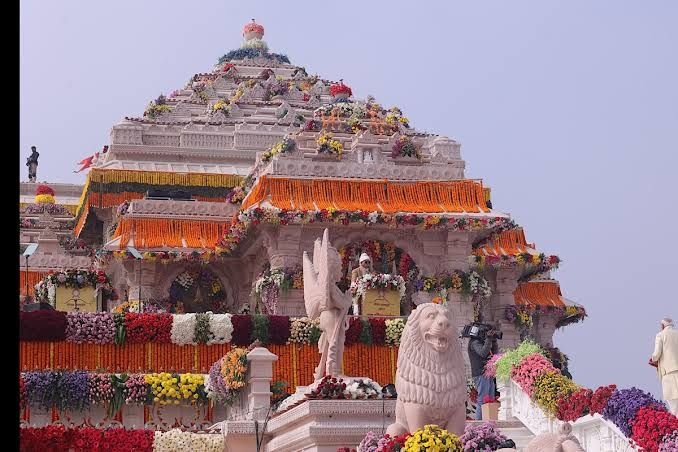
Indian police have arrested eight individuals accused of stealing and misappropriating temple donations at Ram Mandir in Uttar Pradesh, a high-profile religious site that has become central to India's ruling establishment. Authorities registered a criminal case on Thursday and took the suspects into custody following allegations of financial irregularities in how the temple managed devotee offerings. The arrests represent an embarrassing development for a sanctuary that Prime Minister Narendra Modi personally inaugurated just months earlier with considerable ceremonial significance.
Ram Mandir, located in the town of Ayodhya in northern Uttar Pradesh, occupies deeply contested historical and religious terrain. The temple was constructed on a site where the Babri Mosque stood for centuries until it was demolished by Hindu zealots in 1992—an event that fundamentally reshaped Indian politics and elevated Modi's Bharatiya Janata Party to prominence. The BJP's role in championing the mosque's removal and the subsequent temple construction transformed the party from opposition underdog into the dominant political force that now governs India, displacing the Congress party that had led the nation through most of its post-independence era. The 2024 inauguration of the completed temple thereby represented a symbolic culmination of decades of political effort and ideological positioning.
Those arrested include multiple temple employees tasked with processing the substantial cash donations and valuable items presented by visiting worshippers. The alleged theft specifically involved funds and precious metals—gold and silver objects—that devotees had contributed to the temple. While government officials have remained deliberately vague about the scale of the alleged criminal activity, opposition parties and media investigations have suggested the missing amount could total more than US$20 million, representing a staggering breach of trust at a sanctuary that had cost an estimated US$240 million to construct.
The entire construction budget for Ram Mandir came exclusively from public donations, according to the trust administration managing the complex. This funding model meant that devotees across the country had financially contributed to the project's completion. The revelation that temple staff may have subsequently diverted a portion of subsequent donations has created profound disillusionment among believers who funded both the construction and the ongoing operations. Many worshippers now harbour legitimate concerns about whether their offerings reached their intended purpose or disappeared into personal accounts.
Viti Saxena, a 44-year-old homemaker from Lucknow, expressed the emotional distress that many temple donors now experience. Having made financial contributions herself, Saxena questioned whether her money had actually entered the temple's accounts or vanished through fraudulent channels. She articulated broader anxieties permeating the Hindu community, describing the scandal as bringing international embarrassment and fundamentally shaking the faith of countless believers who had trusted the temple administration with their resources. The reputational damage extends beyond mere accounting irregularities to strike at the spiritual and emotional bonds between devotees and the institution.
The arrested individuals face serious criminal charges including criminal breach of trust, theft, criminal conspiracy and corruption. These charges carry substantial legal consequences under Indian law and suggest that investigators uncovered evidence of systematic misappropriation rather than isolated incidents. The nature of the charges indicates that authorities believe the suspects either acted alone in a coordinated scheme or worked collectively to divert temple funds through various mechanisms.
Uttar Pradesh Chief Minister Yogi Adityanath, whose state government had established a Special Investigation Team to examine the allegations, promised that culpable parties would face full legal accountability. His public commitment to ensuring that no guilty person escapes justice reflects the political sensitivity surrounding the case, given the temple's prominence within the ruling BJP's ideological framework and its centrality to Modi's political legacy. The state government's willingness to investigate and prosecute its own officials demonstrates an attempt to contain the reputational fallout, though questions linger about whether the probe is sufficiently independent.
The broader religious context underpinning the temple illuminates why the scandal carries such weight beyond typical cases of administrative corruption. According to Hindu theology, the deity Ram was born in Ayodhya more than seven millennia ago at the precise location where the Babri Mosque subsequently stood. The mosque's construction by a 16th-century Muslim emperor thus represented—in the Hindu nationalist worldview—an act of desecration requiring eventual rectification. The 1992 demolition of the mosque and subsequent construction of the temple fulfilled an ideological mission that mobilized millions of supporters and fundamentally restructured Indian electoral politics.
For Malaysian observers, the Ram Mandir case carries significant implications for understanding communal tensions and religious politics in the South Asian neighbourhood. Malaysia's own complex history of religious coexistence and constitutional frameworks protecting multiple faith communities contrasts sharply with the communal polarization evident in Indian politics. The theft scandal at Ram Mandir illustrates how institutional corruption and breach of devotee trust can cascade into broader crises of confidence affecting entire religious communities. It also demonstrates the political weaponization of religious sites and the risks that emerge when temples, mosques or churches become entangled with partisan political movements rather than serving purely spiritual functions.
The case raises uncomfortable questions about governance, accountability and transparency within major religious institutions across South Asia. The alleged siphoning of donations—whether they total US$20 million or some other figure—represents a fundamental violation of the fiduciary duty that religious administrators owe to their supporters. For devotees who had believed their contributions served sacred purposes, the disclosure of potential systematic theft strikes at the foundation of trust between communities and their religious institutions. As investigations continue, the full extent of the alleged embezzlement and the consequences for those responsible remain uncertain, but the reputational damage to Ram Mandir and broader implications for religious trust in India appear substantial and enduring.

