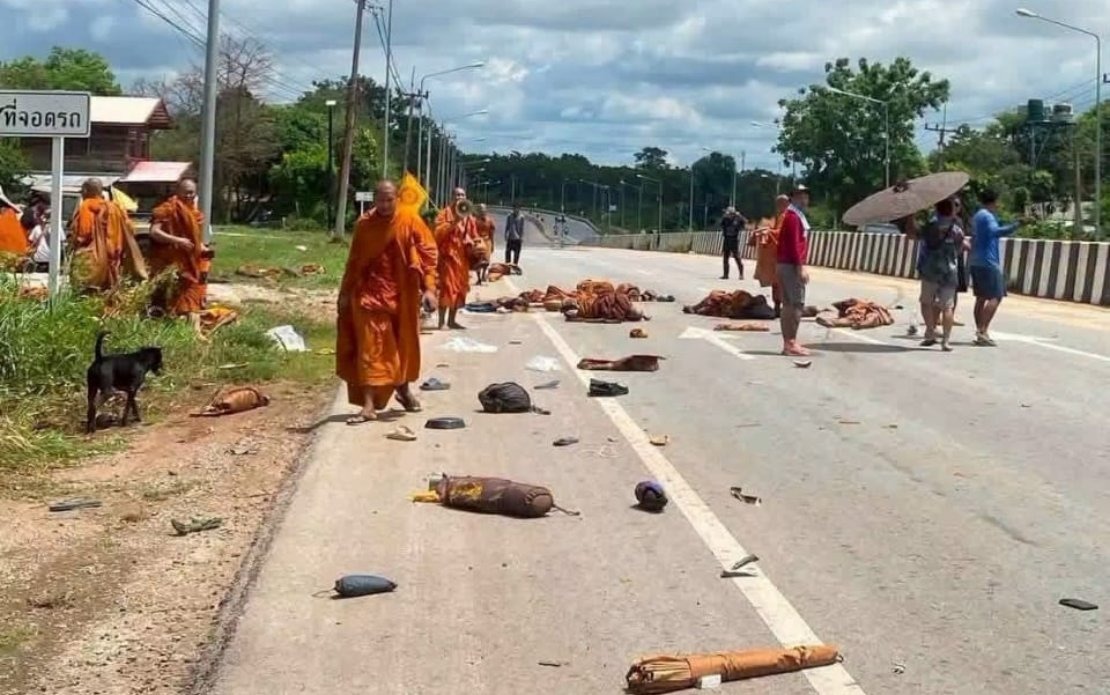
A tragic accident on a rural road in northeastern Thailand has claimed the lives of eight Buddhist monks and left fourteen others injured after a pickup truck careened into their religious procession. The monks were participating in a walking pilgrimage towards Nam Khun district in the adjacent Ubon Ratchathani province when the vehicle struck their group on Thursday morning in Mukdahan province. The collision instantly killed five of the monks at the scene, while three others succumbed to their injuries after being rushed to hospital, according to medical officials treating the victims.
The injured included four monks in critical condition and ten others with moderate injuries requiring hospital admission. In total, 23 patients—comprising 22 monks and one civilian—were brought under medical care following the incident. The scale of the casualty toll underscores the severity of the impact, which authorities say could have resulted in even greater losses had the pedestrian group not been partially dispersed at the moment of impact. Mukdahan Provincial Public Health Chief Dr Narong Chankaew confirmed the injury assessment and hospital admissions from his medical records.
According to Mukdahan Governor Warayan Boonnarat, the monks had commenced their pilgrimage around 11 in the morning along Ban Na Si Nuan Road in Mueang district. The religious group was walking in the correct direction against vehicular traffic flow—a standard pedestrian safety measure that positioned them on the roadside rather than in the vehicle lane itself. However, eyewitness accounts suggest that the pickup truck suddenly lost control and veered sharply onto the shoulder where the monks were walking in single file, approximately two metres from the road's edge.
The governor's statement reveals that the first five monks in the procession managed to escape the vehicle's path, but those following behind were caught in the collision and struck with devastating force. The positioning and sequence of events suggest that the monks' adherence to safety protocols may have prevented an even greater tragedy, though it ultimately could not spare the eight lives lost. The incident raises broader questions about road safety in rural areas of Thailand where traffic accidents involving vulnerable pedestrians remain a persistent concern.
The driver of the pickup truck was identified as a juvenile under fifteen years of age, and was immediately taken into custody by authorities at the scene. Mukdahan Provincial Police Commander Police Major General Phairoj Thaiputra confirmed that investigations are ongoing to establish the precise circumstances that led to the vehicle's loss of control. Police personnel are actively questioning the young driver and interviewing his parents to determine whether mechanical failure, driver error, or other factors contributed to the crash.
Legal proceedings are expected to follow once the investigation concludes, with authorities applying applicable traffic and criminal laws. Police Major General Phairoj indicated that investigators are examining whether the parents could potentially face negligence charges for permitting their underage son to operate the vehicle. This element of the inquiry highlights Thai authorities' intention to establish accountability not only for the driver but also for adult guardians who may have failed in their duty of supervision, particularly given the youth's age.
The accident occurred during daylight hours on a provincial road, and preliminary investigations have not revealed obvious environmental factors such as adverse weather or poor visibility that might have contributed to the loss of control. This suggests that authorities may be focusing on factors more directly related to the vehicle's operation or the driver's actions. The full toxicology results and mechanical inspection reports remain pending as police continue their forensic examination of the pickup truck.
In the immediate aftermath, Mukdahan Hospital issued an urgent appeal for blood donations to support the ongoing medical treatment of injured survivors. The hospital's capacity to manage mass casualty situations, particularly in rural northeastern Thailand, depends heavily on community support and available blood stocks. The appeal underscores the resource constraints faced by provincial healthcare facilities in responding to major incidents and highlights the importance of maintaining adequate emergency medical supplies.
This tragedy carries significant implications for Buddhist communities across Thailand and the broader Southeast Asian region, where religious pilgrimages represent important spiritual and cultural practices. Monks undertaking such journeys are typically unarmed and vulnerable, moving slowly through the landscape in contemplative procession. The incident will likely prompt renewed discussions about traffic safety measures near popular pilgrimage routes and whether additional protection or infrastructure improvements are necessary in areas where monks regularly undertake such religious activities.
For Malaysian readers, the incident serves as a sobering reminder of road safety challenges that extend across Southeast Asia. Thailand's traffic accident rate remains among the highest in the region, with annual statistics consistently exceeding regional averages. While Thailand has implemented various road safety campaigns and enforcement initiatives, particular attention to protecting vulnerable road users—including pedestrians, cyclists, and religious procession groups—remains essential across the region.

