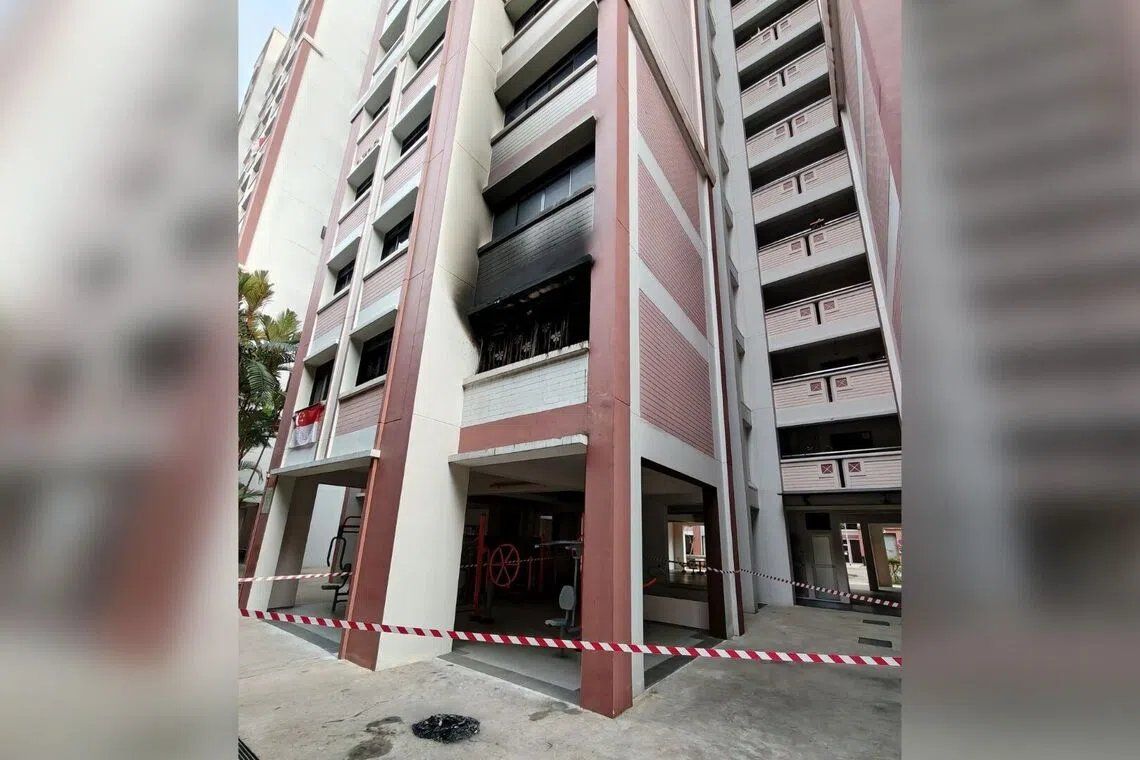
A residential fire in Singapore's Buangkok district in the early hours of Thursday morning saw one elderly occupant treated at hospital, though authorities said he suffered only minor injuries and was subsequently released. The Singapore Civil Defence Force (SCDF) received an emergency call at approximately 12.25am regarding a blaze that had broken out within Block 979B Buangkok Crescent, a public housing development in the Ang Mo Kio area. Firefighting teams responded quickly to contain the flames, which were confined to the contents of a bedroom located on the second floor of the residential unit.
The SCDF deployed a water jet to extinguish the fire, successfully limiting damage to the immediate area where the blaze originated. According to the responding agency, one occupant was transported to Sengkang General Hospital for treatment and observation. However, Ang Mo Kio GRC Member of Parliament Victor Lye subsequently clarified in a public statement posted to Facebook around 1pm that the hospitalised individual, an elderly male, had sustained only cuts to his feet during the incident and had already been discharged from medical care by the time of his post.
The rapid response of neighbouring residents appears to have prevented a more serious outcome. Lye singled out an ITE (Institute of Technical Education) student living in an adjacent unit for particular commendation, noting that this young resident demonstrated considerable presence of mind during the emergency. The student deployed a fire extinguisher from his own flat to help combat the initial flames and, more critically, successfully guided three people from the affected unit to safety before professional emergency responders arrived on scene. This swift action by an untrained civilian likely minimised both the risk to human life and the extent of property damage sustained.
In his capacity as the elected Member of Parliament representing the constituency, Lye visited the affected flat personally to express solidarity with the displaced family and to ascertain their needs in the aftermath of the fire. He noted that his team had made available the Residents' Network centre, a community facility typically used for neighbourhood events and support services, to provide temporary accommodation and assistance to those rendered homeless by the incident. However, the family opted to remain with their helpful neighbour rather than relocate to the communal facility, indicating a level of community cohesion that underscores the role of local networks in managing residential crises.
The cause of the fire remains under formal investigation by the relevant authorities. Such incidents, while relatively rare in Singapore's well-maintained housing blocks, underscore the importance of fire safety awareness and the preparedness of residents to respond to emergencies. The speed with which the ITE student acted demonstrates that public awareness campaigns and basic fire safety training can translate into life-saving action when crises occur.
This incident comes amid broader discussions in Singapore about residential fire prevention and the adequacy of safety equipment in public housing. The Housing and Development Board (HDB), which manages Singapore's vast public housing stock serving the majority of the population, continues to emphasise smoke detector installation and fire safety protocols across its blocks. The quick containment in this case—achieved through a combination of rapid SCDF response and neighbouring residents' intervention—reflects positively on both emergency services capability and community awareness.
For Malaysian readers, the incident highlights similarities in urban housing contexts across Southeast Asia, where high-density public housing developments are common. The Buangkok case illustrates how community vigilance and good neighbourly relations can serve as the first line of defence against residential emergencies. In Malaysia's own apartment complexes and condominium buildings, such incidents underscore the value of regular fire safety drills, maintenance of extinguishing equipment, and the importance of knowing evacuation procedures.
The role of the elected representative in providing immediate support and public reassurance also reflects governance approaches in Singapore's political system. Lye's swift public communication and personal visit to the affected residents served to manage information flow and demonstrate governmental responsiveness—factors that contribute to public confidence in institutional crisis management capacity.

