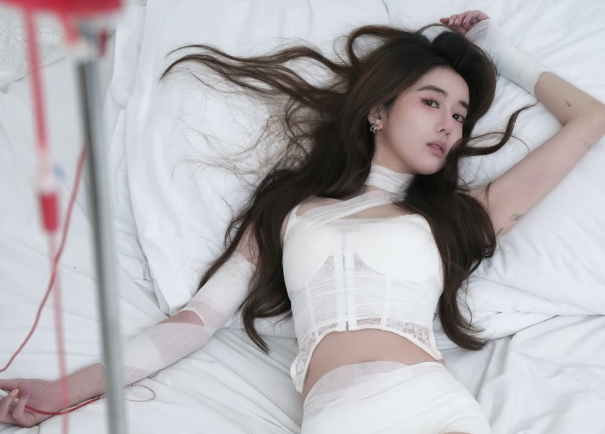
Singaporean actress Eleanor Lee, who maintains a carefully curated social media presence showcasing the glamour of entertainment industry life, recently peeled back the curtain on a traumatic moment from her career. In a detailed post on Chinese social platform Xiaohongshu on July 7, the 26-year-old, who is based in China, revealed footage and personal recollections of a serious on-set accident that occurred during the filming of a Chinese drama production in 2018.
The incident unfolded with startling suddenness when Lee and her co-star Yang Le, a 39-year-old Chinese actor, were attempting to board a moving truck as part of a scene. Behind-the-scenes footage captured the moment the pair approached the vehicle's rear, preparing to climb aboard. Yet before Lee could fully secure herself on the truck, the driver initiated movement. Unable to maintain her balance as the vehicle accelerated, Lee tumbled backwards from the platform. In a protective reflex, Yang, who had been holding onto her, was also thrown off during the fall.
The physical consequences were severe. Lee struck both her head and back during the collision with the ground, rendering her momentarily unconscious. She described the sensation vividly in her social media caption, noting that "everything went black and I could not breathe." Yang sustained injuries to his arm during his own fall. For several moments, uncertainty hung over the set as both performers lay on the ground, the immediate severity of their conditions unclear to onlookers.
The response from those present demonstrated both professionalism and compassion. Production staff and other cast members immediately mobilised to assist. Five crew members carefully lifted Lee and positioned her on a platform where she could lie flat while medical assessment was conducted. Yang was similarly provided with a box to rest upon as they recovered from the shock and physical trauma. The scene captured on video showed Lee hyperventilating while Yang remained crouched, both visibly shaken by their experience.
What resonated most with Lee during this ordeal, according to her reflection shared months later, was the immediate human response from those around her. Extras working on the production rushed to her side, lifting her carefully, holding her hand, and helping to steady her breathing as she recovered. Yet even as she regained consciousness and orientation, Lee's first instinct was to consider the broader implications of the accident. She expressed concern about potentially disrupting the filming schedule and causing inconvenience to fellow cast members who depended on scenes being completed as planned.
Demonstrating a work ethic that speaks to both her dedication and the intense pressures within the entertainment industry, Lee made the controversial decision to continue working after the accident. Once she had sufficiently recovered, she stood up and adamantly refused medical evaluation at a hospital facility, instead insisting on completing the scheduled scene. The production team granted her a full day of rest before resuming work, a concession that reflected both their concern for her wellbeing and recognition of her determination.
Lee's recounting of this incident serves a broader purpose beyond personal narrative. She explicitly reflected on the gap between public perception and professional reality in entertainment. "The entertainment industry always shows us its most glamorous side," she wrote, "but I believe every actor's hard work deserves to be recorded." This observation highlights how the curated nature of social media and industry marketing obscures the physical dangers and emotional tolls that performers endure routinely.
This 2018 truck accident was not an isolated incident in Lee's career marked by physical hazards. In 2023, she shared additional behind-the-scenes footage from filming a Chinese fantasy movie that captured another mechanical failure with serious safety implications. During a sequence requiring her and co-star Chen Xingxu to appear to fly through the air suspended by an elaborate system of wires and pulleys, a mechanical malfunction caused the equipment to suddenly jerk Lee backwards while she remained airborne. Both performers were carefully lowered to the ground, production halted while technical staff assessed their conditions, and filming subsequently resumed.
The pattern evident across these incidents underscores systemic safety concerns within entertainment production, particularly on film and drama sets that demand increasingly ambitious physical sequences. Wire work, vehicle choreography, and mechanical effects create inherent risks that cannot be entirely eliminated, regardless of precautions. Yet the willingness of performers to minimize injuries, refuse hospitalisation, and resume work demonstrates how industry culture can inadvertently prioritise production schedules over genuine medical assessment and recovery.
Lee's decision to publicly document these accidents represents a meaningful contribution to broader conversations about workplace safety and industry transparency. By sharing the footage and detailed accounts, she challenges the sanitised image typically presented to audiences and investors. She acknowledges that accidents occur with regularity but often remain unrecorded in the official narrative of entertainment production.
For regional audiences in Malaysia and Southeast Asia, Lee's experience carries particular resonance given the growing prominence of Chinese film and drama production throughout the region and the increasing involvement of regional actors in these productions. Her account provides candid insight into the professional hazards that performers from Singapore, Malaysia, and other neighbouring countries may encounter when working on major Chinese sets, where safety standards and incident reporting may differ significantly from Western industry norms.

