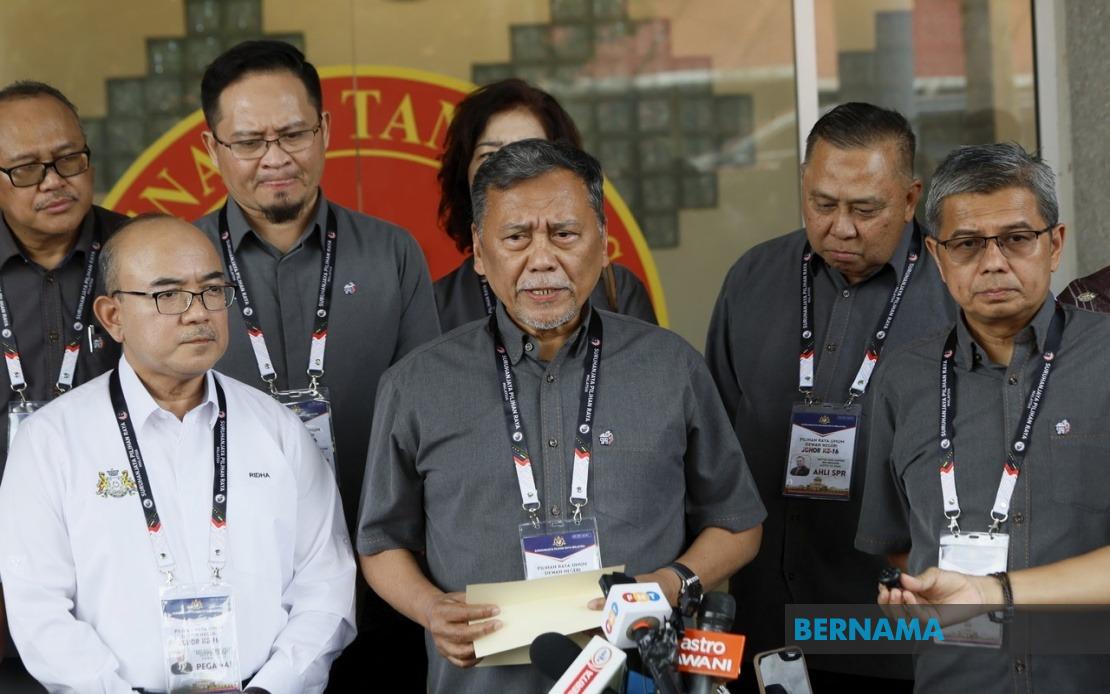
The Election Commission is projecting a 96 per cent participation rate in early voting for the Johor state election, according to targets set by EC chairman Datuk Seri Ramlan Harun. The ambitious benchmark reflects confidence in mobilising eligible early voters and draws upon established patterns from previous electoral contests across Malaysia. Speaking at Kem Mahkota in Kluang on July 7, Ramlan expressed optimism that the projection could be achieved, citing the commission's historical experience with early voting participation in state and federal elections.
Operations commenced across the state on the morning of the election, with 62 early voting centres activated to accommodate the designated voter cohorts. The staggered closure schedule demonstrated logistical complexity—29 facilities shut down at noon, five additional centres concluded voting at 2 pm, while the remaining 28 locations maintained operations until 5 pm. This tiered approach allowed election officials to manage voter flow efficiently while accommodating the schedules of military and police personnel, many of whom face operational deployment constraints that preclude attendance during regular polling periods.
The early voting franchise encompassed 20,607 qualified electors from two categories critical to national security and public order. Military personnel and their spouses accounted for 8,544 of this figure, while police officers and their families constituted 12,063 voters. The inclusion of service members' spouses reflects Malaysia's established practice of extending voting privileges to dependents of uniformed personnel, recognising both spousal citizenship rights and the logistical challenges faced by families in high-mobility occupations.
Security arrangements for the early ballots reflected institutional safeguards embedded throughout Malaysia's electoral process. Completed ballot boxes were to be sequestered at police stations overnight, pending the official count. This storage protocol ensures tamper-proof conditions and maintains the chain of custody integral to electoral integrity. The decision to hold all early ballots in police custody rather than dispersing them among multiple facilities centralises security oversight and simplifies audit procedures.
The counting process itself followed a deliberately conservative timeline designed to minimise procedural errors and provide transparency. Vote tallying for early ballots was scheduled to commence at 5 pm on Saturday, the official polling day, rather than being processed immediately after voting concluded. This synchronisation with regular ballot counting allows election officials to conduct consolidated reporting and cross-verification. Ramlan projected that preliminary results would emerge by 10 pm, with comprehensive final tallies expected before midnight—a realistic assessment given Malaysia's established vote-counting protocols.
For Malaysian observers and regional analysts, the 96 per cent turnout target carries significant implications. High early voting participation typically correlates with strong overall engagement in electoral contests, suggesting that Saturday's general polling would likely generate substantial voter turnout among the 2.7 million eligible ordinary electors. The EC chairman explicitly framed participation as a civic imperative, appealing to voters' democratic responsibilities and underlining the constitutional legitimacy vested in electoral participation. This messaging reinforces Malaysia's commitment to democracy at the subnational level, particularly important during state elections where regional governance directly affects daily quality of life.
The timing of the Johor state election carries particular significance for Malaysia's political trajectory. As the country's second-largest state by population and a traditional electoral battleground, Johor polling outcomes influence broader calculations about ruling coalitions and opposition viability across the federation. Early voting patterns among security personnel often foreshadow the broader electorate's inclinations, making the 96 per cent participation benchmark a potentially useful indicator of engagement levels. If achieved, such comprehensive turnout among these voter cohorts would suggest mobilisation strategies have penetrated effectively into disciplined institutional populations.
From a regional perspective, Malaysia's electoral machinery continues demonstrating institutional capacity for managing complex, multi-stage voting processes. The coordination required to simultaneously operate 62 geographically dispersed centres with differentiated closure schedules, secure ballot materials, and synchronise counting procedures represents sophisticated administrative execution. Other Southeast Asian democracies frequently examine Malaysia's Electoral Commission practices as a comparative benchmark, particularly regarding the integration of security personnel voting into broader democratic processes without compromising operational readiness.
The security personnel voting arrangement itself reflects a calibrated institutional approach to reconciling professional obligations with democratic participation rights. Military and police forces require continuous deployment and cannot afford wholesale attendance at polling stations during standard voting hours. By establishing dedicated early voting arrangements, Malaysia ensures these essential service providers exercise franchise rights without compromising national security posture. This model represents a mature response to the inherent tension between professional duty and democratic citizenship within uniformed services.
Looking ahead, the success or underperformance against the 96 per cent early voting target will offer the EC valuable data for refining future electoral cycles. If turnout approaches or exceeds projections, the commission may expand early voting access in subsequent elections. Conversely, should participation fall short, officials would review logistical arrangements, publicity campaigns, and administrative processes to identify impediments to engagement. Such continuous improvement cycles underscore professional election management and commitment to maximising democratic participation across all eligible voter segments.

