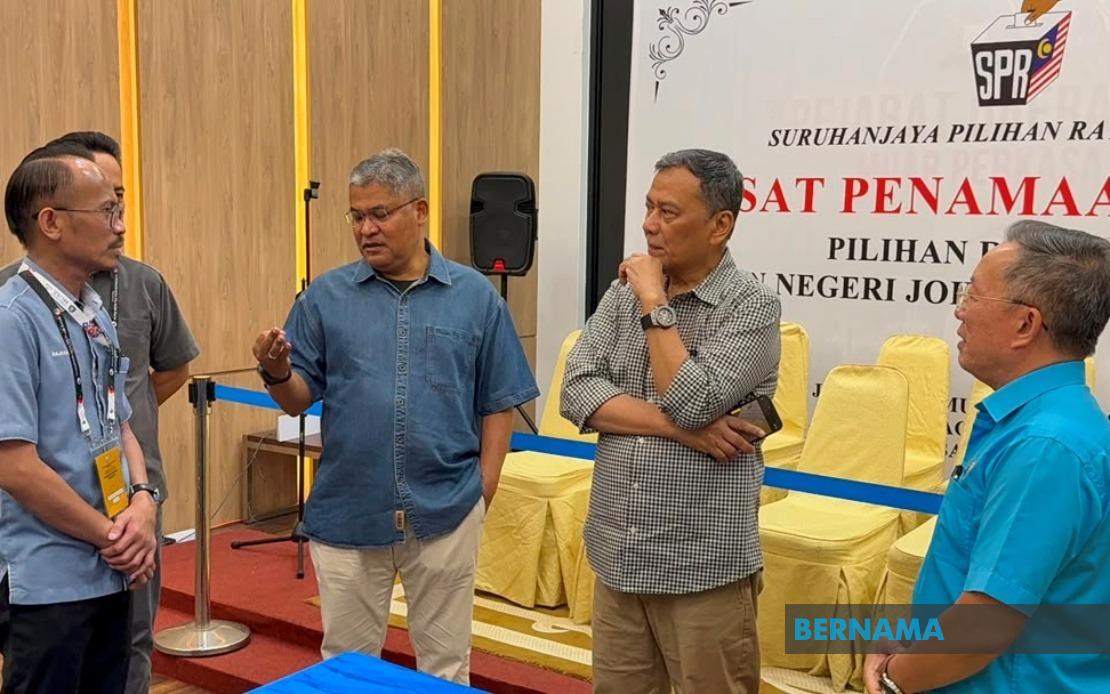
The Election Commission is in the final stages of readying itself for the commencement of the Johor state election nomination process tomorrow, with officials at various candidate nomination centres across the state conducting last-minute checks to guarantee the integrity and efficiency of proceedings. Personnel at multiple nomination centre locations are focused on resolving outstanding technical and logistical matters, having already completed the bulk of their preparatory work in preceding days. The comprehensive readiness across these facilities reflects the institutional effort required to coordinate an election involving nearly 2.73 million registered voters across one of Malaysia's most populous states.
At the Perling state constituency nomination centre, housed at Dewan Jubli Intan Hall in Johor Bahru, returning officer Nazatul Shima Mohamad confirmed that the venue layout had been finalised and all simulation exercises with participating agencies had concluded successfully. She emphasised the collaborative spirit displayed by all stakeholders involved in the process, noting that diverse parties were working together towards the common objective of ensuring tomorrow's proceedings unfold without disruption. Mohamad extended an invitation to prospective candidates to approach the process with patience and cooperation, while providing practical guidance about the necessity of arriving early and bringing essential documentation, including nomination fees. Her remarks underscore the administrative coordination required at the ground level to translate broad electoral principles into smooth day-to-day operations.
The Kota Iskandar nomination centre, located at the Main Hall of Iskandar Puteri City Council in Medani, has implemented security and crowd management measures reflective of the electoral enthusiasm expected to accompany nomination day. Returning officer Shahrulizam Abdul Rashid detailed arrangements involving police coordination to facilitate the movement of candidate supporters, including strategic road closures near the centre and a 50-metre restricted perimeter to separate competing parties' supporter groups. The establishment of designated tent areas and barrier installations represents practical infrastructure planning to accommodate the convergence of multiple political factions at a single location without compromising the nomination process itself. These arrangements acknowledge the heightened emotions and partisan energy characteristic of election-related activities in Malaysia while prioritising public order.
Shahrulizam cautioned members of the public intending to participate in supporter activities to exercise prudence and refrain from provocative conduct towards rival parties' supporters. This appeal reflects longstanding concerns about maintaining civility during high-stakes electoral periods, particularly in states like Johor where electoral competition typically generates significant public interest and engagement. The emphasis on mutual restraint represents an implicit recognition that nomination day, while purely administrative in function, serves as a public manifestation of political competition that can occasionally test civic norms. By addressing this element proactively, election officials are attempting to establish expectations around acceptable behaviour from the outset.
The nomination process is scheduled to operate across 56 candidate nomination centres statewide tomorrow between 9 and 10 o'clock in the morning, following which returning officers will announce the names of candidates officially eligible to proceed to the general election campaign phase. The concentration of this activity within a single two-hour window across such a geographically extensive state demands sophisticated coordination to prevent bottlenecks while maintaining procedural standards. The scale of this undertaking—managing nomination submissions from hundreds of candidates across 56 dispersed locations simultaneously—represents a significant logistical achievement by the election administration.
The voter roll for this election comprises 2,727,926 registered electors, subdivided into three categories reflecting the electoral framework that applies to different Malaysian constituencies. The voter base includes 2,703,175 ordinary voters who represent the primary electorate, along with 12,041 military personnel and their spouses, and 12,710 police personnel and their spouses, whose inclusion reflects Malaysia's framework for accommodating the electoral participation of security force members. This composition underscores the socio-demographic complexity of Johor's electorate and the necessity for electoral administration to function across diverse communities and institutional categories.
The Johor State Legislative Assembly was formally dissolved on June 1, initiating the electoral process that culminates in tomorrow's nomination submissions. The Election Commission has staggered subsequent electoral activities across a fortnight, scheduling early voting for July 7 and the main polling day for July 11. This sequencing allows appropriate intervals for campaign activities to unfold and provides administrative time between distinct phases of the electoral process. The compressed timeline reflects attempts to balance the imperative to hold elections promptly with the practical requirements of conducting an orderly campaign period.
From a broader Malaysian electoral perspective, the Johor state election assumes significance beyond the state's boundaries, as results often carry symbolic weight regarding voter sentiment across the wider nation. Johor, as Malaysia's second-most populous state and a region where multiple political coalitions maintain substantial followings, typically witnesses competitive contests that draw national political attention. The smooth conduct of nomination procedures tomorrow will establish the candidate roster that will compete for the state legislature, effectively determining the range of political choices available to Johor voters on polling day.
The Election Commission's meticulous approach to preparation—evidenced by site inspections, simulation exercises, and coordination with law enforcement—reflects institutional learning from previous electoral exercises and an appreciation for the complexity of coordinating simultaneous administrative activities across dispersed locations. The emphasis placed by returning officers on candidate cooperation and public vigilance suggests a recognition that electoral success ultimately depends on behavioural compliance from multiple actors beyond the administrative machinery itself. As nomination day approaches, the election administration has positioned itself to receive candidates' submissions within a structured framework designed to prevent irregularities while accommodating the volume of activity anticipated across the state.

