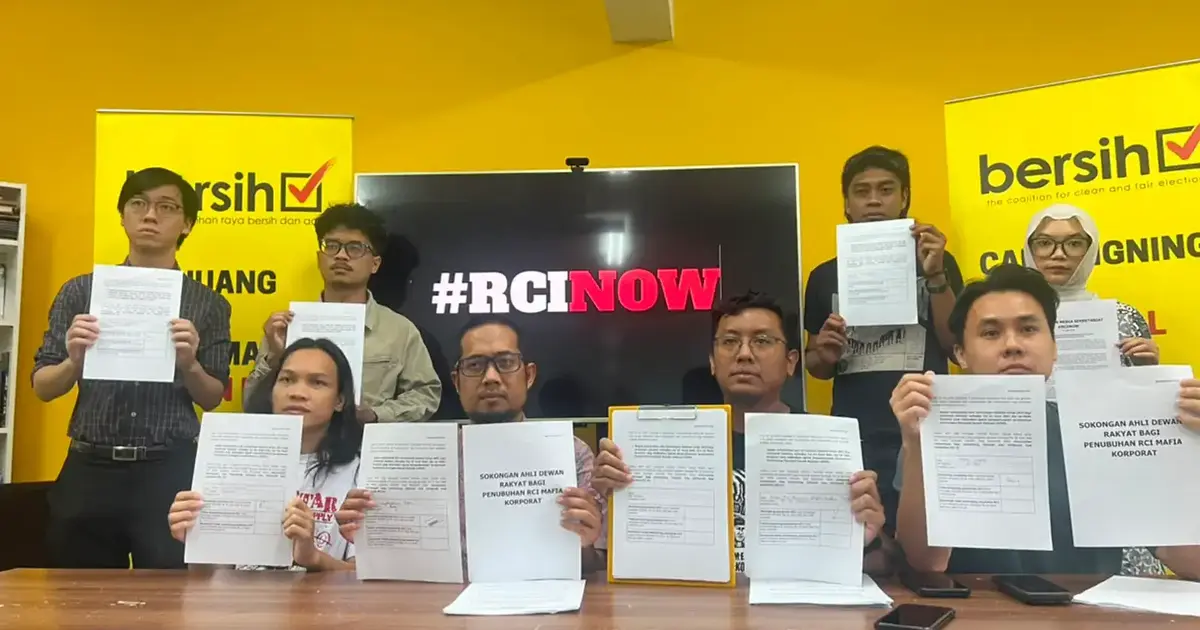
Electoral watchdog Bersih 2.0 has announced that 34 parliamentarians from across the political spectrum have signalled support for establishing a royal commission of inquiry to investigate what the organisation characterises as 'corporate mafia' activities affecting the nation's governance. The coalition of legislators spans multiple parties, including PKR, PAS, DAP and Umno, indicating that concerns about corporate influence and potentially improper business-government relationships transcend the usual factional divides in Malaysian politics.
The initiative by Bersih represents a significant push from civil society to formalize parliamentary scrutiny of the intersection between corporate interests and political decision-making. Such an inquiry would represent an unprecedented institutional examination of how business networks may influence or compromise governmental processes. The breadth of party representation suggests growing recognition among parliamentarians, regardless of coalition allegiance, that transparency mechanisms are needed to address public anxieties about governance standards and corporate accountability.
Bersih's framing of the issue as involving 'corporate mafia' carries considerable weight in Malaysian discourse, particularly given recent years of high-profile scandals involving state investment vehicles, sovereign wealth funds, and business tycoons with alleged political connections. The term encompasses networks of corporate actors that may operate through informal channels to secure favours, contracts, or policy outcomes that benefit specific business interests over the public good. This interpretation reflects broader concerns about whether Malaysia's regulatory frameworks adequately protect democratic institutions from capture by concentrated private interests.
The cross-party nature of the alleged support is noteworthy given Malaysia's fractious political environment. PKR and DAP operate primarily within the opposition framework, while PAS occupies a more complex position having previously collaborated with Umno, the country's largest party. That legislators from such ideologically and politically distinct groups reportedly converge on this issue suggests the matter has moved beyond narrow partisan calculation and touches genuine shared anxieties about systemic governance challenges.
A royal commission of inquiry carries significant institutional weight and investigative authority under Malaysian law, granting it powers of summons and compulsion of evidence far exceeding what parliamentary select committees or civil society organisations can exercise independently. Such an investigation could examine patterns of corporate donations to political parties, the grant of government contracts and licenses, the role of political consultants and middlemen, and the revolving door between government service and corporate positions. The findings could potentially inform legislative reforms to strengthen disclosure requirements, conflict-of-interest rules, and corporate governance standards.
For Malaysian readers and stakeholders, an inquiry into corporate-political relationships carries direct implications for business confidence, regulatory predictability, and the integrity of public procurement. Legitimate businesses operating according to proper procedures could benefit from clearer rules that distinguish lawful corporate engagement from problematic influence. Conversely, companies or individuals engaged in improper practices would face exposure to legal consequences and reputational damage. The outcomes could reshape how government contracts are awarded and how corporate-political relationships are disclosed publicly.
The initiative also reflects international pressure and best practices regarding anti-corruption and good governance. Many advanced democracies have mechanisms to investigate and restrict certain forms of corporate political activity, including caps on donations, transparency requirements, and restrictions on lobbying. A Malaysian royal commission could examine whether existing regulatory gaps leave the system vulnerable to forms of corporate influence that would be prohibited or heavily monitored elsewhere. This would position Malaysia competitively within regional governance standards and potentially support its standing in international corruption perception indices.
However, the pathway from parliamentary support to actual establishment of such a commission involves significant political steps. A royal commission requires formal recommendation from government, typically through the Prime Minister's office or relevant ministry. The political climate, competing legislative priorities, and sensitivity around which corporate networks might come under scrutiny could all affect whether this initiative translates into formal institutional action. The naming of 34 supporting MPs by Bersih serves partly as a gauge of parliamentary sentiment and partly as political leverage to encourage government consideration.
The timing of Bersih's announcement may also reflect strategic positioning ahead of upcoming parliamentary sessions or periods when such proposals could be tabled formally. If the claim of broad multi-party support is accurate, it creates political difficulty for government in dismissing or ignoring the proposal, as doing so could be characterized as protecting vested interests. Conversely, government approval would signal responsiveness to governance concerns but would also require careful management to ensure the inquiry's terms of reference are sufficiently robust to achieve meaningful investigation.
Civil society organisations like Bersih serve a crucial role in Malaysian democracy by maintaining focus on institutional integrity issues that might otherwise fade from public attention amid other competing demands. By documenting parliamentary support for governance reforms, Bersih creates a record of democratic will that can inform future policy debates and legislative initiatives. Whether the 34 MPs mentioned represent firm commitments or expressions of general support remains an open question, but the announcement itself advances public conversation about the mechanisms through which private interests may influence state action.
Looking forward, the proposal raises fundamental questions about Malaysia's governance architecture. The nation's regulatory framework, inherited partly from colonial-era systems and substantially modified but never comprehensively reformed, may not adequately address contemporary forms of corporate influence operating through networks, consultancies, and informal channels rather than obvious bribery. A systematic inquiry could identify specific gaps and recommend targeted reforms that preserve legitimate business-government engagement while restricting or transparently documenting potentially problematic influence.
For ordinary Malaysians concerned about fairness in public contracting, fairness in regulatory enforcement, and confidence in their institutions, an inquiry into corporate-political relationships addresses anxieties that extend beyond partisan politics. The cross-party parliamentary support documented by Bersih suggests that when governance integrity is at stake, consensus becomes possible across the normally polarised political landscape.

