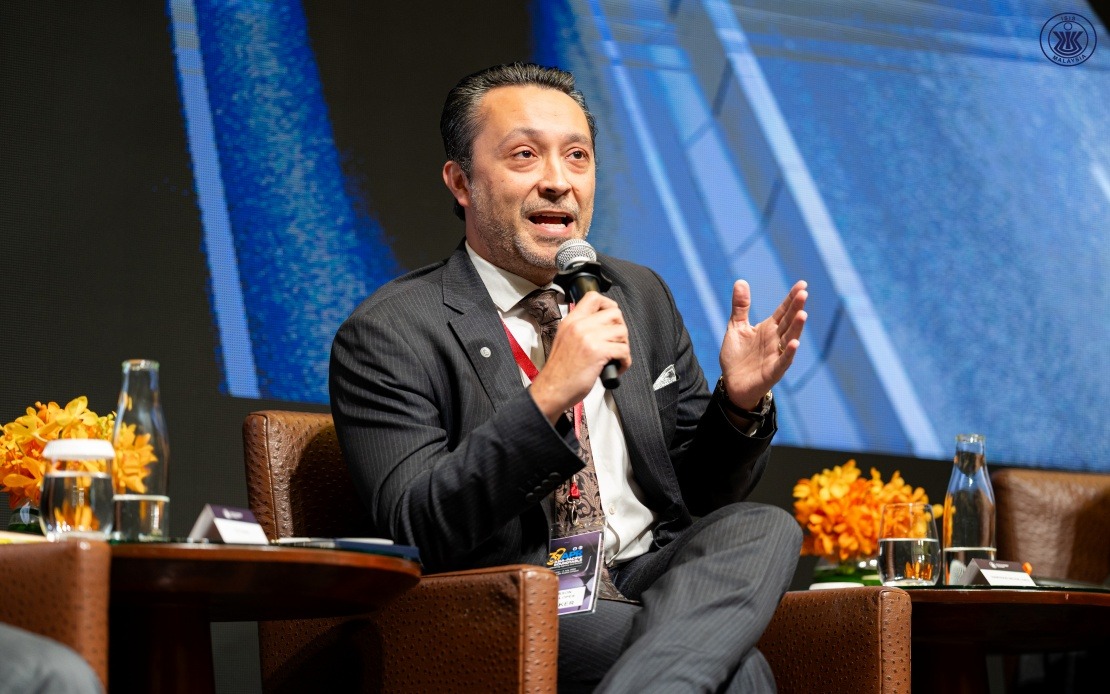
Emerging middle powers including Malaysia, Brazil, India, Indonesia, Turkiye, and Mexico should pursue independent strategic courses tailored to their own interests rather than defer to the priorities of established middle powers, as the international system enters a period of profound restructuring. This assertion emerged from discussions at the 39th Asia-Pacific Roundtable, the two-day conference organised by the Institute of Strategic and International Studies (ISIS) Malaysia, where leading international relations scholars examined the shifting dynamics of global power and the opportunities available to rising nations.
Dr Dawisson Belém-Lopes, a professor of international and comparative politics at Federal University of Minas Gerais in Brazil, argued that emerging and established middle powers inhabit fundamentally different political contexts and should not be conflated into a single analytical category. Speaking during the session "Rogue World Order: Power, Principles, and Pragmatism," he emphasised that emerging middle powers, predominantly drawn from Global South nations, have maintained a longstanding unease with the post-World War Two liberal international order. Rather than passively accepting the institutional frameworks and rules established by earlier industrialised powers, these rising nations have persistently advocated for comprehensive reforms that would better reflect contemporary geopolitical realities and address historical grievances.
The distinction between emerging and established middle powers carries significant implications for regional stability and the architecture of future international cooperation. Belém-Lopes highlighted that these two categories possess markedly different historical trajectories and policy priorities. Established middle powers typically benefited from or accommodated themselves to the existing system, whereas emerging economies never fully integrated into post-war structures and retain substantially different perspectives on how global governance should function. This divergence suggests that simply inviting rising powers into existing institutional frameworks may prove insufficient to address underlying tensions and competing visions for international order.
The Global South's accumulated resources and institutional platforms have strengthened considerably in recent years, creating unprecedented opportunities for collective action and negotiation. Belém-Lopes noted that contemporary developing nations possess both material capabilities and multilateral forums that were unavailable to their predecessors. Regional organisations, development banks, and informal coordination mechanisms provide channels through which emerging powers can amplify their influence and coordinate positions on issues ranging from climate change to trade and security. This shift represents a structural change in global politics rather than merely cyclical fluctuations in power distribution.
Peter Varghese, Chancellor of the University of Queensland and former secretary of Australia's Department of Foreign Affairs and Trade, characterised the current moment as one of transition between international orders. The post-war system, historically anchored by American leadership and underpinned by liberal institutions, is gradually losing coherence and capacity to manage global affairs. This erosion stems not simply from decisions made by the current US administration but rather reflects deeper structural transformations that have accumulated over decades. China's economic and military rise, the shift toward multipolarity, the declining appeal of the Washington Consensus among developing nations, and the resurgence of identity-based and cultural considerations in politics all contribute to this fundamental reordering.
Varghese cautioned against overestimating the speed or smoothness of transition to a new multilateral system. Creating functional global governance arrangements requires sustained cooperation, institutional innovation, and agreement on basic principles—all of which remain elusive in an environment characterised by competing visions and deepening strategic competition. While individual nations possess agency and the capacity to shape outcomes, such agency alone cannot generate a functional replacement for the disintegrating post-war order. Instead, Varghese advocated for prioritising regional cooperation and cross-regional frameworks as building blocks toward eventual broader multilateral arrangements. This approach acknowledges the challenges of achieving global consensus while maximising stability and cooperation within manageable geographic areas.
Ken Jimbo, professor of international relations at Keio University in Japan, offered perspective on Asia's enduring centrality to the evolving global order despite significant shifts in American foreign policy priorities. Regardless of rhetorical changes or shifts in strategic emphasis emanating from Washington, the United States will necessarily maintain reliance on regional partnerships to advance its strategic objectives across the Indo-Pacific. Even an America First agenda, which emphasises national interest and reduced global commitments, cannot escape the geopolitical reality that forward-deployed partners and alliances remain essential for managing great power competition and securing vital interests in Asia.
Simultaneously, countries such as Japan continue to depend fundamentally on the maintenance of a free and open rules-based international order for both security guarantees and economic prosperity. Japan's geographic position, resource dependencies, and export-oriented economic model all hinge on unobstructed maritime access, stable trade arrangements, and predictable international law. This creates a nuanced situation where traditional American allies in Asia maintain strong incentives to support institutional frameworks and cooperative arrangements, even as the broader post-war system transforms. Such nations face complex calculations regarding which elements of the existing order merit preservation and which require fundamental revision.
The implications for Malaysia and other Southeast Asian nations merit particular attention given the region's exposed position within great power competition and its substantial economic integration into global trade systems. Malaysia, as an emerging middle power with significant diplomatic experience and economic heft, possesses genuine capacity to shape regional arrangements and participate in negotiations over new institutional frameworks. The nation's membership in various regional and cross-regional organisations, from ASEAN to the East Asia Summit to forums addressing maritime security and economic cooperation, provides platforms for advancing national interests and influencing outcomes.
However, realising this potential requires clearly articulating Malaysia's strategic interests independently rather than defaulting to the positions of either established powers or other emerging nations. The Global South encompass diverse interests and priorities; what benefits Brazil or India may not align with Malaysian objectives. Consequently, careful strategic assessment of each issue in light of Malaysian circumstances—geographic, economic, and security-related—is essential. This approach demands rejecting the false choice between aligning with established powers or automatically supporting other Global South nations, and instead pursuing principled positions grounded in demonstrable national interest.
The emergence of multiple power centres, competing institutional arrangements, and weakened consensus on fundamental principles creates both risks and opportunities for middle-power nations. The risks include unpredictability, potential conflict among great powers that could engulf regions, and possible collapse of trade and financial systems that developing economies depend upon. The opportunities derive from greater flexibility in partnerships, potential to build new coalitions around specific issues, and reduced capacity of any single power to dictate terms unilaterally. Navigating this environment requires sophistication, clear strategic vision, and commitment to strengthening regional frameworks that enhance stability and prosperity.
The 39th Asia-Pacific Roundtable discussions suggest a growing recognition among international relations scholars and policymakers that the post-war global order, while imperfect, provided certain stabilising functions that its successor arrangements have yet to establish. The transition period will likely extend for years or decades, creating an extended interval of uncertainty during which assertive nations can shape outcomes. Emerging middle powers from the Global South, including Malaysia, possess genuine agency in this process. Whether they exercise it effectively depends on clear-eyed assessment of national interests, strategic sophistication in building partnerships and coalitions, and commitment to institutional cooperation that enhances rather than undermines regional and global stability.

