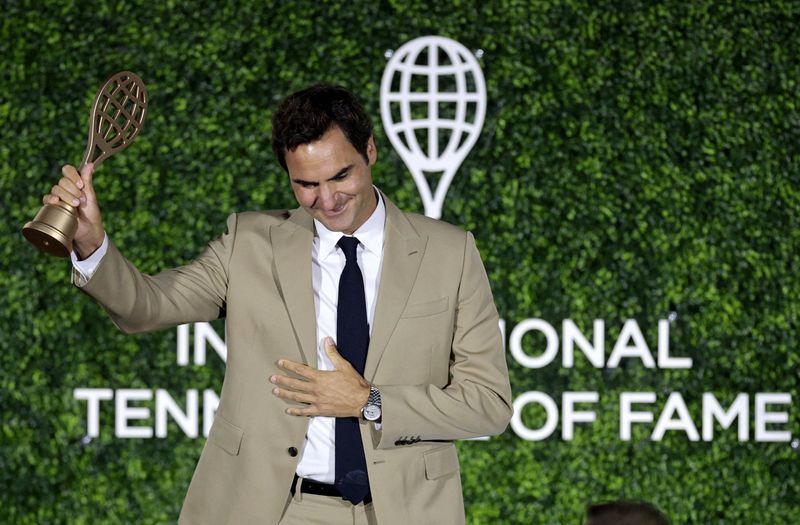
Roger Federer's induction into the International Tennis Hall of Fame in Newport, Rhode Island, proved to be an emotional milestone for the Swiss champion, who used the occasion to express profound gratitude for a sport that has defined four decades of his life. Alongside broadcaster and journalist Mary Carillo, Federer was formally recognized for a career that fundamentally changed the landscape of professional tennis and set new standards for athletic excellence and sportsmanship.
During his acceptance speech, the 45-year-old 20-time Grand Slam champion repeatedly emphasized that his pursuit had never been driven by the trappings of fame or celebrity. Instead, Federer articulated a philosophy centered on the sheer joy of competing, the relationships forged through tennis, and the constant drive to innovate within the sport. His remarks revealed a player who viewed his professional journey as inseparable from his personal growth and the bonds he shared with fellow competitors and supporters. The distinction between achievement and purpose became a recurring theme, with Federer stressing that winning tournaments, while significant, represented only part of what made his career meaningful.
Federer's competitive achievements remain staggering by any measure. His eight Wimbledon titles stand as a men's record, a testament to his mastery of grass-court tennis and his ability to adapt his game across multiple surfaces and eras. Beyond the grass courts of Southwest London, he claimed six Australian Open championships, five U.S. Open titles, and a single French Open crown. The consistency required to reach world number one and maintain that ranking for 310 weeks underscores the relentless dedication that sustained his career from the late 1990s through his retirement in 2022. By the time he stepped away from professional competition, Federer had accumulated 103 ATP Tour titles, cementing his status among the greatest players in tennis history.
What distinguished Federer's approach to the game extended well beyond raw statistics and trophy counts. His signature playing style emphasized elegance, creativity, and a willingness to attempt unconventional tactics that challenged the increasingly formulaic nature of professional tennis. During his career, he famously wore more than 5,000 headbands, becoming visually synonymous with precision and style on court. His serve-and-volley technique, willingness to play from behind the baseline and transition aggressively toward the net, and his occasional deployment of the SABR—the Sneak Attack by Roger—demonstrated a player unafraid to take calculated risks and entertain audiences. These tactical innovations reflected a deeper commitment to pushing tennis forward rather than simply executing a defensive game plan.
The personal toll of such a demanding career was evident in Federer's emotional remarks about those who supported him throughout his journey. His tears during the ceremony reflected genuine appreciation for the coaches, medical professionals, and family members whose contributions proved essential to sustaining his performance across four decades. His wife Mirka received particular recognition, with Federer acknowledging that her influence extended far beyond tennis, shaping the kind of husband, father, and friend he strived to be. This acknowledgment highlighted a dimension of Federer's character that transcended his identity as a competitor, suggesting that his Hall of Fame induction represented recognition not merely of a tennis player but of a person who used his platform responsibly.
Federer's reflection on representing Switzerland during his induction carried poignant personal significance. He reminisced about watching tennis as a 13-year-old ball boy in Basel, revealing how that formative experience sparked a lifelong passion that would eventually lead him back to represent his nation at the highest levels of competition. This connection to his roots underscored the organic nature of his journey from aspiring young player to global ambassador for the sport. His pride in bringing Switzerland's name into the Hall of Fame alongside his own reflected an understanding that individual achievement gains deeper meaning when connected to national heritage and childhood inspiration.
Crucially, Federer's speech shifted from retrospective celebration toward forward-looking counsel for the next generation of professional players. He expressed genuine hope that emerging competitors would maintain the spirit of amateurism—the pure love of the game—even as professional tennis continues to accelerate in pace and globalize in scope. His encouragement for younger players to stay authentic, ask challenging questions, and take creative risks suggested a concern that the professionalization and commodification of tennis might threaten the qualities that originally attracted him to the sport. These remarks carried implications for tennis development across Asia and Southeast Asia, where rapidly growing player bases increasingly focus on rankings and commercial success.
Federer's vision for tennis's future emphasized continuous evolution and the pursuit of innovation that he himself embodied throughout his career. He urged contemporary and future players to push boundaries, attempt tactical approaches never previously attempted, and resist complacency even as they achieve success. This philosophy suggested that the highest form of competition involves not merely winning matches but advancing the sport itself through creative experimentation. For Malaysian and Southeast Asian tennis communities, Federer's emphasis on maintaining camaraderie among players and avoiding pure calculus-driven competition models offered valuable perspective on how to develop the sport locally while respecting its global standards.
The Hall of Fame induction also served as an occasion for Federer to reflect on the privilege of competing across multiple generations of tennis players. His career spanned encounters with Andre Agassi and Lleyton Hewitt during his early years, through his iconic rivalries with Andy Roddick, Rafael Nadal, and Novak Djokovic. This cross-generational experience positioned him uniquely to observe how the sport evolved in terms of athleticism, technology, and global representation. His respect for players who came before and alongside him suggested that true greatness involves acknowledging the contributions of others and understanding one's place within tennis's broader historical arc.
Federer's repeated assertion that his time as an active player had concluded, yet that his relationship with tennis remained evolving and incomplete, captured the complexity of stepping away from elite competition. His declaration that he remained "still writing my love letter to tennis" suggested that retirement from professional play represented a transition rather than a conclusion. By framing his Hall of Fame induction not as an endpoint but as a threshold toward new engagement with the sport, Federer signaled that meaningful connection to tennis extends far beyond playing in tournaments. This perspective offers reassurance to aging athletes facing retirement and hints at the multiple ways retired professionals can remain meaningfully engaged with their sports.
For Malaysian and broader Southeast Asian audiences, Federer's induction carries significance beyond mere recognition of historical achievement. His example of sustained excellence, elegant competition, and commitment to the sport's integrity provides a template for how professional tennis can be practiced with respect for opponents, fans, and the game itself. As tennis development initiatives expand across the region, Federer's emphasis on maintaining authenticity, camaraderie, and the amateur spirit offers valuable counterbalance to purely results-oriented approaches. His Hall of Fame recognition celebrates not only what he accomplished but how he accomplished it, affirming that the manner of one's pursuit ultimately defines its meaning.

