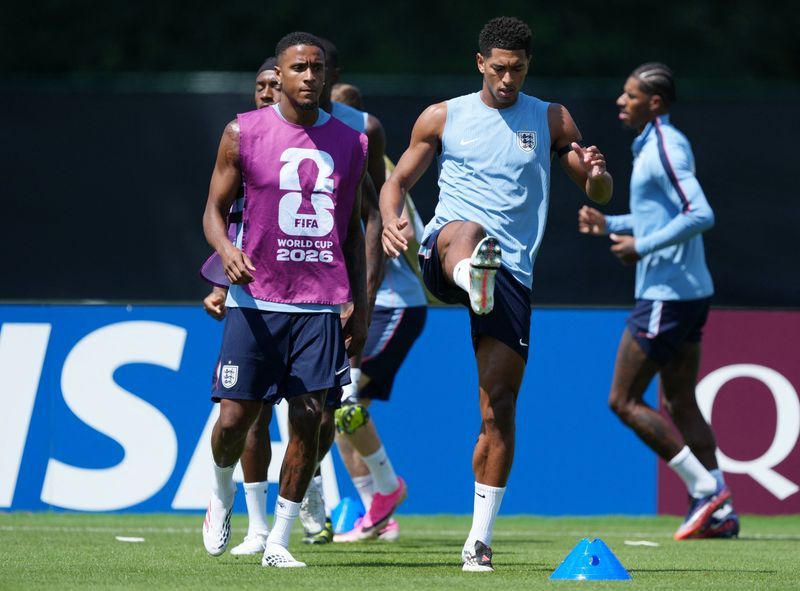
England's players are presenting a picture of unwavering internal cohesion as they prepare to face Argentina in a World Cup semi-final in Atlanta. The three-time European champions have consolidated their group spirit following their quarter-final victory over Norway, where midfielder Jude Bellingham's two-goal performance proved decisive in a 2-1 extra-time win. Despite the on-field success, the match's aftermath generated considerable discussion about managerial philosophy, with Thomas Tuchel expressing disappointment with aspects of the team's performance while Bellingham responded by questioning the coach's understanding of the pressures inherent in elite competition. Rather than allowing such divergence to fracture the squad, defenders Ezri Konsa and Marc Guehi suggested this moment has instead strengthened collective resolve ahead of the Wednesday fixture.
Konsa addressed the persistent media narrative surrounding the team during pre-match comments in Atlanta, acknowledging that external scrutiny represents an inevitable element of playing at international level. The Aston Villa defender argued that experienced professionals must develop the psychological capacity to filter out distracting commentary and concentrate on their immediate objectives. He characterised the current squad environment as exceptionally harmonious, with no underlying tensions or interpersonal difficulties threatening to undermine their campaign. This assessment carries particular weight given England's history of dealing with fractious dressing rooms during major tournaments, making Konsa's testimony noteworthy for regional readers familiar with the English team's occasional struggles with internal management.
Guehi's perspective offered deeper insight into the impact of Tuchel's leadership since the German took charge. The Crystal Palace centre-back articulated how the manager has cultivated an atmosphere that combines high-energy engagement both during training and in social settings, while fostering genuine belief in the team's tactical approach and ultimate objectives. Guehi contended that players across the squad have bought into Tuchel's vision and methodology, creating an environment where individual ambitions align with collective purpose. The defender concluded that the events following the Norway match, rather than creating division, have paradoxically strengthened the group's coherence and determination.
When Tuchel was subsequently informed of his players' testimonials during his own press conference, the manager expanded on his philosophical approach to team management. He characterised his primary contribution as reinforcing the fundamental principle that football remains fundamentally a collaborative endeavour rather than a platform for individual brilliance. Tuchel noted that across the broader World Cup tournament, he had observed a widespread pattern of elite players subordinating personal achievement to team requirements and national pride. This observation carries significance for Malaysian observers following a tournament that has demonstrated how organisational coherence often determines outcomes as decisively as technical ability.
Tuchel's assessment of his squad's mentality focused on their resilience and refusal to capitulate when facing adversity. The German manager characterised the team's determination as their defining attribute, suggesting that their capacity to maintain intensity and purpose throughout matches represents the foundation of their competitive strength. He emphasised that this psychological resilience develops through sustained work away from public view, indicating that the squad's internal cohesion reflects consistent reinforcement of shared values rather than superficial unity.
England's progression to the semi-final stage now positions them for a potential final rematch against Spain, who advanced past France with a 2-0 victory on Tuesday evening. A repeat of the Euro 2024 final, which Spain won decisively, would represent the tournament's most significant narrative arc. However, the immediate focus remains on Argentina, the defending champions and among the tournament's most formidable opponents. Argentina's presence in the semi-finals underscores the quality of opposition England must overcome to advance further.
The logistical demands of international football were apparent in Guehi's casual mention that he had slept through Spain's impressive semi-final performance during England's flight from their Kansas base to Atlanta. Such mundane details illustrate the compressed schedules and geographical challenges that modern World Cup tournaments impose on competing nations. For Malaysian audiences accustomed to their national team's relatively limited resources, the infrastructure surrounding major footballing nations provides instructive contrast.
The cohesion that England's leadership describes represents a departure from tournament cycles when internal friction or philosophical disagreements between manager and players have destabilised campaigns. The apparent ease with which Bellingham's public questioning of Tuchel has been absorbed into the squad narrative suggests a more mature group dynamic than previously characterised English tournaments. Whether this unity proves sufficiently robust when facing Argentina's renowned intensity and experience will determine England's progression toward potential glory.
For Southeast Asian observers, England's approach to managing internal dynamics offers commentary on contemporary football culture more broadly. The willingness of elite players to subordinate ego to collective purpose contradicts certain stereotypes about individual-driven Western sports culture. Tuchel's insistence on team-first mentality and his players' apparent embrace of this philosophy demonstrates how top-level football organisations balance individual excellence with collaborative structure, a lesson potentially instructive for developing football nations throughout the region.

