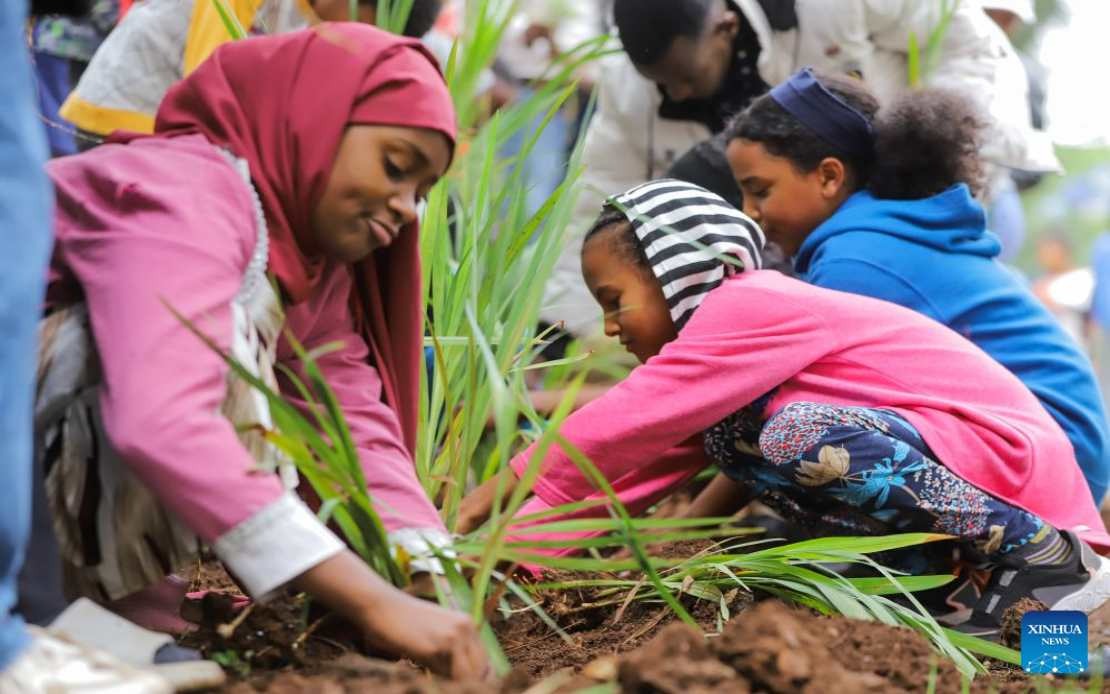
Ethiopia mounted an ambitious environmental push on Monday as millions of citizens and foreign residents participated in a coordinated tree-planting exercise designed to establish a new continental record. The campaign targeted the planting of 800 million seedlings across the East African nation in just one day, representing a landmark moment in the country's struggle against environmental degradation and forest loss. Organizers mobilized participants from all walks of life, from schoolchildren to healthcare professionals, reflecting the government's determination to embed reforestation as a national priority embedded in the cultural consciousness.
The event represents the latest chapter in Prime Minister Abiy Ahmed's Green Legacy Initiative, a signature environmental programme that commenced in 2019. What began as an innovative policy response to Ethiopia's deforestation crisis has evolved into an annual ritual that captures public imagination and demonstrates the potential for mass mobilization around environmental causes. This year's campaign is particularly significant because it forms part of a broader effort to plant more than 8 billion seedlings during the current rainy season, substantially accelerating the country's reforestation timeline and bringing it closer to an audacious long-term target of 50 billion trees.
The participation rates underscore how deeply the initiative has penetrated Ethiopian society. Edilawit Legesse, a thirteen-year-old from the Alembank neighbourhood outside Addis Ababa, exemplified this grassroots engagement by marking her third consecutive year of participation in the annual planting exercise. Despite her youth, Legesse approached the task with visible enthusiasm and commitment, having waited eagerly with her family and community members for the opportunity to contribute to the nation's greening efforts. Her willingness to return year after year suggests that the initiative has succeeded in creating a sense of collective ownership and intergenerational responsibility for environmental restoration.
At planting sites throughout the capital and surrounding regions, professional and volunteer participants demonstrated the breadth of support for the campaign. At a location near Entoto Mountain, nursing staff from local healthcare facilities organized themselves into coordinated teams, with individual nurses committing to plant between ten and more seedlings during the single-day effort. The participation of healthcare workers and other urban professionals reflects how the initiative has transcended rural constituencies and agricultural communities to embrace metropolitan centres and diverse occupational groups. This horizontal integration across social categories amplifies the symbolic power of the campaign beyond its immediate environmental outcomes.
The scale of Ethiopia's ambition must be understood within the context of the nation's severe environmental challenges. Deforestation has historically devastated the Ethiopian landscape, with forest cover declining dramatically over recent decades due to agricultural expansion, charcoal production, and unsustainable land management practices. The resulting ecosystem degradation has compromised water availability, soil fertility, and biodiversity while intensifying the country's vulnerability to climate-related shocks including droughts and erratic rainfall patterns. By positioning reforestation as a mass-participation exercise rather than a technocratic or top-down initiative, the government has sought to reframe environmental restoration as a collective national project rather than a sectoral concern.
Prime Minister Abiy Ahmed has consistently framed the Green Legacy Initiative as more than an environmental programme, emphasizing its role in forging national unity and creating shared purpose. In statements released following his own participation in Monday's planting activities, Abiy highlighted the initiative as an embodiment of Ethiopian values and collective aspiration. His characterization of the campaign as "a moment when Ethiopians from all walks of life come together to create a lasting legacy for generations to come" illustrates how environmental policy has been integrated into the broader national narrative around development and social cohesion. The emphasis on cross-generational responsibility underscores the initiative's framing as something that transcends immediate political cycles.
The trajectory of progress since 2019 indicates the cumulative impact of sustained commitment. With eight years of continuous implementation, the initiative has moved beyond novelty status to become institutionalized within Ethiopian governance and public consciousness. The proposed addition of more than 8 billion seedlings this year alone would bring the total planted under the programme substantially closer to the 50 billion target established at its inception. Achieving such numbers requires not only political will but also sophisticated logistics, reliable seed supplies, and effective coordination across multiple government levels and community organizations. The fact that Ethiopia has sustained this momentum despite the country's multiple concurrent challenges—including conflict, economic pressures, and institutional constraints—demonstrates a genuine commitment to the environmental agenda.
For Southeast Asian observers, Ethiopia's experience offers instructive lessons about scaling environmental initiatives. Many regional governments have launched tree-planting programmes, yet few have achieved the organizational coherence and popular participation visible in the Green Legacy Initiative. The Ethiopian model demonstrates how environmental objectives can be harmonized with social mobilization goals, creating programmes that simultaneously address ecological restoration while reinforcing national identity and intergenerational bonds. The initiative's success in maintaining public enthusiasm across multiple years suggests that sustainability comes not merely from policy frameworks but from embedding environmental action within cultural narratives and popular participation structures.
The initiative also reflects broader African and global shifts in climate policy and environmental governance. As international climate commitments become increasingly stringent, countries are recognizing that forest restoration represents one of the most cost-effective mechanisms for carbon sequestration and climate mitigation. Ethiopia's investment in reforestation aligns with global commitments while addressing domestically urgent environmental imperatives. The programme simultaneously contributes to international climate goals while tackling local water scarcity, soil degradation, and biodiversity loss. This dual functionality—serving both global and local environmental objectives—enhances the programme's resilience and justifies the substantial resource allocation required to maintain it.
The economic dimensions of the initiative warrant consideration as well. Ethiopia's aspiration to develop as a green, lower-middle-income economy depends partly on restoring natural capital and environmental infrastructure. Reforestation generates multiple co-benefits beyond carbon sequestration, including improved watershed protection, enhanced agricultural productivity through improved soil conditions, and potential revenue streams from sustainable forestry and agroforestry systems. By framing tree-planting as an investment in future economic resilience rather than merely an environmental obligation, the government has articulated a compelling development rationale that extends the initiative's appeal across constituencies concerned with economic growth and prosperity.
The success of Monday's campaign will ultimately be measured not merely by the seedlings planted but by their survival rates and the ecosystem recovery they catalyze. Mass planting events generate immediate publicity and public participation, yet long-term reforestation success depends on maintenance, protection against grazing pressures, and adaptive management. Ethiopia's challenge lies in sustaining the momentum generated by one-day campaigns into continuous environmental stewardship and landscape restoration. The involvement of diverse community stakeholders and the embedding of tree-planting within annual civic rituals suggest that the necessary institutional foundations for long-term success may be present. For Ethiopia and for other nations confronting environmental degradation, the Green Legacy Initiative offers a model of how ambitious environmental goals can be pursued through inclusive, nationally-resonant programmes that capture popular imagination while advancing measurable ecological restoration.

