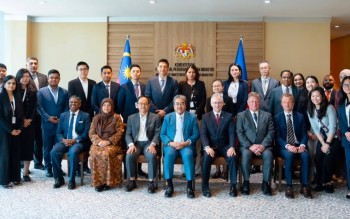
European business leaders representing more than 25 companies converged on Kuala Lumpur this week for an intensive engagement with Malaysian policymakers, signalling renewed momentum in efforts to deepen economic ties between Europe and Malaysia. The three-day visit by the EU-ASEAN Business Council delegation from August 4-6 underscored the bloc's strategic interest in Southeast Asia's largest economy, with discussions spanning government reforms, sustainable development pathways and investment opportunities across multiple sectors.
Chris Humphrey, executive director of the EU-ABC, characterised the visit as an opportunity for European enterprises to obtain direct insights into Malaysia's policy trajectory while demonstrating support for the country's modernisation efforts. The delegation's itinerary reflected a comprehensive approach to bilateral relations, rotating through multiple ministries to address sector-specific opportunities and regulatory challenges. At the Economy Ministry, discussions centred on ongoing reform packages, with European investors expressing confidence in Malaysia's commitment to green transition, circular economy frameworks and digital transformation initiatives.
Finance Ministry engagements shifted focus to the investment ecosystem itself, exploring taxation structures, government procurement pathways and overall business climate conditions. According to Humphrey, these conversations generated substantial positive sentiment about Malaysia's receptiveness to European capital and expertise. The breadth of ministerial engagement—encompassing figures such as Bank Negara Malaysia Governor Datuk Seri Abdul Rasheed Ghaffour and Investment Minister Datuk Seri Johari Abdul Ghani—demonstrated the government's prioritisation of this relationship during a critical period for Malaysia's economic repositioning.
Subsequent interactions with the Natural Resources and Environmental Sustainability Ministry, alongside energy and water transformation officials, revealed European interest in supporting Malaysia's environmental agenda. These discussions carried particular significance given the region's vulnerability to climate impacts and the growing global emphasis on sustainability credentials in trade relationships. European companies indicated readiness to contribute technology, financing mechanisms and operational expertise to accelerate Malaysia's green initiatives, positioning environmental stewardship as a mutual opportunity rather than merely a regulatory compliance issue.
The delegation's remaining planned engagements with customs authorities, agricultural ministries and health sector representatives highlight the diversity of European investment interests. Customs modernisation and anti-illicit trade cooperation emerged as priority areas, with tobacco smuggling identified as a persistent challenge requiring coordinated effort. Healthcare discussions centred on pharmaceutical supply chains, medicine availability and innovative financing models—sectors where European pharmaceutical and medical device companies maintain substantial competitive advantages and operational experience.
Malaysia's strategic positioning as a Southeast Asian hub underpinned the business case presented during the visit. The country's geographic location, advanced infrastructure networks, skilled workforce capabilities and natural resource endowments have rendered it consistently attractive to European investors seeking Asian exposure. These fundamentals, combined with demonstrated commitment to regulatory modernisation and digital advancement, create a compelling investment narrative that the delegation intended to amplify among its member companies upon return.
The most substantive long-term implication emerging from this visit concerns the Malaysia-EU free trade agreement negotiations, which have already progressed through four rounds of discussions. With a fifth round scheduled for September 21-25 in Brussels and a potential sixth round before year-end, both parties are targeting completion by 2027. Humphrey expressed confidence that sufficient momentum exists to achieve agreement within 12 months—a timeline that would position Malaysia advantageously relative to other ASEAN nations in securing preferential European market access. Such an accord would reshape bilateral trade architecture and potentially influence broader ASEAN-EU engagement frameworks.
The quantitative dimensions of the existing economic relationship provide context for the delegation's optimism. In 2025, bilateral merchandise trade reached €48.9 billion, with Malaysian exports comprising €30.3 billion and European sales to Malaysia totalling €18.6 billion. This volume underscores Malaysia's importance as both a supplier to and market for European goods, with sectoral distribution spanning electronics, chemicals, machinery and processed foods. European investment stock in Malaysia had reached €33.1 billion by 2024, reflecting decades of accumulated corporate commitment across manufacturing, finance, telecommunications and services sectors.
For Malaysian readers and policymakers, this delegation visit carries multiple implications. The visible European engagement suggests that international business confidence in Malaysia's reform trajectory remains solid, potentially influencing further foreign direct investment flows during a period of global economic uncertainty. The emphasis on green transition alignment indicates that Malaysia's environmental commitments are being taken seriously by major trading blocs, creating both obligations and opportunities for domestic enterprises positioned to capture regional and global demand for sustainable products and services.
The customs and trade facilitation discussions point to European recognition that Malaysia's competitiveness partly depends on operational efficiency in logistics and cross-border transactions. Collaborative efforts to digitise customs procedures and expedite clearances benefit not only European traders but also Malaysian businesses seeking to improve supply chain responsiveness. The health ministry engagement signals potential European interest in participating in Malaysia's healthcare infrastructure development, a sector facing rising demand as prosperity increases and demographics shift.
Beyond immediate commercial considerations, the visit underscores the importance Malaysia attaches to maintaining diversified great power engagement. As geopolitical competition intensifies globally, deepened economic ties with Europe provide strategic balance and reduce dependence on any single economic bloc. The FTA negotiations, if successfully concluded by 2027, would represent a significant diplomatic achievement and economic accomplishment, potentially catalysing similar agreements with other major trading regions.
The delegation's composition—encompassing companies across manufacturing, services, technology and healthcare—suggests European appetite extends across Malaysia's entire economic spectrum rather than concentrating in traditional sectors. This diversification offers opportunities for Malaysian enterprises across multiple industries to participate in European supply chains, technology transfer arrangements and joint ventures, particularly as companies seek to diversify supply bases away from concentrating risk in single geography.
As negotiations progress toward the September round in Brussels, both sides will need to address remaining contentious issues—likely including intellectual property protections, labour standards, and sectoral market access terms. The positive sentiment conveyed by the delegation during this visit, combined with expressed confidence in achieving agreement, suggests that both parties perceive mutual benefit significant enough to justify compromise on remaining differences. For Malaysia, successful FTA conclusion would represent tangible evidence that reform initiatives are yielding concrete international recognition and economic benefits.

