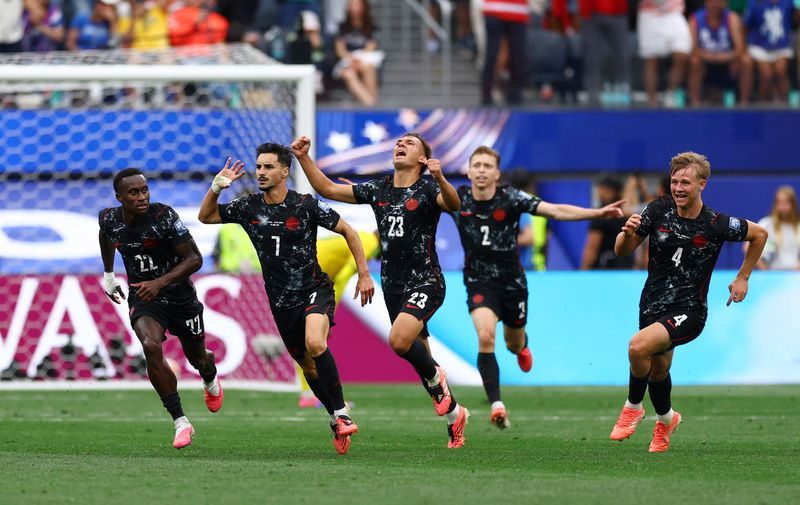
Stephen Eustaquio delivered a moment of pure footballing drama that will define Canadian soccer history, striking decisively in the 92nd minute to secure a 1-0 victory over South Africa and propel his nation into the World Cup knockout stages for the first time. The midfielder received possession near the edge of the penalty area before unleashing a powerful strike that evaded the outstretched hands of diving goalkeeper Ronwen Williams, sending the Canadian supporters who dominated the stands into scenes of jubilation beneath the Los Angeles Stadium skies.
This victory marks a watershed moment for Canadian football. The co-hosts have now progressed beyond the group stage at a World Cup for the first time in three tournament appearances, a achievement that carries profound significance for a nation still building its footballing infrastructure and global competitiveness. The manner of the triumph—through a late, decisive goal rather than a comfortable victory—adds an extra layer of drama to their accomplishment and demonstrates the mental resilience required to compete at sport's highest level.
The match itself was a tense, closely-fought encounter that reflected the relative inexperience of both teams in knockout football. South Africa, competing in their fourth World Cup, were appearing in the final rounds for the first time, while Canada faced their inaugural knockout experience. Neither side dominated proceedings, and the first half offered few clear-cut opportunities as both teams appeared to approach the contest with tactical caution. Canada came closest to breaking the deadlock shortly before halftime when a corner kick sparked chaos in the South African penalty area, with Moise Bombito's header going narrowly wide before Tajon Buchanan's attempt struck Williams directly in the chest.
Controversy nearly overshadowed the opening period when Canadian midfielder Richie Laryea went down in the penalty area under South African pressure, prompting immediate appeals from the Canadian bench and supporters. The referee initially remained unmoved, and a subsequent VAR review upheld the decision to deny a penalty kick—a moment that provoked loud boos from the red-clad Canadian contingent filling the stands. Coach Jesse Marsch visibly protested the decision as teams departed for halftime, illustrating the intensity of the moment and the desperation both nations felt to secure victory.
The second half followed a similar pattern of few genuine scoring opportunities, with South Africa seemingly content to contain Canada's attacking play and carry the contest toward extra time and the potential drama of a penalty shootout. Canada continued to probe for an opening, with Jonathan David narrowly failing to convert when a goalkeeper's save fell loose in the box, only for excellent defensive work to clear the danger before the forward could react. The frustration mounted visibly on the Canadian bench and faces of supporters as the match drifted toward a denouement that seemed destined for the lottery of penalties.
Canada's achievement carries additional context given the demanding circumstances of their passage to this knockout encounter. Having advanced from the group stage for only the second time in their tournament history, the co-hosts were required to play their first knockout match outside Canadian territory, facing the journey to Los Angeles Stadium with merely three days of rest following a disappointing 2-1 group-stage defeat to Switzerland on Wednesday. The physical and mental toll of such conditions could easily have proven decisive against fresher opposition, yet Marsch's squad demonstrated remarkable composure and determination throughout.
Eustaquio's moment of brilliance arrived precisely when Canadian fortunes appeared bleakest. The midfielder's strike in deep stoppage time—timed at the 92nd minute—possessed the kind of power and precision that eliminates all doubt the instant it leaves the boot. The South African goalkeeper's desperate dive could not affect the trajectory as the ball found the net, releasing emotions that had accumulated through ninety minutes of nervous tension. For the Canadian players and their supporters, the goal represented validation of their belief and character throughout an increasingly tense encounter.
In the immediate aftermath, Eustaquio articulated the collective emotion binding his team together. He spoke of continuous belief and momentum, describing how the goal felt like a shared endeavour where every member of the squad contributed invisible energy toward the strike. Coach Jesse Marsch expanded on this theme, acknowledging that Canada had created chances throughout the contest but lacked the clinical finishing required to convert opportunities earlier. The late goal represented not luck but the culmination of persistent pressure and determination, rewarded when the moment mattered most. Marsch's characterization of his players as "Canadian heroes" reflected the historical magnitude of the achievement for a nation with relatively modest soccer credentials compared to traditional powerhouses.
Canada will next contest the knockout stages against either the Netherlands or Morocco on July 4 in Houston, facing opponents with substantially greater pedigree in international football competitions. The Dutch bring a tradition of World Cup success and technical excellence, while Morocco brings African Continental Championship experience and growing global standing. Neither represents a favorable draw for Canada, yet the Canadians have already demonstrated that they belong on this stage and possess the character to compete.
South Africa, meanwhile, must contend with a sense of missed opportunity and a tame exit from the competition. While they achieved the distinction of reaching the knockout rounds for the first time in four attempts, the manner of their defeat—surrendering a late goal to less-vaunted opposition—will sting considerably. The question now surrounds the future of 74-year-old coach Hugo Broos, who indicated cryptically that he would reflect on his position in coming days while confirming this World Cup represents his final tournament at the helm. Whether South African football chooses to rebuild under new leadership or attempt continuity remains uncertain, but the opportunity has clearly passed for this particular team and coaching tenure.
For Malaysian and Southeast Asian football observers, Canada's breakthrough carries instructive lessons about patience, tactical discipline, and the value of gradual development in building competitive national programs. The Canadian achievement demonstrates that nations without deeply-rooted football traditions can reach the sport's highest stages through sustained investment, professional infrastructure, and coaching expertise. As regional federations across Southeast Asia continue to invest in their programs and seek international partnerships, the Canadian model offers evidence that ambitious targets remain achievable across multiple competitive cycles.

