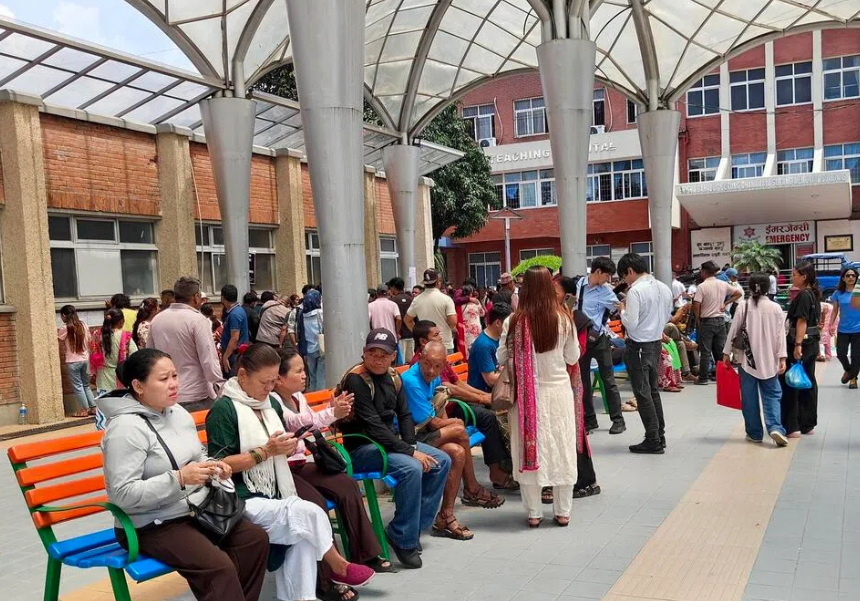
The corridors of Kathmandu's major hospitals have transformed into grim identification centres following Nepal's catastrophic August 26 flash flood, which has claimed more than 500 lives in the northern regions bordering Tibet. Photographs of mangled corpses now line the gates of Tribhuvan University Teaching Hospital (TUTH), creating a haunting scene that underscores the scale of the humanitarian crisis unfolding across the Himalayan nation. The disaster struck without warning in the border region, forcing hundreds of families to embark on desperate searches through the capital's medical facilities, hoping against diminishing odds to locate their missing relatives.
Three days after the catastrophic flooding, the full scope of the tragedy continues to unfold in incremental and heartbreaking revelations. At TUTH, one of Kathmandu's two principal public hospitals, the official missing persons list had grown to exceed 1,500 individuals by late afternoon on August 28, though authorities acknowledge this figure likely understates the true number of unaccounted persons given communication breakdowns across affected districts. Rescue personnel from multiple branches of Nepal's security apparatus—including over 4,400 police officers, the Nepali Army, and the Armed Police Force—have been systematically combing the Bhotekoshi river system and downstream valleys, recovering survivors trapped beneath collapsed structures and within destroyed tunnels. However, the gruelling pace of recovery operations reflects both the geographic vastness of the disaster zone and the sheer complexity of locating individuals across multiple districts.
For those awaiting news, the emotional toll manifests in profoundly human ways. Dolma Tamang, a 36-year-old woman whose sister and brother-in-law disappeared while transporting goods from the Chinese border through Rasuwa district, has spent three consecutive days navigating between hospitals with diminishing hope. Her last contact with them came as they travelled through the affected region on the morning of August 26; their phones have remained silent ever since. Outside TUTH's gates, she joined hundreds of other anxious relatives clutching printed photographs and mobile phone images, scanning the displayed photographs of unidentified remains in anguished recognition. Similarly, Sushila Shrestha, just 23 years old, searches for her younger brother Bir Bahadur, a truck driver who was transporting goods when the flood struck. Though the absence of identified remains provides a fragile thread of hope that he might yet be alive, the uncertainty compounds the psychological burden carried by families across Kathmandu.
The psychological dimension of this crisis extends beyond Nepali citizens, encompassing international tourists and cross-border pilgrims caught in the disaster's path. At least nine Singaporean nationals remain missing following the flooding, whilst approximately 288 Indian nationals are unaccounted for, many of whom were either embarking upon or returning from the sacred Kailash-Mansarovar pilgrimage circuit. This spiritual journey, which carries profound religious significance for Hindu and Buddhist devotees across South Asia, typically routes through Rasuwa district and the Gyirong border crossing between Nepal and Tibet—precisely the areas most devastated by the flash flood. By August 28, the Nepal Tourism Board had confirmed the rescue of 121 foreign nationals, including 85 Indian citizens and 16 Chinese nationals, yet these figures provide minimal solace to families arriving in Kathmandu from across South Asia. A group of men from Tamil Nadu flew into the capital on an early morning flight from New Delhi specifically to search for missing members of their travel group, their expressions reflecting the particular anguish of those separated by distance and national borders from their loved ones.
The scale of infrastructure destruction in downstream areas illustrates why recovery operations face mounting complications beyond the initial search phase. Chitwan district, situated further downstream and celebrated internationally for its national park and elephant sanctuary, suffered particularly severe damage with roads becoming impassable under accumulations of debris and silt. By afternoon on August 28, recovery teams had already discovered 186 bodies in Chitwan alone, yet the district's hospitals possessed combined morgue capacity of merely 30 to 50 bodies—a catastrophic shortfall that forced authorities to seek additional storage facilities and raising urgent questions about dignified treatment of the deceased. Dozens of bridges spanning critical transportation routes across the region were obliterated by the flooding, further complicating both search operations and the delivery of humanitarian assistance to isolated communities. The destruction of the Gyirong Port at the Nepal-Tibet border, captured in widely circulating video footage showing mudslides and torrents of floodwater overwhelming the crossing point, has become emblematic of the disaster's ferocity and has intensified concerns about how many individuals might have been swept away without witnesses or survivors to report their disappearances.
Government response mechanisms have reflected lessons learned from Nepal's experience with the catastrophic 2015 earthquake, a historical event that fundamentally shaped contemporary disaster management philosophy within the nation. Prime Minister Balen Shah explicitly declined multiple international offers to deploy foreign search and rescue teams from countries including China, India, and others, determining that coordination difficulties experienced during the 2015 earthquake made independent foreign operations more hindering than helpful. Rather than welcoming direct foreign deployment, the government has instead prioritised requests for financial assistance channelled through a single coordinated mechanism that officials announced they would establish imminently. This strategic decision reflects institutional learning about crisis management whilst simultaneously placing the burden of coordination entirely upon Nepal's already-strained bureaucratic apparatus during an emergency requiring immediate action and massive resource mobilisation.
International humanitarian response has nevertheless been mobilised, though channelled primarily through material assistance rather than personnel deployment. India initiated the relief effort by transporting 47 tonnes of humanitarian supplies via military aircraft, including temporary shelter systems, blankets, sanitation kits, solar lighting units, pharmaceuticals, and prepared food rations for affected populations. New Delhi additionally extended an offer to provide prefabricated truss bridges to facilitate rapid reconstruction of critical transportation infrastructure, recognising that bridge destruction represents a primary constraint on access to affected communities and continuation of rescue operations. These gestures, whilst materially significant, underscore the complex interdependencies between South Asian nations and the manner in which natural disasters transcend political boundaries and necessitate coordinated regional responses. The scope of required reconstruction and rehabilitation will demand sustained international engagement, with government sources indicating that formal approaches to international agencies and bilateral partners would follow once immediate crisis response priorities became more manageable.
The logistics of the ongoing crisis extend beyond the visible humanitarian dimensions into complex administrative challenges that remain partially invisible to families searching desperately for their relatives. Nepal's security agencies have established a government website where names of rescued individuals are systematically updated, providing at least a mechanism through which families might verify survival status. Yet this system's utility remains constrained by communication breakdowns across affected districts, incomplete recording of rescued persons' identities in chaotic circumstances, and the ongoing uncertainty surrounding hundreds of individuals who may be trapped in remote locations awaiting discovery. On the morning of August 28, rescue operations momentarily paused following concerns that a barrier lake formed by debris damming might breach and trigger a secondary flash flood of potentially catastrophic proportions. Though officials subsequently determined that no immediate danger existed, the resumption of rescue operations proceeded within an atmosphere of continued uncertainty, with conditions on the ground remaining fundamentally unpredictable and dangerous even for experienced emergency personnel.
The human cost extends beyond mortality figures to encompass profound psychological trauma among survivors, bereaved families, and rescue workers navigating scenes of devastating destruction. Bikesh Shrestha, a 35-year-old man searching for his missing cousin Rakesh Shrestha, found himself unable to examine the photographs of deceased individuals displayed at TUTH despite his desperate need for information. His emotional fragility—manifesting in self-hugging and an inability to maintain composure—represents one of countless individual tragedies playing out across Kathmandu's hospital system. Conversely, some families maintain hope sustained by the simple fact that their relatives' names have not yet appeared among identified deceased. Sushila Shrestha's conviction that her brother remains alive, grounded in the absence of contradicting evidence, demonstrates how uncertainty itself becomes both burden and source of desperate optimism. These psychological dimensions of catastrophe often receive insufficient attention in quantitative assessments of disaster impact, yet they fundamentally shape how communities process trauma and mobilise for recovery in subsequent months and years.

