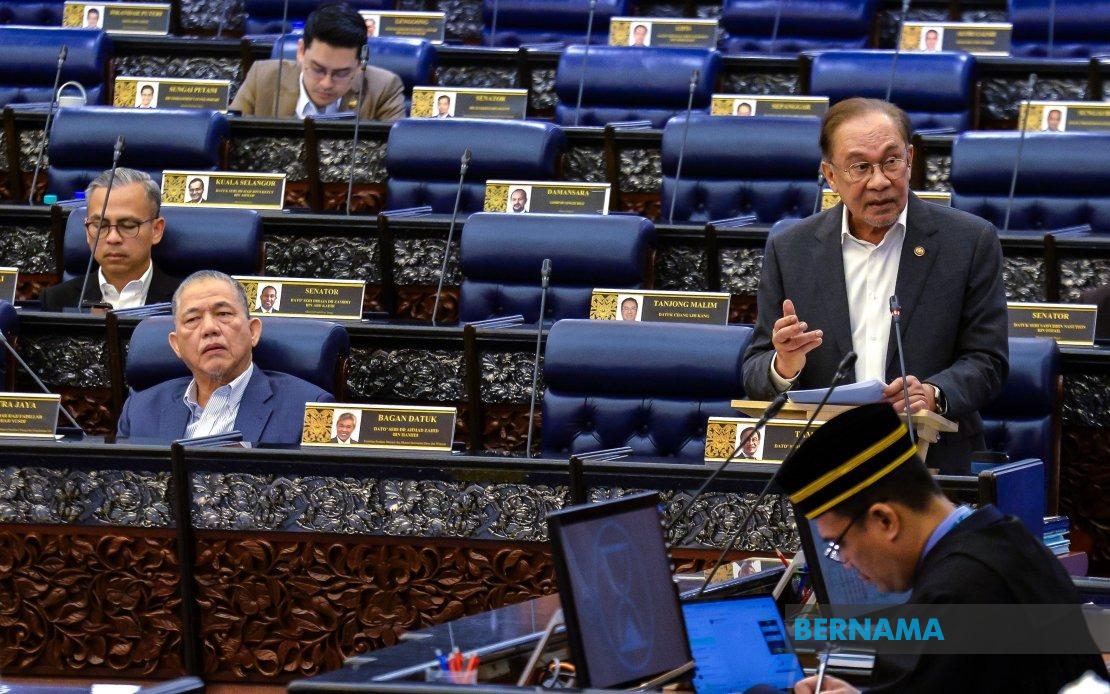
Prime Minister Datuk Seri Anwar Ibrahim has clarified that the federal government's distribution of state allocations operates on a needs-based framework rather than a system pegged to individual states' tax contributions. Speaking during parliamentary question time on June 30, he underscored that the vast majority of Malaysian states benefit from federal support exceeding their own tax revenue generation. The explanation comes as the government continues to address perceptions of unequal or inadequate funding to certain state administrations, a concern that periodically surfaces in the political discourse surrounding fiscal federalism in Malaysia.
Under the current allocation system, only Selangor and Penang generate tax revenues that exceed the federal funding they receive, reflecting their stronger economic bases and urbanisation. Anwar emphasised that this arrangement is neither discriminatory nor reflective of government indifference toward any state, but rather a deliberate policy choice grounded in addressing specific developmental gaps across the nation. The approach recognises that poorer and less developed states require proportionally larger investments to narrow regional disparities and meet basic infrastructure and service needs.
The Prime Minister itemised the criteria guiding federal resource allocation, demonstrating the breadth of needs-driven considerations. These include targeted investments in flood mitigation infrastructure, particularly relevant given Malaysia's vulnerability to seasonal inundation in several states; the systematic upgrading of the Pan Borneo Highway, a major development corridor spanning Sarawak and Sabah; construction and maintenance of new road networks connecting underserved communities; enhancement of water drainage and sewerage systems in both urban and rural settings; programmes aimed at reducing poverty headcount in lower-income states; and substantial outlays on educational facilities and human capital development infrastructure. This multifaceted approach reflects the government's view that equitable development requires tailored solutions rather than uniform formulas.
Anwar's emphasis on comparison with the previous administration signals a political dimension to the allocation narrative. The MADANI Government has prioritised states such as Kedah, Terengganu and Kelantan with significantly enlarged budget allocations, Anwar noted, positioning this as evidence of the current administration's commitment to addressing historical imbalances. This framing matters in Malaysian politics, where state governments controlled by different ruling coalitions sometimes contend they face disadvantageous treatment. By highlighting increases to states regardless of their political affiliation, Anwar sought to position the present government as above partisan considerations in fiscal distribution.
The question that prompted Anwar's response, raised by Datuk Seri Doris Sophia Brodi of GPS representing the Sarawak state seat of Sri Aman, touched on long-standing grievances about the perceived inadequacy of federal support relative to tax contributions. This tension between states' revenue generation and their federal allocations reflects deeper questions about Malaysia's fiscal federalism architecture and the redistribution mechanisms embedded within the federal system. In Sarawak's case, this debate carries particular weight given its substantial oil and gas revenues, which have historically been a source of friction in federal-state financial relations.
The needs-based allocation methodology employed by Kuala Lumpur aligns broadly with international development practice, where backward regions receive enhanced support to promote convergence and reduce spatial inequality. However, wealthier and more developed states sometimes view this approach as inadequately rewarding their economic contributions and productivity. The tension between equity in distribution and horizontal fiscal imbalance represents a persistent challenge in Malaysia's federal governance structure. Anwar's parliamentary statement represents an attempt to reframe this debate, suggesting that current allocation patterns reflect conscious policy rather than inadvertent oversight or discriminatory intent.
For Malaysian readers and observers of regional governance, the allocation formula underscores broader questions about how federal systems balance development equity with fiscal incentives for economic productivity. The government's position, as articulated by Anwar, holds that national prosperity is best served by investing in infrastructure and human capital across all states, particularly in regions facing developmental challenges. This contrasts with arguments that fiscal transfers should more closely mirror revenue generation, which would concentrate resources in already-advanced states. The current debate in Parliament reflects these competing philosophies within Malaysia's ongoing fiscal federalism dialogue.
Anwar's rebuttal also carries implications for state-federal relations more broadly. By transparently listing the specific developmental priorities guiding allocation decisions, the government attempts to move beyond perception-based criticism toward substantive discussion of needs assessment and project prioritisation. However, the effectiveness of this approach depends partly on whether state governments and opposition figures accept the framework itself, or whether they continue challenging the underlying premise that need-based distribution rather than revenue-based sharing represents the appropriate allocation principle.
The statement reflects growing attention to federal-state fiscal tensions as Malaysian states seek greater financial autonomy and clearer commitments regarding development support. The MADANI Government's emphasis on transparency regarding allocation criteria suggests an effort to depoliticise what has traditionally been a contested area of Malaysian federalism. Whether this rhetorical shift translates into enhanced confidence among state administrations and opposition lawmakers remains uncertain, but Anwar's parliamentary intervention signals that the government intends to actively defend its allocation philosophy rather than allowing alternative narratives to dominate discussion of federal fiscal policy.

