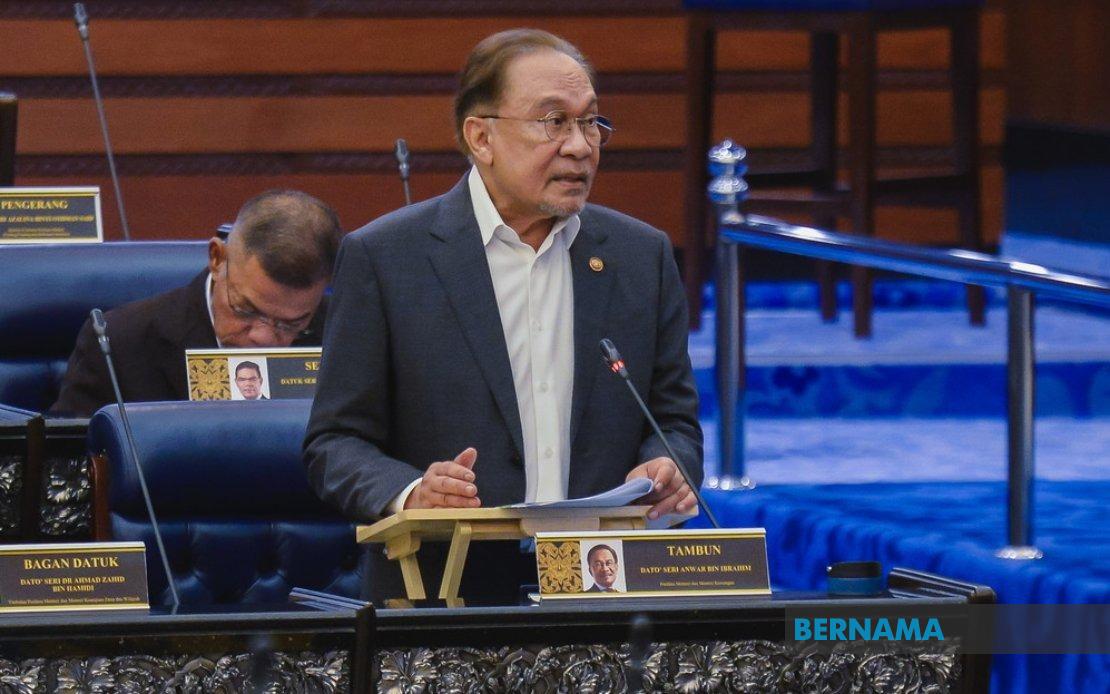
Prime Minister Datuk Seri Anwar Ibrahim has drawn a firm line on federal financial responsibility, declaring that state governments cannot expect automatic approval for additional funding whenever development projects encounter cost overruns. Speaking in Parliament on June 30, Anwar emphasised that any request from a state for extra money to cover a Notice of Change (NOC) must be formally renegotiated with the Federal Government before any additional allocation or loan can be considered.
The Prime Minister's statement addresses a critical issue in Malaysia's federal fiscal architecture: the tension between state autonomy in project management and federal oversight of budgetary commitments. When a Notice of Change is issued on a construction or development contract, it typically signals that project costs have escalated beyond original estimates. Anwar made clear that such situations trigger automatic obligations on the Federal Government to reassess rather than simply rubber-stamp state requests.
Anwar outlined the systematic approach the Federal Government now requires. First, authorities must establish the root cause of any cost increase and determine what role the contractor played in driving up expenses. This investigation is crucial because different causes demand different responses—a contractor's error or poor performance carries different implications than unforeseen market conditions or genuine scope changes. Second, once additional funding becomes necessary, the Federal Government cannot be treated as merely a backup funding source whenever costs escalate. The PM stressed that the Federal Government cannot be bound by decisions made solely by state administrations and compelled to provide extra money automatically.
The remarks came in direct response to a parliamentary question from Datuk Awang Hashim, member for Pendang representing Perikatan Nasional, regarding Kedah's request for additional funding for the Pulau Bunting Water Treatment Plant project. This specific case exemplifies the broader challenge facing Malaysia's infrastructure development: balancing the need to complete essential services with prudent fiscal management. Water treatment plants are critical infrastructure, yet cost overruns must not become embedded in project management culture.
This policy position reflects broader federal governance principles that have gained prominence under Anwar's administration. By requiring renegotiation rather than automatic approval, the Federal Government signals that it will not absorb inefficiencies or enable poor project planning at the state level. The approach creates accountability mechanisms whereby states must justify each increment and demonstrate that cost increases are legitimate and unavoidable rather than symptomatic of poor initial estimation or weak project oversight.
The implications for state administrations across Malaysia are significant. Infrastructure projects funded through federal-state partnership arrangements will now face stricter scrutiny. States cannot budget with the assumption that the Federal Government will bridge every funding gap. This necessitates more rigorous initial cost estimation and stronger project management on the ground. For states with limited capacity to assess construction costs accurately, this policy may mean seeking external technical expertise or renegotiating with contractors more carefully upfront.
The water sector carries particular importance for Malaysia's development agenda. Water security remains a critical challenge for several states, including Kedah, which faces seasonal supply pressures. However, Anwar's stance indicates that urgency around service delivery will not override fiscal discipline. The Pulau Bunting Water Treatment Plant serves Kedah's communities, yet the Federal Government's position suggests that completion cannot justify unlimited financial commitments without fresh assessment of how costs increased.
Anwar delegated detailed explanation to Deputy Prime Minister and Energy Transition and Water Transformation Minister Datuk Seri Fadillah Yusof, signalling that the Energy and Water Ministry will develop implementing guidelines for how such renegotiations proceed. This coordination between the Prime Minister's office and the relevant ministry ensures consistency in policy application across multiple state-level requests. The approach demonstrates institutional coordination in federal fiscal governance.
For Malaysian readers and regional observers, this policy reflects a maturing approach to infrastructure finance in a middle-income economy. Malaysia cannot afford unlimited cost escalation in state-level projects if it aims to maintain fiscal sustainability and manage federal debt. Southeast Asian countries facing similar infrastructure challenges will watch how Malaysia implements this principle, as the region grapples with balancing growth ambitions against fiscal constraints.
The statement also carries implications for federal-state relations during Malaysia's ongoing governance transition. By establishing clear rules about financial responsibility, the Federal Government reduces scope for political disputes or accusations of favouritism. States run by all political parties now operate under the same framework, which enhances transparency in resource allocation. This clarity helps prevent situations where federal funding becomes a tool for political bargaining or reward.
Looking forward, state governments will need to strengthen their project management capacity and contractor oversight to avoid the cost escalations that trigger renegotiation. The policy incentivises better planning, more competitive tendering processes, and stronger on-site monitoring. States that consistently produce accurate cost estimates and manage contractors effectively will have smoother funding relationships with the Federal Government than those that generate repeated cost-increase requests.

