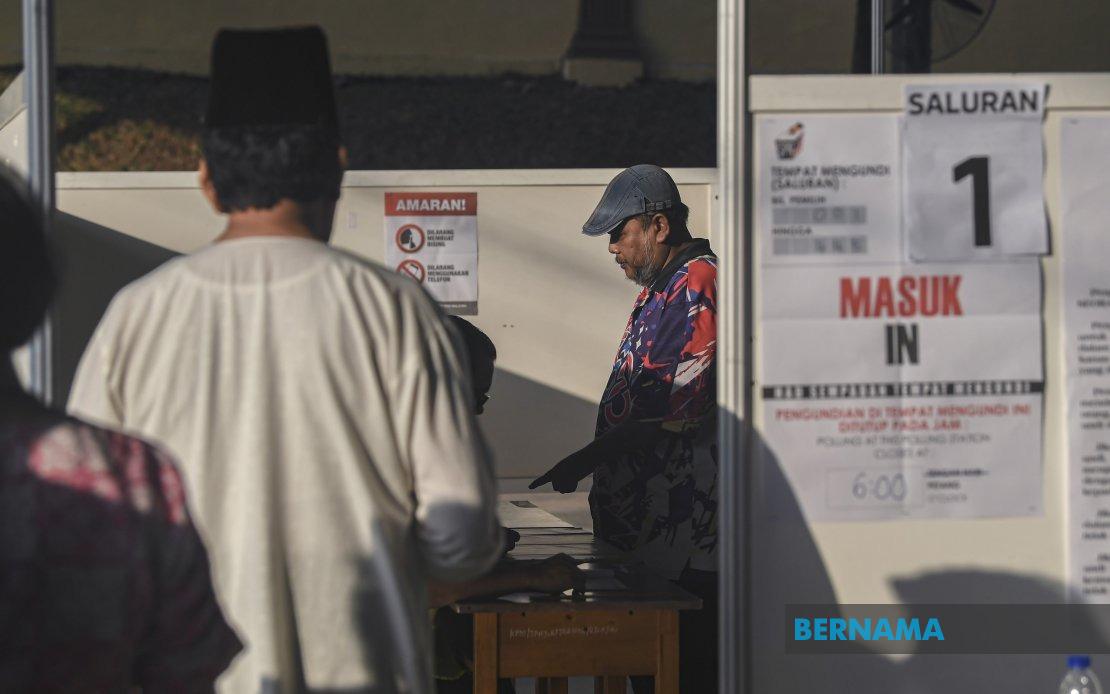
A cross-section of the federal government's Cabinet demonstrated their commitment to the electoral process by voting in the 16th Johor State Election held on July 11, with polling centres operating across the state from 8 am to 6 pm. The participation of sitting ministers underscored the significance of the contest, which determines the composition of Johor's state assembly and government for the coming term. The staggered arrival of high-ranking officials at various polling stations throughout the morning highlighted the broad geographic spread of voting locations and the government's efforts to ensure accessibility across the state's diverse communities.
Datak Seri Azalina Othman Said, the Minister in the Prime Minister's Department (Law and Institutional Reform), was among the first federal leaders to cast her ballot, visiting Sekolah Kebangsaan Bandar Penawar in Pengerang at 8.15 am. Her early participation sent a symbolic signal of institutional commitment to the electoral process. Approximately fifteen minutes later, Defence Minister Datuk Seri Mohamed Khaled Nordin fulfilled his voting obligation at Sekolah Kebangsaan Rinting 1 in Masai, exercising his rights as a registered voter despite his demanding portfolio.
Other significant figures in the federal administration also made their way to polling stations during the morning hours. Plantation and Commodities Minister Datuk Seri Dr Noraini Ahmad voted at Sekolah Menengah Kebangsaan Dato' Onn in Batu Pahat at 8.50 am, bringing attention to southern Johor's electoral participation. Deputy Works Minister Datuk Seri Dr Ahmad Maslan cast his ballot somewhat earlier, at 8.40 am, at Sekolah Kebangsaan Seri Bahagia in Benut, demonstrating that even officials responsible for critical infrastructure projects prioritized their civic duties. The presence of these officers across different districts also reflected the interconnected nature of federal-state governance in Malaysia's constitutional framework.
The participation extended across ministerial portfolios, with Deputy Communications Minister Teo Nie Ching voting at Sekolah Jenis Kebangsaan Cina (SJKC) Kulai Besar at 9.30 am, just ten minutes after arriving at the polling centre. Her presence at a vernacular school underscored the state election's role in representing Malaysia's diverse communities and the importance various government representatives attach to multicultural inclusion within the democratic process. The choice of polling venues by these officials, spanning Malay-medium schools and Chinese vernacular institutions, reflected the demographic complexity of Johor's electorate.
The scale of the electoral operation proved substantial, with a total of 1,076 polling centres operating simultaneously across Johor. These centres contained 4,889 individual polling streams, creating a logistical framework designed to accommodate approximately 2.7 million registered voters. The opening of all polling stations at the identical time of 8 am ensured a coordinated and fair electoral process, preventing any geographic advantages or disadvantages in campaign momentum. This simultaneous approach has become standard practice in Malaysian elections, reflecting lessons learned about maintaining uniformity and public confidence across dispersed voting locations.
The election followed a fourteen-day campaigning period that concluded at midnight on July 10, after which political parties and candidates were prohibited from canvassing or promoting their positions. This cooling-off period reflects Malaysia's regulatory framework aimed at ensuring voters make decisions based on comprehensive information rather than last-minute emotional appeals. The transition from campaigning to voting represented a crucial institutional moment where democratic processes moved from persuasion to choice, from rhetoric to action.
For Malaysian voters and observers, Johor's state election carries particular weight within the federation's political landscape. As one of Malaysia's largest and most economically significant states, developments in Johor's governance influence national political dynamics and economic policy directions. The participation of federal ministers and their deputies signals that the central government regards the outcome as consequential for broader policy implementation and political stability. This electoral contest provides insight into voter preferences and emerging political alignments that may reshape parliamentary mathematics at the national level in subsequent electoral cycles.
The 2.7 million registered voters exercising their franchise in Johor represent one of the largest state electorates in Malaysia, making this contest a meaningful barometer of public sentiment across diverse socioeconomic and demographic groups. The state's mix of urban, suburban, and rural constituencies presents a microcosm of Malaysian society, encompassing industrial zones, agricultural regions, and rapidly developing urban centres. The voting patterns evident in this election frequently offer early indicators of broader electoral trends that may manifest in future general elections.
The administrative coordination required to manage voting across 1,076 centres involving nearly 5,000 polling streams demonstrates the institutional capacity developed by Malaysian electoral authorities over decades of democratic practice. The participation of senior government figures as ordinary voters, rather than in official capacities, reinforces the principle that all citizens stand equal before the ballot regardless of rank or position. This symbolic equality, combined with transparent polling procedures, helps sustain public confidence in electoral integrity and democratic legitimacy.

