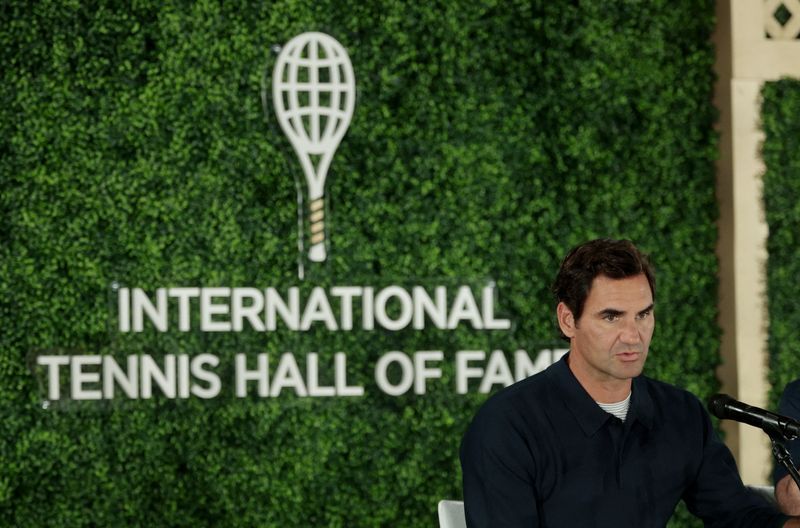
Roger Federer used his induction into the International Tennis Hall of Fame as an occasion to consider the broader arc of his career and the ways his presence shaped professional tennis beyond the victories that dominate record books. The Swiss legend, now 45, received this recognition alongside broadcaster and journalist Mary Carillo during ceremonies held in Newport on Saturday, marking a milestone that Federer described as fundamentally different from the tangible rewards of his playing years.
The distinction Federer drew between major championship titles and Hall of Fame membership speaks to how contemporary sport figures grapple with legacy. During his competitive life, he accumulated an extraordinary collection of accolades: eight Wimbledon crowns, six Australian Open championships, five U.S. Open trophies, and the 2009 French Open that completed his career Grand Slam. His 103 ATP Tour titles and record 310 weeks at world number one position have rarely been approached by subsequent generations. Yet Federer suggested these metrics, while undeniably impressive, represent only a partial accounting of what he contributed to professional tennis.
Federer's perspective carries particular relevance for Southeast Asian tennis enthusiasts and emerging players throughout the region. His emphasis on structural improvements within professional tennis—prize money distributions at early rounds, better stadium facilities, enhanced support for medical staff and media operations—reflects concerns that have long preoccupied lower-ranked and developing-nation competitors. When Federer highlighted the expansion of earning opportunities beyond major tournaments for players competing in early rounds, he articulated a concern that directly affects emerging markets where tennis infrastructure remains underdeveloped. The ability to earn sustainable income throughout a professional career, not merely through major championship victories, represents a fundamental shift in how tennis accessibility has evolved.
Federer's engagement with governance structures within professional tennis proved as consequential as his on-court performances. Rather than viewing his career solely through the prism of winning, he positioned himself as an advocate who worked alongside ATP leadership, Grand Slam organizers, and player councils to reshape the economic and operational foundations of the sport. This administrative contribution, conducted away from televised courts and championship glory, demonstrates how athlete influence extends into institutional domains that determine whether professional tennis remains economically viable for thousands of competitors worldwide. For Malaysian and regional players aspiring to professional careers, these structural reforms represent the invisible infrastructure enabling their livelihoods.
The psychological burden accompanying elite sport achievement received considerable attention during Federer's reflection. He acknowledged that external commentary and expectation could accumulate into overwhelming pressure, particularly when media narratives and fan engagement collapse an athlete's value into simple win-loss propositions. Federer admitted that some players lose enjoyment amid relentless scrutiny, though he credited himself with maintaining emotional equilibrium through much of his career. This candid assessment resonates across professional sports globally, where mental health and psychological resilience have emerged as critical discussions. For younger Southeast Asian players navigating international competition, Federer's testimony that success requires protecting one's psychological wellbeing from constant external judgment offers important validation.
Federer's competitive arc began with a teenager from Switzerland who possessed exceptional talent but faced the uncertainty common to all emerging international athletes. His embrace of pressure—actively seeking major championships and prestigious venues rather than avoiding them—reflected a particular psychological approach to competitive sport. He candidly described preferring Centre Court to lesser venues, acknowledging that this orientation toward elite stages drove much of his career trajectory. This psychological positioning, a deliberate choice to seek rather than escape high-pressure situations, distinguished his approach from competitors who might have maintained comfort in lower-stakes competition.
The exhibition match Federer played at Arthur Ashe Stadium ahead of the U.S. Open demonstrated his continued engagement with professional tennis, even in retirement. Rather than withdrawing entirely from the sport following his 2022 retirement, Federer maintained selective involvement through competitive exhibitions and event attendance. This ongoing participation reflects an assumption increasingly common among elite athletes: that retirement from competitive participation need not entail retirement from a sport entirely. His consideration of potential future roles—Laver Cup captain, mentor to younger players, or commentator—suggests pathways through which retired champions can continue contributing to professional sports ecosystems.
Federer's comments regarding mentorship possibilities carry implications for regional tennis development. Many Southeast Asian nations lack world-class retired champions capable of offering high-level coaching and guidance to emerging players. Federer's willingness to consider such roles, even conditionally, illustrates how global tennis leaders might channel their expertise toward developing markets and underrepresented regions. The investment of time and knowledge from retired champions could significantly accelerate player development trajectories in emerging tennis nations throughout Asia.
The Swiss champion's reflection on how he remained emotionally engaged with professional tennis despite the pressures accompanying sustained success offers insights into longevity in sport. Federer emphasized maintaining happiness while competing at the highest levels, a psychological state that research increasingly connects to improved performance and extended career duration. His maintenance of curiosity about tennis—attending multiple events yearly and observing contemporary competition—kept him intellectually engaged even after physical retirement. This model of sustained engagement without active competition suggests how retired athletes might remain meaningfully connected to their sports without pursuing comeback competitions or maintaining exhausting schedules.
Federer's induction into the Hall of Fame represents a formal recognition of his historical significance, yet his comments suggested he measured his satisfaction differently. The opportunity to reflect publicly on his contributions to tennis infrastructure, player welfare, and the sport's institutional development indicated that Federer valued this recognition for enabling such reflection rather than for the honor itself. This philosophical orientation—prioritizing the ability to influence and contribute over receiving recognition—reflects a maturity emerging with distance from competitive necessity. For younger athletes and sports administrators throughout Southeast Asia, Federer's prioritization of systemic impact over personal accolades offers a competing framework for evaluating professional achievement and legacy.
The future possibilities Federer left open demonstrate that elite athletes' careers need not follow linear trajectories from competition through complete disengagement. His tentative interest in mentorship, administration, and continued observation suggests he would shape professional tennis for years beyond his playing days. This extended influence, exercised through advisory roles and developmental initiatives rather than tournament victories, may ultimately prove as significant to the sport's evolution as his legendary performances.

