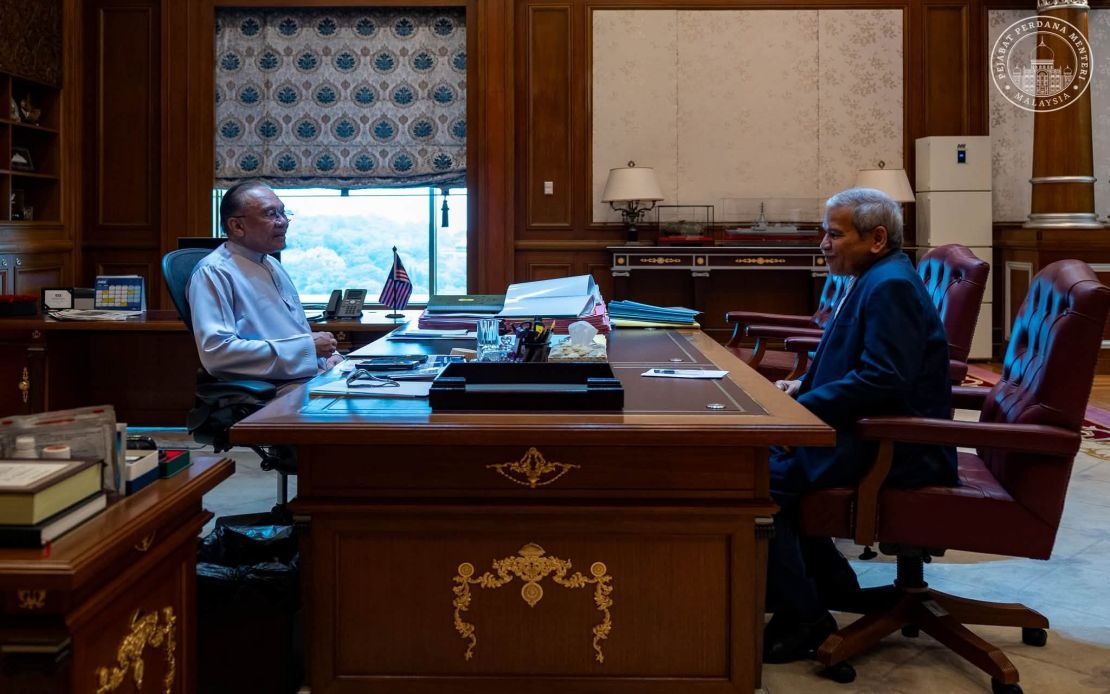
Prime Minister Datuk Seri Anwar Ibrahim has underscored the critical importance of sustaining institutional reforms at the Federal Land Development Authority, asserting that robust support for the settler communities remains a central pillar of the government's agenda. During a recent courtesy meeting in Putrajaya with newly appointed FELDA chairman Tan Sri Ahmad Badri Mohd Zahir, Anwar reiterated the necessity of maintaining momentum in strengthening the organisation's capacity to serve the people who depend on its programmes and policies.
Anwar, who holds the concurrent portfolio of Finance Minister, framed the challenge facing FELDA as one requiring a multifaceted approach. Beyond addressing immediate welfare concerns affecting settlers and their households, he emphasised that the organisation must simultaneously enhance its operational efficiency and market competitiveness. This dual mandate reflects an understanding that long-term dignity for settler communities cannot be sustained through welfare alone, but requires FELDA to remain economically viable and competitive within Malaysia's evolving agricultural and land-development landscape.
The appointment of Ahmad Badri as FELDA chairman, effective July 15, marks a transition in institutional leadership. He succeeds Datuk Seri Ahmad Shabery Cheek, whose tenure concluded on June 30. This change arrives at a moment when FELDA faces mounting scrutiny regarding its ability to adapt to contemporary economic pressures whilst maintaining its foundational commitment to improving the circumstances of generations of settlers who have built their livelihoods through the scheme.
A notable dimension of Anwar's remarks concerns the younger generation of settlers. The Prime Minister specifically highlighted that policymakers must give focused attention to the distinctive challenges encountered by younger cohorts within FELDA communities. This acknowledgment suggests growing awareness within government circles that settler demographics are shifting, and that the traditional models through which FELDA operated may require recalibration to remain relevant for those inheriting land and enterprise responsibilities in an increasingly digital and globally connected economy.
The FELDA system, established decades ago as a flagship programme to eradicate rural poverty and redistribute land to smallholder farmers, represents a substantial social investment by the Malaysian state. Over the decades, thousands of families have benefited from its land settlement and support schemes. However, structural challenges including commodity price volatility, generational transitions, and the need for technological modernisation have tested the organisation's resilience. Anwar's emphasis on "restoring and strengthening" FELDA carries implicit acknowledgment that the institution requires renewal rather than merely routine management.
In his Facebook statement, Anwar expressed confidence in Ahmad Badri's ability to advance the reform agenda. This public endorsement from the Prime Minister signals that the government intends to actively support FELDA's transformation rather than treating it as a peripheral concern. The statement also reflects a political calculation: FELDA settlers and their families constitute a significant electoral constituency, particularly in rural Peninsular Malaysia, and demonstrating commitment to their welfare remains strategically important for the MADANI administration.
The government's declared commitment to provide "full support" to FELDA carries both symbolic and practical weight. Symbolically, it reassures settler communities that their concerns remain central to national policy priorities. Practically, it may translate into resource allocation, policy reforms, or legislative adjustments designed to enhance FELDA's financial sustainability and operational flexibility. Without such backing, Ahmad Badri's reform mandate would face considerable headwinds.
Economic sustainability emerges as a critical theme in Anwar's formulation of FELDA's future. The organisation operates in an environment where agricultural commodity markets fluctuate significantly, where land values in developed areas create pressure to convert agricultural holdings into alternative uses, and where generational transitions often result in fragmentation of viable farming units. Balancing the imperative to maintain settlers' economic viability against these structural pressures requires strategic planning, investment in value-added agricultural activities, and potentially diversification into other income sources for settler families.
For Malaysian policymakers and observers, the trajectory of FELDA reform carries implications beyond the settler communities directly involved. The scheme represents a historical experiment in state-facilitated rural development and land redistribution. Its success or failure holds lessons for contemporary discussions about addressing rural inequality, managing agricultural transitions in middle-income economies, and designing institutions that can sustain social goals whilst adapting to economic change. The prominence of FELDA in national discourse also reflects broader questions about how Malaysia manages the relationship between rural and urban development priorities.
The appointment of a new chairman and the Prime Minister's public reaffirmation of commitment to FELDA's strengthening suggest that institutional renewal is underway. However, the real test will lie in translating rhetorical support into concrete programmes and resources. Addressing the particular challenges facing younger settlers, improving FELDA's competitive position in regional and global markets, and ensuring that institutional reforms deliver tangible improvements in settler household incomes will require sustained attention and investment beyond the initial phase of leadership transition.
Looking forward, the success of FELDA's reformation under Ahmad Badri's leadership will likely depend on whether the organisation can navigate the tension between its social mission—uplifting settler dignity and welfare—and economic pressures requiring efficiency and profitability. This balance will determine whether FELDA remains a viable institution serving future generations or gradually diminishes in relevance as settlers and their children seek alternative economic opportunities.

