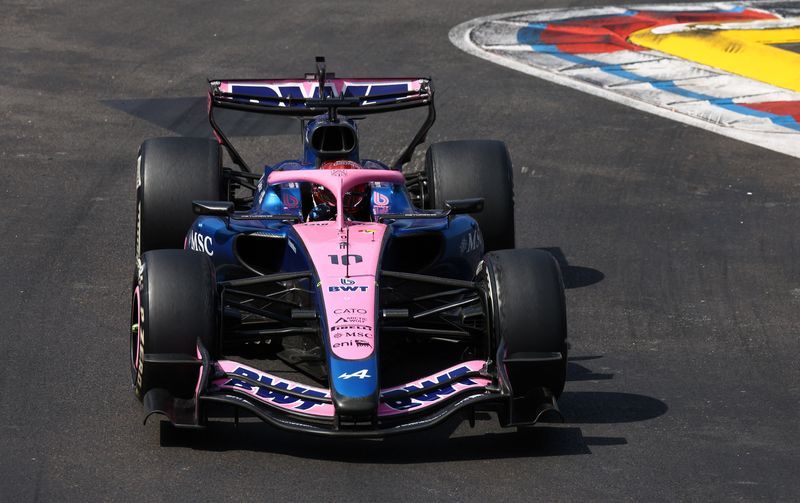
The sporting saga surrounding Pierre Gasly's third-place finish at the Monaco Grand Prix will finally reach its conclusion when Formula One's international court of appeal sits in Paris on Tuesday to render a binding decision on the disputed result. What should have been a straightforward podium celebration on June 7 has evolved into a protracted legal battle involving multiple teams, competing interpretations of penalty protocols, and fundamental questions about consistency and fairness in motorsport governance.
Gasly's initial third-place result was overturned just hours after the race concluded when FIA stewards imposed two five-second penalties for pit-lane speeding violations. These penalties demoted the Alpine driver to seventh position and elevated Red Bull's Isack Hadjar onto the podium, a decision that prompted the traditional champagne spray and official photographs. Yet this outcome proved remarkably short-lived, as just five days later on June 12, stewards reversed their decision after accepting evidence from Renault-owned Alpine that a timekeeping error had occurred during the pit-stop sequence.
The correction of this administrative mistake allowed Gasly to reclaim the third-place trophy, with Hadjar graciously returning the medals and stepping off the podium. However, this reversal initiated precisely the kind of controversy that governing bodies typically seek to avoid. Several observers within the F1 paddock raised concerns that the decision-making process had established problematic precedent, suggesting that penalties could be reconsidered and removed under certain circumstances even after a race had officially concluded.
These concerns prompted McLaren and Red Bull to lodge formal appeals with the FIA's international court on June 16, just four days after the initial reversal. McLaren's grievance centred on Oscar Piastri, the team's Australian driver who had been running in fourth position when Gasly was reinstated. Piastri's reinstatement from fifth to fourth place would not ordinarily constitute a significant issue, but the circumstances surrounding his own penalties created a perplexing asymmetry that underscores the appeal's substantive merit.
Piastri had received identical pit-lane speeding penalties during the race itself, penalties he accepted and served without protest as they were applied in real-time by race officials. Unlike Gasly, who never served his penalties and instead had additional time added to his race duration as compensation—time that stewards could subsequently remove—Piastri's penalties represented permanent time lost in the pit garage. This time loss generated cascading consequences throughout the remainder of the race, affecting race strategy, his competitive positioning, and ultimately his finishing position relative to other competitors.
The fundamental inequity that McLaren seeks to address involves the treatment of two drivers penalised for the same infraction at the same event, yet afforded radically different recourse pathways depending on timing and administrative circumstances. Piastri had no mechanism to challenge or reverse his penalties since they were served during the race and thus constituted completed sporting action. Gasly, by contrast, benefited from an administrative review that ultimately nullified his penalties entirely, thereby erasing their competitive impact.
McLaren team principal Andrea Stella articulated this dual-layered concern during the subsequent Dutch Grand Prix weekend, where his team's Lando Norris claimed victory. Stella emphasised that McLaren's appeal encompasses both broader philosophical questions regarding sporting integrity and direct material consequences affecting the team's championship campaign. The removal of Gasly's penalties meant that McLaren's driver remained fifth rather than advancing to fourth, a single-position difference that translates directly into championship points and standings progression.
Stella's statement reflected frustration not merely with the outcome in Monaco but with the procedural framework that permits such divergent treatment. "The process that happened after the race in Monaco needs to be reviewed because from a standpoint of fairness for all competitors, the fact that the penalty was removed introduces some significant elements of concern," he explained. He further highlighted that McLaren had been materially penalised for serving a penalty that offered no appeal mechanism, while simultaneously watching a competitor escape identical sanctions through administrative review.
The Italian team principal characterised the dispute as possessing both systemic and specific dimensions. Beyond McLaren's particular interests, the appeal raises fundamental questions about the consistency and predictability of FIA steward decision-making, the circumstances under which penalties may be revisited, and whether competitive fairness permits such disparate outcomes when identical infractions are involved. These considerations hold implications extending well beyond a single race result, potentially influencing how stewards approach future penalty decisions and appeals.
The FIA has confirmed that the international court will convene at its Paris headquarters to hear arguments from all interested parties, though proceedings will remain confidential without public or media attendance. This confidential nature reflects standard FIA procedure for appeals of this magnitude, though it also means that the reasoning underlying the court's decision may remain opaque to external observers depending on how comprehensively the FIA publishes its ruling.
The timing of this appeal remains notable, occurring more than two months after the Monaco Grand Prix concluded. This extended interval illustrates both the complexity of the underlying disputes and the procedural requirements involved in escalating matters through successive appeal layers within FIA governance structures. For McLaren, the stakes encompass both vindication regarding the fairness of pit-lane penalty administration and potential championship implications should the court determine that competitive positioning from Monaco requires adjustment.
The ruling will establish definitively how F1 adjudication handles situations where administrative errors, penalty application timing, and comparative competitor treatment intersect. Whether the court upholds Gasly's reinstatement or alters the finishing order will send significant signals about FIA governance philosophy and the precedents it establishes for future penalty disputes. For McLaren, Alpine, Red Bull, and indeed all competitors, this decision carries implications extending well beyond the trophy presentation from a single Mediterranean race weekend.

