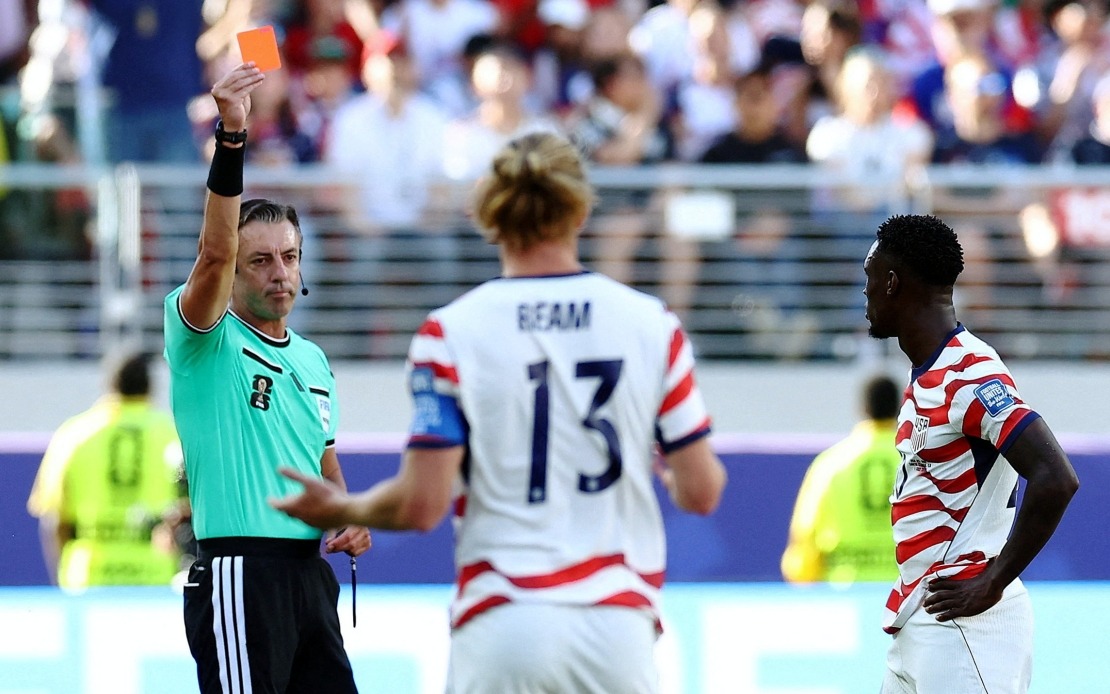
FIFA has moved to suspend enforcement of a one-match suspension imposed on United States striker Folarin Balogun, permitting the player to feature in Monday's World Cup knockout encounter against Belgium in Seattle. The decision came just hours before the fixture and immediately triggered a formal protest from Belgian officials, who view the ruling as inconsistent with precedent and the competition's own regulations.
Balogun received a red card during the Americans' 2-0 group-stage victory over Bosnia and Herzegovina on July 1, after making contact with Bosnian defender Tarik Muharemovic. The FIFA Disciplinary Committee had initially sanctioned him with a one-match ban for violating Articles 14 and 66 of the FIFA Disciplinary Code, a standard consequence for such infractions. However, FIFA invoked Article 27 of its own disciplinary framework to suspend the implementation of this penalty, effectively nullifying its immediate effect.
The strategic importance of this decision cannot be overstated. Balogun has emerged as a crucial player for the United States throughout the tournament, netting three goals and operating as the team's primary attacking threat. His availability dramatically enhances American prospects in a knockout tie against a Belgian side that has historically performed well in tournament football. For the US, seeking its first quarterfinal appearance since 2002, the presence of their leading scorer represents a significant tactical advantage.
FIFA's rationale centres on Article 27, which grants the disciplinary committee discretionary power to suspend sanctions during a probationary period. Under this framework, Balogun's ban remains technically active but unenforced for twelve months. The governing body stipulated that any subsequent infringement of comparable severity during this period would automatically activate the suspension without prejudice to additional penalties. This conditional approach appears designed to balance disciplinary consistency with tournament fairness, though the logic has proven contentious.
Belgium's formal response was swift and sharp. The Royal Belgian Football Association issued a statement expressing "astonishment" at the outcome, signalling serious concerns about the precedent being established. The Belgian federation's core argument rests on Article 66.4 of the FIFA Disciplinary Code, which explicitly mandates automatic suspension for any player receiving a direct red card in their team's subsequent match. Belgium maintains that this provision has been consistently applied throughout the current World Cup without exception until Balogun's case.
The Belgian protest extends beyond the immediate match outcome. Officials pointed to Article 10.5 of the FIFA World Cup 2026 Competition Regulations, which clearly articulates that players dismissed by either direct red card or accumulation of cautions "will automatically be suspended from their team's subsequent match," with potential for supplementary discipline. This regulatory language appears unambiguous and leaves little room for discretionary suspension under Article 27. Belgium contends that FIFA's decision contradicts the explicit terms of its own competition framework.
Further strengthening Belgium's position is documentation indicating that FIFA explicitly communicated the automatic suspension rule to all participating nations. Circular No. 16, distributed on May 12 to every member association competing in the tournament, reaffirmed this automatic consequence. Belgian officials also note that match coordinators and official tournament workshops repeatedly stressed this principle before each fixture. From Belgium's perspective, FIFA has essentially overridden its own clearly communicated rules specifically to benefit one nation.
The timing and selectivity of FIFA's decision have raised broader questions about the consistency of tournament administration. Belgian officials emphasise that numerous other players have received red cards during this World Cup without enjoying similar mitigation measures, raising concerns about unequal treatment and competitive integrity. The federation's investigation into "all potential options" suggests consideration of formal appeals, legal challenges, or complaints to international sporting authorities.
For Malaysian and Southeast Asian observers, this situation illuminates important dynamics within global football governance. Smaller nations often feel disadvantaged when major football powers receive preferential treatment from international bodies, whether consciously or unconsciously. The perception that regulations are applied flexibly depending on a nation's prominence can undermine confidence in tournament fairness. This case demonstrates how discretionary provisions within disciplinary codes, while potentially offering necessary flexibility, can become sources of controversy when invoked selectively.
The broader implications extend to future competitions and rule-making. If Article 27 can be routinely invoked to circumvent automatic suspension regulations, then those regulations lose meaningful force. Conversely, if the provision genuinely serves a legitimate corrective function, FIFA's reasoning requires much clearer articulation to justify why this particular case merited exceptional treatment while others did not. The lack of transparent rationale has amplified Belgian grievances and invited scrutiny of FIFA's decision-making processes.
Belgium's determination to explore all available remedies suggests this matter may not end with kickoff on Monday. While the immediate outcome grants the United States a significant advantage, the precedent established and the questions raised about governance consistency could reverberate throughout international football. For tournament credibility, FIFA now faces pressure to provide comprehensive justification for its interpretation of Article 27 and clarify how future similar situations will be adjudicated.

