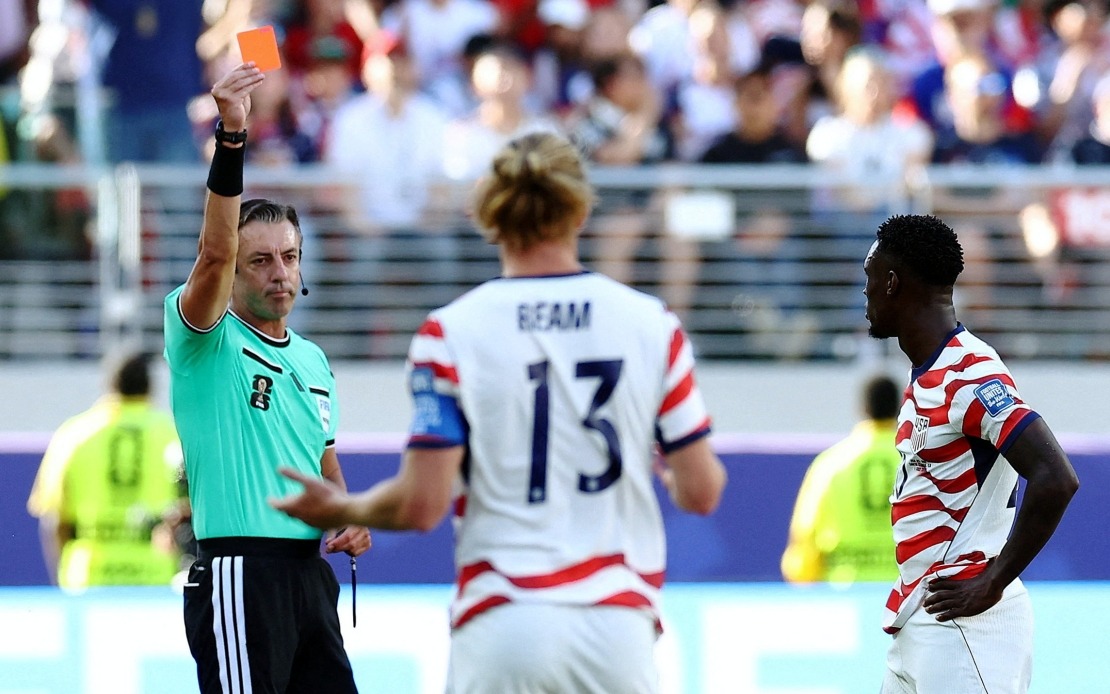
FIFA has moved decisively to support Brazilian referee Raphael Claus after United States President Donald Trump questioned the official's integrity during the World Cup tournament. The controversy centres on Claus's decision to send off American striker Folarin Balogun during a last-32 encounter against Bosnia and Herzegovina, a dismissal that prompted direct intervention from Trump seeking a review of the incident.
The red card decision against Balogun proved momentarily damaging to the US team's tournament prospects. However, the suspension of the red card was later overturned on Sunday, reinstating the player's eligibility for the crucial last-16 fixture against Belgium that same Monday in Seattle. Despite this reprieve, the American side suffered a heavy 4-1 defeat, leaving questions about whether the controversy had unsettled the team before kickoff.
Trump's criticism of Claus, delivered publicly on Monday following the Belgium result, represented an unusual intervention by a sitting US president into matters of sporting governance. The president's characterization of the referee as 'suspect' signalled deep dissatisfaction with the decision-making process and raised broader concerns about the consistency of match officiating at the tournament. Such high-profile political pressure on international sporting bodies carries implications for how tournaments are managed and whether officials remain insulated from external influences.
In response, FIFA released an official statement affirming Claus's standing within the organization. The governing body described him as "one of the world's leading professional referees and a valued member of Team One," the designated group responsible for overseeing matches at the FIFA World Cup. The statement emphasized that throughout his career, Claus had "consistently demonstrated the highest standards of professionalism and integrity," establishing a clear counter-narrative to Trump's allegations.
Pierluigi Collina, FIFA's chief of referees, provided additional vocal support for the Brazilian official. Collina noted that Claus was competing in his second FIFA World Cup, having previously been selected for the 2022 tournament in Qatar. This track record, Collina stressed, demonstrated both his experience and his standing as "a highly respected referee" within the international football community. The explicit reassurance that FIFA maintained "full confidence in him as a trusted match official" effectively signalled that the organization would not yield to external political pressure in its management of refereeing personnel.
Claus's trajectory in the tournament has been sufficiently impressive that he may yet be considered for higher-profile assignments, potentially including the tournament final itself. Brazil's exit from the competition at the last-16 stage has removed any concerns about conflicts of interest or home-nation bias, theoretically clearing the path for Claus to handle the championship's most prestigious match. Such a progression would represent a powerful statement by FIFA about its confidence in the official's abilities.
FIFA President Gianni Infantino crafted a more measured public response, notably refraining from naming Claus directly while offering general praise to the referees' corps. Infantino revealed that he had been contacted personally by Trump regarding the matter, an unprecedented intervention that highlighted the political dimensions now attached to World Cup administration. In a post on Instagram, the FIFA president celebrated the tournament as "an overwhelming success," crediting the "fantastic group of match officials – Team One" as a major contributor to its quality.
Infantino emphasized that the officials operating at the tournament represented "the best in the world," selected through a rigorous evaluation process. He stressed that the selection criteria examined "skills, consistency, and quality over a sustained period," establishing that appointments reflected genuine merit rather than political or commercial considerations. This framing sought to reinforce FIFA's autonomous authority over refereeing decisions while indirectly rebutting any suggestion that appointment decisions might be compromised.
The FIFA president's Instagram statement concluded with a more philosophical meditation on the referee's role in professional football. Infantino argued forcefully that "we must respect the referees and respect the rules that govern our game," positioning respect for officiating as fundamental to the sport's integrity. By asserting that "without referees, there is no football," he articulated a vision of refereeing authority that transcends individual political figures or national interests.
For Malaysian and Southeast Asian observers, this episode illuminates the complex intersection of geopolitical influence and international sports governance. The willingness of a sitting US president to publicly criticize and seek intervention regarding a referee's decision demonstrates how tournament administration increasingly operates within a landscape where powerful political actors feel empowered to challenge sporting decisions. The incident also reveals tensions between FIFA's desire to appear autonomous and its vulnerability to pressure from stakeholders with significant global influence.
The outcome—decisive backing for Claus by multiple FIFA officials—suggests that the organization, at least in this instance, prioritized institutional independence over accommodation of political pressure. However, the very fact that such pressure was applied and publicly acknowledged indicates that referees at major tournaments now operate within a polarized environment where their decisions attract immediate political scrutiny. For future tournaments, including those potentially hosted in Asia, this precedent raises questions about how sporting governance maintains integrity when subjected to high-level political engagement.
The Balogun incident ultimately reflects broader uncertainties about VAR implementation and red card consistency at major tournaments. While Claus received unequivocal support from FIFA, the controversy underscores ongoing difficulties in translating technological precision into consistent interpretations of match rules. Whether enhanced political engagement will genuinely improve decision-making or merely add external pressure remains an open question as international football continues evolving its approach to technology and human judgment in refereeing.

