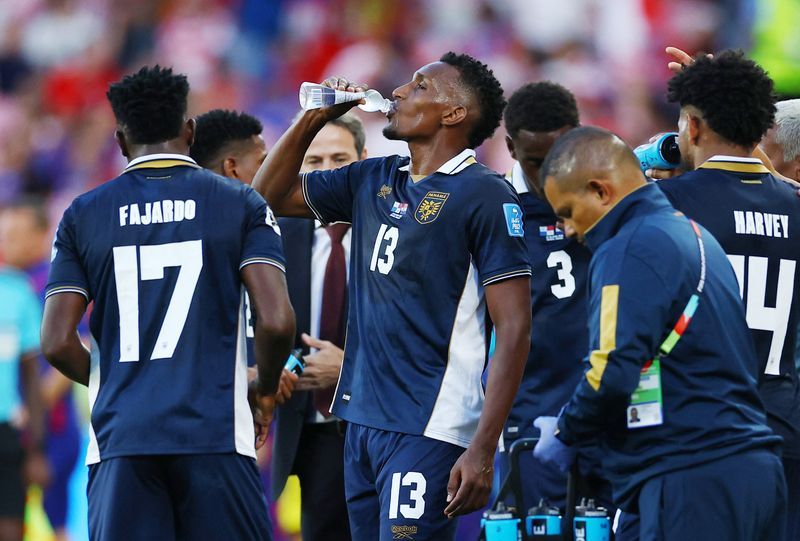
FIFA president Gianni Infantino has pushed back against mounting criticism of mandatory hydration breaks introduced at the World Cup, asserting that the measure stems entirely from player welfare considerations rather than commercial opportunism. The three-minute breaks, mandated during the 22nd and 67th minutes of every fixture, have sparked considerable backlash from players, coaches, and fans since matches began, with detractors questioning both their necessity and their true purpose.
The introduction of these stoppages was ostensibly designed to safeguard player health in the extreme heat conditions prevalent across North America during the tournament. However, the decision has inadvertently created significant advertising opportunities for broadcasters, allowing them to air commercials during these structured pauses. This convenient alignment between player protection and revenue generation has fuelled scepticism among observers who suspect the breaks serve dual purposes.
Infantino directly addressed these suspicions in a statement, emphasising that FIFA derives no additional financial benefit from the innovation. He noted that all commercial agreements with broadcasters and partners were finalised long before the hydration breaks were conceived, effectively ruling out the possibility that revenues generated from the advertising windows represent new income streams for the organisation. This distinction matters substantially, as it positions the breaks as a policy decision made independently of financial calculations rather than a revenue-maximising scheme disguised as health policy.
Beyond hydration, the breaks serve a secondary but strategically significant function: they provide coaching staff with opportunities to deliver tactical instructions and make in-match adjustments. This operational advantage has emerged as a lightning rod for criticism, with several prominent coaches and players arguing that these moments fundamentally alter the traditional character of football. The ability to pause the match and recalibrate strategy represents a departure from the sport's conventional rhythm and demands adaptability in ways that some argue diminish the beauty of the game.
Thomas Tuchel, England's manager, articulated this concern bluntly, describing the additional break as something that "interrupts and changes the identity of the football match." Similarly, Uruguay's Marcelo Bielsa contended that subdividing matches into shorter temporal segments strips away what he considers football's essential characteristic: continuous, uninterrupted play that demands sustained tactical awareness and physical endurance. These critiques point to a philosophical tension between modernised player care and footballing tradition.
Yet support for the underlying intent exists among some quarters, even where scepticism about implementation persists. Spain's Luis de la Fuente and Netherlands captain Virgil van Dijk have acknowledged the legitimate concern about excessive heat, particularly in North American venues during summer months. However, both have questioned whether uniform application makes sense across all conditions and venues, particularly in matches played in cooler climates or under roof where temperature regulation is less problematic. This nuanced position suggests the breaks themselves may not require elimination but rather contextual refinement.
Infantino countered by emphasising the tournament's gruelling schedule, with teams potentially playing eight matches across a compressed 39-day window. Within this context, he argued, structured rest moments assume critical importance for recovery and maintenance of performance levels. The World Cup, unlike domestic league seasons spread across months, compresses elite-level football into an intense period that places extraordinary physical demands on players competing repeatedly with minimal recovery time between fixtures.
The FIFA president further justified uniform application of the breaks through an equity lens, arguing that standardisation ensures all teams operate under identical conditions throughout the tournament. Without consistent breaks across all matches, teams and coaches playing in cooler conditions would theoretically gain competitive advantage by avoiding opportunities for tactical recalibration available to opponents in hotter venues. From this perspective, mandatory hydration breaks represent a mechanism for levelling the playing field, preventing climatic variation from creating unequal competitive circumstances.
Infantino also rejected suggestions that the breaks have diminished match intensity, contending that players maintain robust performance levels throughout fixtures despite the interruptions. This assertion directly challenges the narrative that pauses allow tired players to fully recover their physical resources, potentially making matches less compelling or competitive. If breaks genuinely fail to reduce intensity substantially, the case for treating them primarily as a player welfare measure rather than a game-altering intervention gains credibility.
For Malaysian and Southeast Asian readers, this debate resonates particularly given the region's experience with tropical heat and humidity at sporting venues. Any future tournaments hosted in the region might necessitate similar provisions, making the precedent established by the World Cup's hydration breaks potentially relevant to local sports governance. The balance FIFA has attempted to strike between player protection and competitive integrity offers instructive lessons for regional sporting bodies considering policy adaptations.
The broader implications extend beyond mere scheduling adjustments. This controversy illustrates the ongoing tension within modern football between maximising player welfare and preserving the sport's traditional characteristics. As climate change renders extreme heat increasingly common at major tournaments, sports authorities will face recurring pressure to implement protective measures that simultaneously reshape how matches function. Infantino's defence essentially argues that such evolution serves players first and foremost, with any commercial benefits remaining incidental rather than driving.