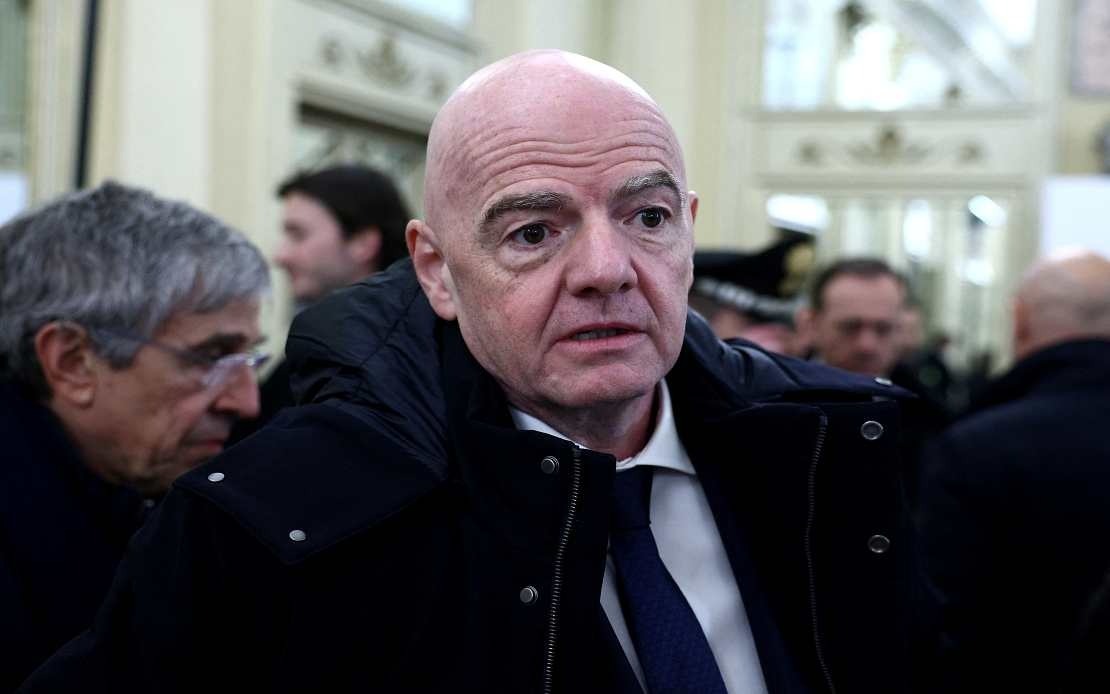
A prominent human rights organisation has escalated its campaign against FIFA President Gianni Infantino by submitting a formal complaint to the International Olympic Committee, alleging that the Swiss administrator has systematically breached rules requiring political impartiality. FairSquare, which has been monitoring governance issues within international sports bodies, contends that Infantino's conduct—particularly his recent involvement in a high-profile disciplinary decision—demonstrates a pattern of behaviour incompatible with the Olympic Charter and the IOC's ethics code.
The complaint centres on Infantino's handling of a disciplinary matter involving a US national team player, whose one-match suspension was controversially lifted by FIFA's disciplinary committee. The decision became contentious after it emerged that United States President Donald Trump had telephoned Infantino shortly before the reversal, enabling the athlete to participate in a crucial World Cup knockout round against Belgium. Although Infantino has publicly maintained that FIFA's committees operate with complete independence from executive influence, the timing and circumstances surrounding the case have prompted questions about whether external political pressure may have influenced the sporting determination.
According to FairSquare's filing with the IOC, the Infantino situation represents far more than a single isolated incident. The organisation identifies five explicit violations of international Olympic governance standards regarding political neutrality, alongside what it characterises as prima facie evidence of two additional serious breaches. The cumulative pattern suggests, in FairSquare's assessment, a troubling departure from the principles that should govern the conduct of senior officials within international sporting institutions, particularly those who hold dual memberships in multiple governing bodies.
Infantino's position as an IOC member since 2020 places him under the direct purview of Olympic governance rules, creating the legal and jurisdictional foundation for FairSquare's complaint. The appointment represented a significant elevation in status for the FIFA leader, integrating him into the Olympic movement's highest decision-making circles. However, FairSquare argues that membership within the IOC carries corresponding obligations regarding political conduct and ethical behaviour, obligations which Infantino has allegedly disregarded.
This development represents an escalation in scrutiny of Infantino's leadership, building upon earlier complaints filed through other channels. In December, FairSquare submitted a detailed complaint to FIFA's own ethics committee, initiating an internal process that has thus far yielded no public action or response. The decision to bring the matter before the IOC appears calculated to create additional pressure and ensure the allegations receive examination by an independent body with clear authority over Olympic members.
The complaint has garnered support from multiple international actors with standing in sporting governance matters. Norway's football federation formally wrote to FIFA's ethics committee requesting serious consideration of FairSquare's allegations, effectively amplifying the original complaint through an official football association. Meanwhile, fifty members of the European Parliament issued a joint letter to FIFA's ethics committee on June 29, urging it to investigate the concerns raised by FairSquare. This multi-level pressure from legislative bodies, national football associations, and human rights organisations demonstrates the seriousness with which the governance concerns are being treated in international political and sporting circles.
The Balogun case has proven particularly significant in mobilising opposition to Infantino's conduct. The suspension's reversal, coupled with the proximity of Trump's telephone conversation to the decision, created an optics problem that FIFA has struggled to address. The organisation has offered no public explanation of the procedural reasoning that justified overturning the disciplinary committee's original determination, a silence that invites speculation about whether normal rules and processes were followed.
For Southeast Asian sporting observers and policymakers, this dispute carries broader implications regarding the integrity of international sporting governance structures. As regional nations participate increasingly in global competitions and interact with FIFA on matters of qualification, discipline, and tournament hosting, the question of whether executive leadership operates according to consistent, transparent standards becomes directly relevant. If senior FIFA officials can be influenced by political figures, then the competitive fairness that all nations rely upon is fundamentally undermined.
The complaint also reflects growing international concern about the concentration of power in individual leaders of large sporting bodies and the inadequacy of existing accountability mechanisms. Despite FIFA's claims of committee independence, the sequence of events in this case has created at minimum the appearance of impropriety—a threshold that should trigger serious institutional inquiry even in the absence of definitive proof of wrongdoing. The IOC's response to FairSquare's filing will therefore signal how seriously the Olympic movement treats governance violations by its own members and whether it possesses effective remedial tools.
Infantino's leadership of FIFA has been marked by various controversies spanning governance, financial transparency, and his expansion of World Cup participation. The current complaint represents a new dimension of criticism, one that strikes at the institutional legitimacy of FIFA's decision-making structures. Whether the IOC investigation substantiates FairSquare's allegations remains uncertain, but the formal complaint itself demonstrates that international sporting governance faces sustained pressure to conform to principles of political neutrality that competitive integrity fundamentally requires.
The broader implications extend beyond one individual administrator or one disciplinary decision. The case illustrates how even elite sporting institutions struggle to insulate themselves from political influence and how establishing genuine independence remains a continuing challenge. For the IOC and FIFA alike, the investigation process ahead will test their commitment to enforcing governance standards consistently and to maintaining the institutional integrity upon which the entire global sporting system depends.

