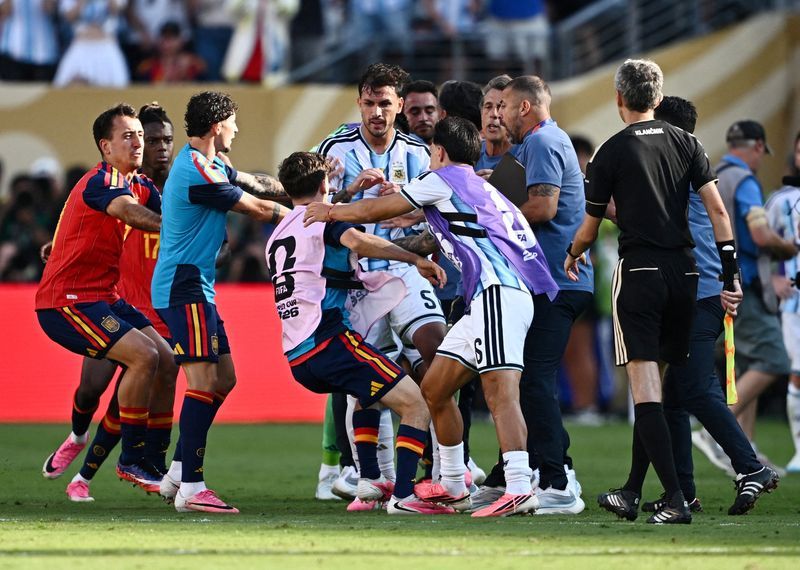
Football's international governing body FIFA has formally initiated disciplinary proceedings following the violent altercation that marred the conclusion of the World Cup final, appointing a dedicated prosecutor to oversee the investigation into the confrontation between Spanish and Argentine players. The decision to launch a formal inquiry signals FIFA's commitment to addressing the incident while the sport faces scrutiny over player conduct and on-field discipline at its highest level.
Spain secured their second World Cup championship through a hard-fought extra-time goal from winger Ferran Torres, delivering a trophy that had eluded the European powerhouse since their 2010 triumph. The match itself had already been marked by disciplinary upheaval when Argentina midfielder Enzo Fernandez received a second yellow card in the 93rd minute of normal time, leaving the South American side to contest the remainder of the contest with ten players. This numerical disadvantage created mounting pressure on the Argentine squad, though their resistance ultimately crumbled only in the additional period.
The peaceful conclusion that typically characterizes football's grandest stage gave way to chaos as the final whistle sounded, with Argentine midfielder Leandro Paredes initiating contact with multiple Spanish opponents that quickly escalated into a broader melee. Spanish defender Eric Garcia and midfielder Gavi were among the players directly involved in the physical exchanges, though the altercation rapidly expanded beyond these individual confrontations as teammates from both benches rushed onto the field to join the fray. What began as isolated pushing and shoving between individual players snowballed into a chaotic scene requiring intervention from match officials and coaching staff.
The physical nature of the post-match disorder necessitated significant effort from both teams' support personnel to restore order and separate the combatants. Argentina's head coach Lionel Scaloni intervened directly in attempts to de-escalate tensions among his own players, though the deterioration of discipline had already progressed substantially by this point. The visible discord provided stark contrast to the typically triumphant atmosphere that accompanies World Cup victory celebrations, transforming what should have been a moment of sporting joy into an embarrassing spectacle broadcast globally.
For Southeast Asian football enthusiasts and observers, this incident carries particular relevance as the region continues developing its own professional leagues and youth academies that increasingly look to international standards for guidance on player development and conduct. The behaviour exhibited in this match—escalating from isolated incidents to full-team involvement—demonstrates how quickly professionalism can unravel when emotions override discipline, a cautionary lesson for emerging football cultures throughout the region. Malaysia, as an ASEAN nation with growing football ambitions, must take note of how the world's elite handle high-pressure situations and the consequences that flow from lapses in discipline.
The investigation itself will likely examine video evidence, witness testimony from match officials, and statements from players and coaching staff to determine appropriate sanctions. FIFA's disciplinary and ethics framework provides prosecutors with substantial discretionary power when addressing post-match misconduct, and the severity of penalties will depend upon the specific findings regarding individual responsibility and the extent of each player's involvement. Previous World Cup-related disciplinary cases have sometimes extended to bans from international competition and substantial financial penalties against national associations.
The broader context of this confrontation reflects growing tensions that periodically surface in high-stakes football matches, particularly when considerable national pride and sporting prestige hang in the balance. The Enzo Fernandez red card had already inflamed emotions before the final moments, creating a powder-keg atmosphere that required careful management from match officials. Once Paredes initiated physical contact, the emotional intensity that had accumulated throughout the tournament finally burst forth in unfiltered form, revealing the passions that drive international football competition at its most consequential level.
FIFA officials have notably declined to establish a specific timeline for completing the investigation, suggesting the body intends to conduct a thorough examination rather than rushing toward conclusions. This measured approach contrasts with occasional criticism that international football's governing body sometimes applies inconsistent standards when addressing player misconduct across different matches and tournaments. The decision to mount a formal investigation rather than issuing immediate sanctions suggests FIFA recognizes the gravity of post-match brawls and their potential to undermine the sport's global reputation.
As the investigation proceeds, national football associations of both Spain and Argentina may face ancillary pressure to address their players' conduct independently, creating potential for parallel disciplinary processes. The incident serves as a reminder that football's emotional intensity, while part of the sport's appeal, demands rigorous professional standards to prevent competition from descending into chaos. For players across the globe, including in Southeast Asia's developing football ecosystems, the proceedings will illustrate how international bodies respond when discipline collapses at football's pinnacle.

