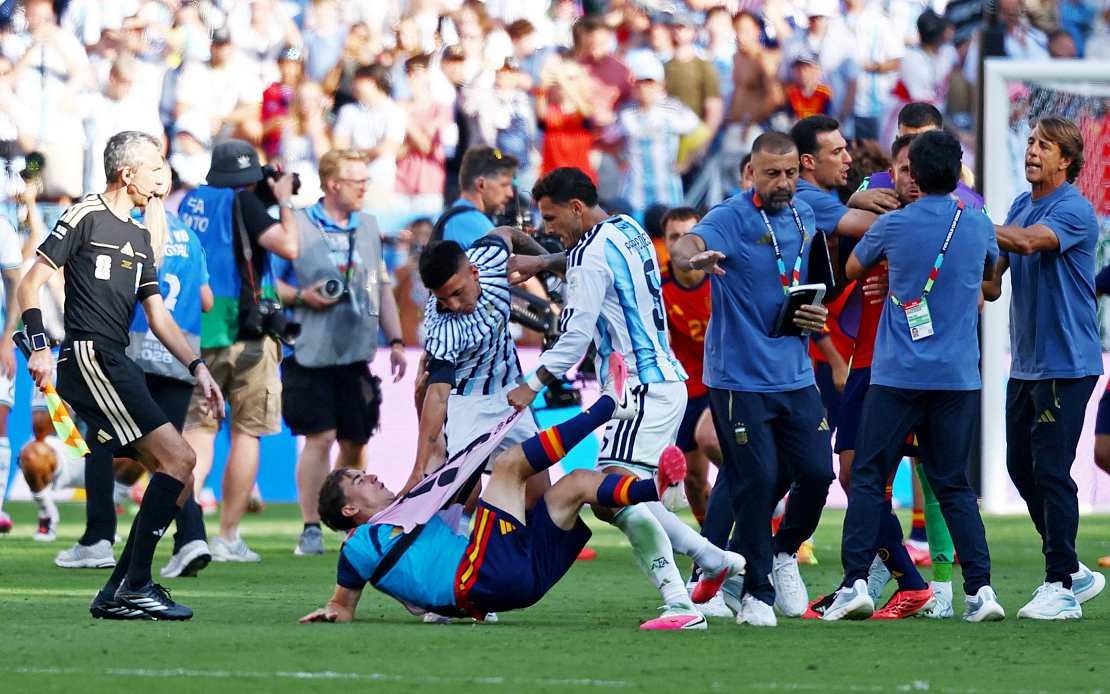
FIFA has formally launched an investigation into possible disciplinary violations committed by Argentina in the aftermath of their World Cup final defeat to Spain, marking the latest chapter in a tournament marked by rising tensions between competing nations over conduct and political expression. The decision to open a formal probe comes after a review of match reports and incident documentation from the championship-deciding contest held in New Jersey, with the football governing body now tasking a dedicated Disciplinary and Ethics Prosecutor to examine whether Argentina breached its code of conduct.
The immediate trigger for FIFA's inquiry centres on on-pitch conduct during the post-match celebrations, when Argentina midfielder Leandro Paredes was observed throwing punches in the direction of Spanish players who were commemorating their victory. Footage of the incident circulated widely, drawing condemnation from observers who viewed the action as an unsportsmanlike response to defeat. This episode represents the second consecutive flashpoint involving Argentina's physical intensity during the tournament, following widespread criticism of their combative style throughout the competition.
Argentina's approach to defending and midfield engagement had already drawn scrutiny during their semi-final triumph over England, where midfielder Enzo Fernandez received a red card for accumulating two bookable offences within the same match. That performance raised questions about whether the team's tactical instructions explicitly encouraged a harder style of play, or whether individual player discipline had broken down under tournament pressure. The pattern of incidents suggests either systemic coaching concerns or a troubling lack of emotional regulation among key squad members.
Beyond the Paredes incident, uncertainty remains regarding whether FIFA will investigate other post-match controversies involving Argentina. Specifically, unconfirmed reports suggest the team may have displayed a banner asserting Argentine sovereignty over the Falkland Islands following their semi-final victory over England, an action that would directly contravene Article 34.3 of the tournament regulations governing political gestures and national claims. Argentina's football association (AFA) was previously sanctioned for an identical act during a 2014 friendly against Slovenia, creating a precedent for potential punishment.
FIFA's appetite for enforcing political neutrality remains inconsistent across different scenarios and confederations. When UEFA addressed similar nationalism-tinged celebrations following Euro 2024, the governing body imposed one-match bans on Spain's Rodri and Alvaro Morata for chanting related to Spain's territorial claims over Gibraltar. That decisive approach contrasts with FIFA's more measured response to Argentina's Falkland Islands banner, suggesting either different thresholds of enforcement or uncertainty about how to handle sovereignty disputes outside Europe's framework.
The broader context of FIFA's disciplinary philosophy adds another layer to the current investigation. The governing body has demonstrated a willingness to prevent players from expressing values or allegiances deemed political or controversial. At the 2022 World Cup in Qatar, English captain Harry Kane faced explicit warnings that wearing a 'OneLove' rainbow armband—a gesture supporting LGBTQ+ inclusion—would result in immediate sporting sanctions beginning with a yellow card. That decision drew fire from human rights advocates, given Qatar's criminal penalties for homosexuality. The contrast between FIFA's stringent action on the armband and its sometimes lenient approach to nationalist gestures underscores the selective nature of its enforcement.
For Malaysian and Southeast Asian observers, the Argentina investigation carries relevance beyond football spectacle. Regional nations regularly navigate the tension between sporting competition and nationalist expression, particularly given the complex geopolitical environment of Southeast Asia. The precedents FIFA sets regarding political conduct at major tournaments will influence how players and associations from ASEAN countries approach future competitions, especially regarding symbols of territorial claims or historical grievances that remain unresolved within the region.
The investigation's outcome will also signal FIFA's commitment to maintaining order at its flagship event. If the organisation pursues significant sanctions against Argentina for the Paredes incident or the banner display, it sends a message that post-match violence and nationalist provocation carry genuine consequences. Conversely, lenient treatment would suggest that wealthy football nations enjoy latitude unavailable to smaller confederations, potentially undermining the credibility of FIFA's disciplinary framework among member associations from developing nations.
The Disciplinary and Ethics Prosecutor tasked with the investigation must now compile evidence, interview involved parties, and determine which specific regulatory articles Argentina may have breached. The FIFA Disciplinary Committee will ultimately decide whether to pursue formal charges and, if violations are confirmed, impose appropriate penalties. Given the high-profile nature of the World Cup final and the global attention on Argentina's performance, the committee will likely face external pressure to either demonstrate consistency with previous UEFA decisions or articulate why FIFA's standards differ from those of its continental peer.
Until the prosecutor completes their report and the Disciplinary Committee issues its determination, uncertainty will linger over whether Argentina faces financial fines, player suspensions, or sanctions affecting their qualification for future tournaments. The investigation represents a crucial test of FIFA's stated commitment to maintaining sporting integrity and disciplinary consistency across confederations and nations of different sizes and influence. The coming weeks will reveal whether that commitment extends equally to all member associations or remains subject to the gravitational pull of football's traditional powers.

