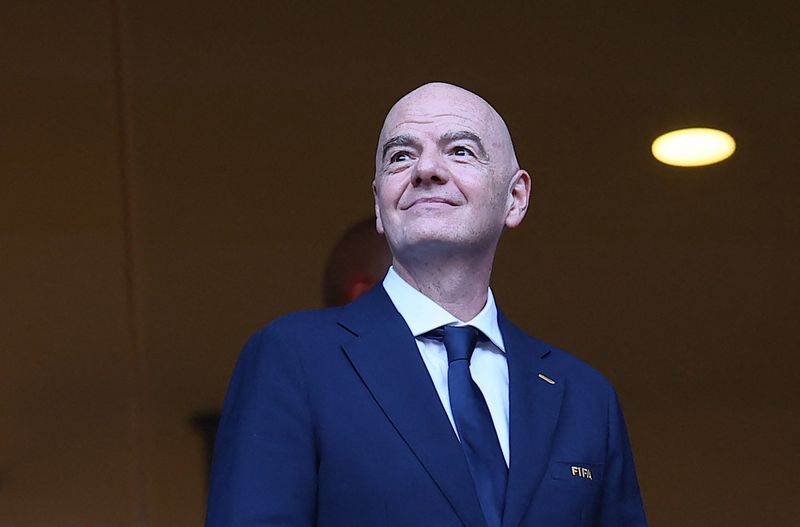
FIFA President Gianni Infantino faces the most serious threat to his leadership since taking control of world soccer's governing body eight years ago, following the spectacular collapse of his bid to inject private investment into the World Cup. The Swiss-Italian official abandoned his proposal to raise $4.2 billion through a newly created commercial entity last Friday, after three days of extraordinary turmoil within FIFA administration. Although he offered an apology for the divisive nature of the initiative, the reverberations continue to reshape the political landscape at the world's most powerful soccer organisation, with regional confederations now openly questioning whether he should continue in the role he has occupied since 2016.
The proposal represented a fundamental departure from how the World Cup has been managed, seeking to bring private equity into the tournament for the first time in its modern history. Infantino pitched the scheme to less wealthy national associations with specific financial incentives, promising dividend payments ranging between $20 million and $40 million to each federation backing the initiative. However, the manner in which he advanced the plan—without meaningful consultation with major stakeholders—proved catastrophic for his political standing. Five European football associations, including the prestigious English FA, have formally withdrawn their support for his reelection campaign scheduled for the FIFA Congress in Morocco in March. Denmark went further, declaring they would never vote for him under any circumstances.
The damage to Infantino's previously unshakeable position has been most evident in the public statements issued by regional confederations, the true power brokers in FIFA politics. UEFA, Europe's continental governing body, and CONCACAF, which oversees soccer across North and Central America and the Caribbean, both issued strongly worded declarations withdrawing confidence in his leadership. Even the usually more cautious Asian Football Confederation (AFC), which has historically maintained closer ties with FIFA's inner circle, condemned the lack of consultation as "totally unacceptable" and demanded sweeping institutional reforms. Only a handful of national associations—those from Morocco, Qatar, Kuwait, Lebanon, and Sri Lanka—have publicly pledged continued support for the 56-year-old administrator.
According to reporting from the Times of London, the three largest regional confederations have begun coordinating efforts to remove Infantino from office. The report suggests these bodies are prepared to pursue an aggressive strategy, potentially including the paralysis of FIFA's normal operations and the establishment of rival competitions outside FIFA's framework if he refuses to voluntarily resign. Such a scenario would represent an unprecedented constitutional crisis for an organisation that has historically managed dissent through backroom negotiations rather than public confrontation. Neither CONCACAF nor the AFC responded to requests for comment on these allegations, though UEFA declined to elaborate further on their position.
The immediate political threat to Infantino centres on the possibility of an Extraordinary Congress being convened. Should 43 or more of the 211 FIFA member associations formally request such a session in writing, it would provide a platform for his opponents to challenge his authority directly. This threshold represents roughly 20 percent of the total voting body, a hurdle that remains surmountable for an incumbent with substantial resources and entrenched support networks. Infantino therefore faces a critical window before that threshold is reached, requiring him to stabilise his position among wavering confederations and member associations over the coming months.
Infantino's political strategy has historically relied on building power among the less wealthy national associations, particularly in Africa, Asia, and smaller confederations that depend heavily on FIFA revenue distributions to maintain their operations. His predecessors Joao Havelange and Sepp Blatter employed similar approaches, recognising that traditional soccer powerhouses in Europe possessed less urgent financial dependency on FIFA funding. This explains why Infantino targeted his investment proposal specifically at these cash-strapped federations, dangling the prospect of substantial one-time payments to secure their backing. The plan was designed to bypass the more sceptical prosperous nations by offering something they could not refuse.
The withdrawal of confidence from UEFA and CONCACAF represents a serious erosion of this carefully constructed coalition. European associations, while financially independent, carry considerable cultural prestige and historical authority within FIFA governance structures. CONCACAF's defection is equally significant given that region's growing commercial importance to world soccer. The fact that even the AFC, which has rarely publicly challenged FIFA leadership, felt compelled to register formal complaints suggests the proposal was perceived as disrespectfully exclusionary even by confederations most dependent on FIFA's benevolence.
Infantino's immediate priority must be preventing the convening of an Extraordinary Congress, which would shift the narrative from internal FIFA politics to a direct democratic challenge to his authority. Beyond this defensive manoeuvre, he has approximately seven months before the November 18 deadline for nominating candidates in the presidential election to attempt repairs to damaged relationships. This task is complicated by the fact that his opponents now have a clear template for action and a demonstrated willingness to act in concert across traditionally separate regional blocs.
The search for a challenger candidate presents another complex dimension to this unfolding drama. Any serious contender would need to appeal to the less wealthy associations that currently form Infantino's core constituency whilst simultaneously addressing the governance and transparency concerns that animated the recent rebellion among major confederations. Finding a figure who can credibly represent both interests—financial dependence and institutional reform—remains a formidable challenge for the opposition. The November nomination deadline creates a defined timeline by which such a candidate must emerge from within FIFA's existing leadership structures or from outside the organisation entirely.
For Malaysian and Southeast Asian readers, this internal FIFA crisis carries particular significance given the AFC's prominent position in these negotiations and the broader questions it raises about regional representation in global sports governance. The AFC's formal criticism of the consultation process suggests a growing assertiveness among Asian football authorities in demanding meaningful participation in major decisions affecting their members. This pattern could influence how Asian confederations approach other international sports organisations and governance forums, potentially emboldening regional actors to demand greater transparency and stakeholder engagement in future initiatives.
The stakes of this confrontation extend far beyond Infantino's personal political survival. The outcome will shape FIFA's approach to commercial development, the balance of power between regional confederations, and the extent to which African, Asian, and smaller European associations can influence the organisation's strategic direction. If Infantino successfully navigates this crisis, it will validate his approach to independent executive decision-making. If he falls, it may signal a return to more consensus-driven governance that requires broader stakeholder agreement before major initiatives proceed, fundamentally altering how world soccer's governing body conducts business.

