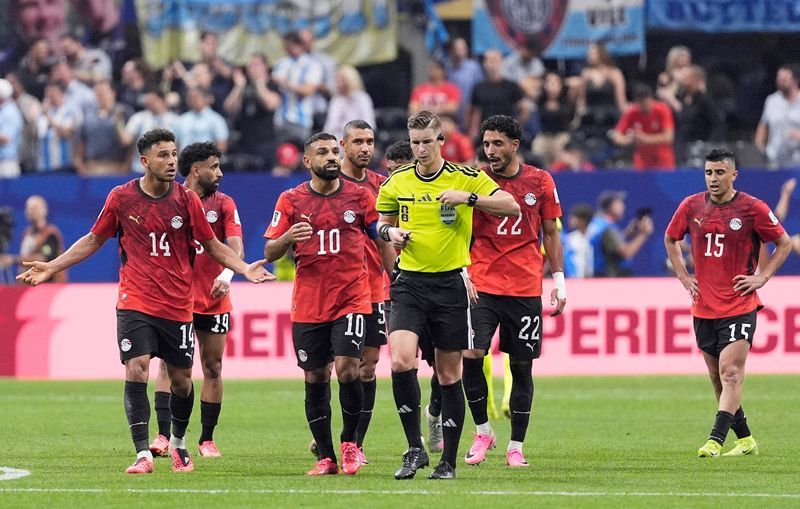
The head of FIFA's refereeing operations has firmly pushed back against accusations that match officials favoured Argentina in their dramatic 3-2 World Cup elimination of Egypt, asserting that referees operate free from external pressure and that scrutiny of their judgment amounted to unfounded attacks on their character. In comments published through FIFA's official channels on Thursday, Pierluigi Collina acknowledged that debate over specific decisions forms a normal part of football discourse, but he drew a sharp distinction between constructive criticism and what he characterised as baseless claims that questioned the impartiality of World Cup match officials.
The Egyptian Football Association had lodged formal complaints following their team's exit from the tournament, arguing that several pivotal moments—including a disallowed goal and an unpenalised challenge on Mohamed Salah—demonstrated inconsistent application of the rules that fundamentally altered the match's trajectory. Coach Hossam Hassan suggested publicly that officials may have faced pressure to keep the Argentine squad in the competition, a claim that struck at the heart of competitive integrity. These assertions reflected a wider frustration among Egyptian football circles about what they perceived as a pattern of decisions favouring the more prominent South American nation.
Collina's response was unequivocal: questioning the integrity of World Cup referees represented a serious breach of sporting conduct that extended beyond the pitch itself. The FIFA official warned that allegations of corruption or bias could expose match officials and their families to threats and harassment, underscoring the real-world consequences of such accusations. His comments reflected growing concern within global football governance about maintaining the credibility of refereeing systems, particularly as matches involving high-profile teams and nations draw intense scrutiny from fans, media, and sporting institutions across the world.
Central to the Egyptian grievance was the disallowance of Mostafa Zico's second-half goal, which the association contended was ruled out for a non-existent foul during the build-up play. According to Egypt's assessment, Marwan Attia's contact with Argentina defender Lisandro Martinez did not meet the threshold for an infringement serious enough to negate a legitimate goal. Collina directly addressed this controversy, confirming that video assistant referee technology had recommended the overturn based on identification of a foul by Attia. The FIFA official framed the decision within established protocol, arguing that the visibility or obviousness of an infringement should not determine whether VAR intervenes when a referee misses contact on the field.
The incident involving Salah presented an equally contentious question of refereeing judgment. Moments before Argentina scored their winning goal through Enzo Fernandez in stoppage time, contact occurred between the Liverpool forward and Argentine defender Julian Alvarez in the penalty area. The Egyptian camp maintained that this contact warranted a penalty that would have fundamentally altered the match's outcome, whereas FIFA's assessment, endorsed by both the on-field referee and VAR personnel, classified the incident as standard physical play within the boundaries of lawful defence. Collina articulated the distinction FIFA applies: defenders who make contact with the ball before engaging an opponent commit no offence, whereas deliberate contact without touching the ball constitutes a foul.
Argentina's recovery from a two-goal deficit to snatch victory in the final moments created the precise conditions for such disputes to fester. The dramatic nature of the turnaround, combined with the marginal decisions that facilitated it, meant that any hint of inconsistency would invite examination and suspicion. For Malaysian and Southeast Asian football followers, the case illustrated how VAR implementation remains contested terrain despite its intended purpose of eliminating obvious errors. The controversy also highlighted how refereeing decisions in high-stakes matches involving traditionally powerful football nations can generate perceptions of favouritism, even when officials believe they have followed established protocols correctly.
Collina's comments effectively represented FIFA's position that while subjectivity necessarily enters some decisions, the application of VAR principles had been thorough and consistent throughout the tournament. This stance adopted a defensive posture, treating Egyptian objections not as legitimate concerns worthy of detailed examination but as attacks on the credibility of the match management system itself. The framing implicitly placed the burden on Egypt to accept rulings rather than acknowledge any possibility that reasonable officials might interpret borderline moments differently.
The episode raises important questions about how football governance communicates with disappointed teams and their supporters when controversial decisions occur. Rather than engaging substantively with specific technical points—why, for instance, the Attia contact should be classified as a foul when similar contacts elsewhere in football sometimes escape sanction—Collina's response emphasised the integrity of the officials and the threat posed by questioning that integrity. This rhetorical strategy, while protecting the institutional interests of FIFA and its referees, potentially left unresolved the underlying technical and interpretive questions that troubled observers throughout the world.
For regional football communities in Southeast Asia watching elite international competition, these disputes carry significance beyond a single match. They shape understanding of how global football power operates and whether established rules apply uniformly regardless of a nation's status within the sport's hierarchy. The Argentina-Egypt controversy illustrated how VAR, despite its technological sophistication, cannot eliminate the human judgment that remains central to football adjudication. Collina's defence of the match officials reasserted FIFA's confidence in its systems, but the controversy itself suggested that confidence alone insufficient to resolve disputes when major tournaments and national pride intersect with marginal refereeing decisions.

