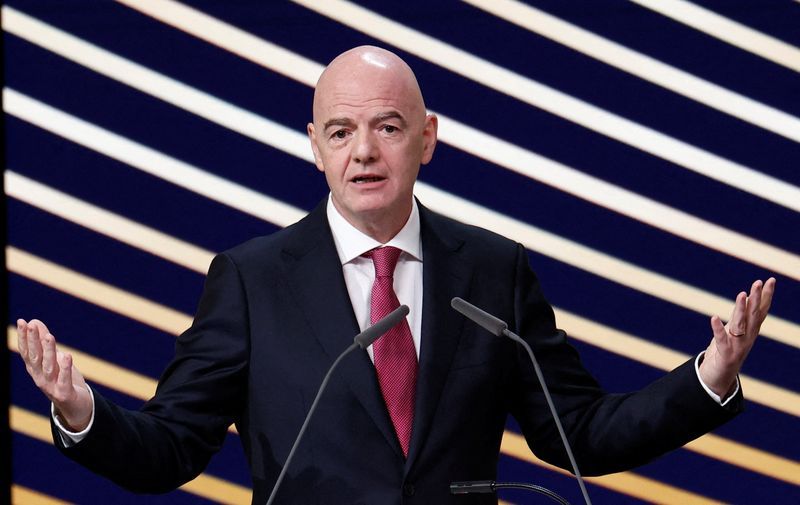
FIFA president Gianni Infantino's authority within soccer's governing apparatus has been dealt a significant blow following the collapse of his ambitious strategy to commercialize the World Cup through private capital investment. The proposal, which would have established a dedicated commercial entity to manage the tournament while allowing private investors to acquire a 20% stake, unravelled spectacularly on Friday after three days of escalating tension within the sport's international hierarchy. Infantino himself acknowledged in a FIFA statement that the initiative had proven too contentious to advance, effectively abandoning an idea he had championed with considerable personal investment.
The scheme's sudden demise stems largely from an unprecedented coordinated response by regional confederations, most notably UEFA, which represents Europe's financially dominant footballing nations. Faced with the prospect of a complete boycott of all FIFA competitions, Infantino capitulated despite FIFA's initial Friday announcement attempting to double down on the proposal by emphasizing promised funding streams to national federations. The rapid collapse exposes fundamental fractures in Infantino's typically insulated decision-making apparatus and has left several of his closest advisers scrambling to distance themselves from the initiative. Carlos Cordeiro, a senior adviser to the FIFA president, resigned in protest characterising the arrangement as fundamentally detrimental to the sport, whilst Kevin Lamour, FIFA's Chief Operating Officer, alleged that staff had been deliberately misled and denounced the proposal as reflecting the unilateral vision of a solitary individual.
The timing of this reversal carries particular significance given that Infantino was preparing to contest his re-election for a fourth term at the FIFA Congress scheduled for March in Morocco. Until the preceding week, his path to victory appeared virtually assured, buttressed by the unprecedented commercial success of the recently concluded World Cup tournament and the absence of credible rival candidates. However, the private equity gambit has fundamentally altered the political landscape. As Victor Matheson, an economics professor at the College Of The Holy Cross in Massachusetts, observed to Reuters, Infantino's formerly unassailable position has become precarious, with his demonstrated financial acumen now overshadowed by questions regarding his judgment and stakeholder management.
Infantino's methodology in advancing this initiative represents a significant departure from FIFA's customary consultative protocols and institutional norms. Rather than building consensus through transparent discussions with regional confederations and key stakeholders, he elected to pursue investor meetings discreetly whilst keeping confederation leaders uninformed until the initiative surfaced through media leaks on Tuesday. The decision to partner with Thrive Capital, a firm founded by Joshua Kushner and possessing notable connections to the Trump family, compounded the controversy by introducing geopolitical dimensions into what should have remained a purely footballing matter.
The Asian Football Confederation registered particular objection to this circumvention of established procedures, characterizing the approach as wholly unacceptable and subsequently calling for comprehensive institutional reform at FIFA. This response from Asia's forty-seven member body signals that discontent extends well beyond UEFA, suggesting Infantino has fractured relationships with multiple confederations simultaneously. The lack of consultation appears to have wounded even confederations traditionally aligned with Infantino's administration, indicating that his approach alienated supporters as profoundly as opponents.
Infantino's association with United States political figures has attracted growing scrutiny and increasingly appears to have clouded his judgment regarding the boundary between commercial partnerships and political relationships. FIFA controversially awarded its inaugural Peace Prize to Donald Trump in December, an honour that appeared incongruous to many observers within the sport. During the World Cup, Trump publicly claimed to have contacted Infantino requesting the suspension of English midfielder Folarin Balogun be rescinded, permitting the player to participate in subsequent knockout matches. Though FIFA's independent disciplinary apparatus ultimately authorised Balogun's continued participation, the incident created an enduring perception that the Trump administration possessed inappropriate influence over FIFA's operational decisions.
Jim Boyce, a former FIFA vice-president who worked alongside Infantino during the latter's tenure at UEFA, suggested that proximity to political prominence may have distorted the president's judgment. Speaking to the BBC, Boyce attributed Infantino's increasingly unilateral decision-making style to the intoxicating effects of elevated political access and celebrity status. The involvement of the Kushner family in the private equity proposal therefore compounded existing concerns about potential political interference, as sports marketing analyst Bob Dorfman emphasized to Reuters. For many confederation representatives and football stakeholders, the convergence of Trump-family financial interests with FIFA's most significant commercial asset appeared to represent precisely the kind of improper entanglement the sport sought to avoid following the corruption scandals that consumed Infantino's predecessor, Sepp Blatter.
Infantino's track record demonstrates both resilience and a pattern of over-reaching followed by tactical retreats. In 2018, he withdrew from a preceding proposal guaranteeing 25 billion dollars in private investment for the Club World Cup following UEFA's coordinated opposition. He subsequently weathered considerable international criticism regarding Qatar's selection as 2022 World Cup host and recovered from widespread outcry over his controversial pre-tournament speech declaring solidarity with gay individuals, disabled persons, and migrant workers. His capacity to absorb political damage and maintain position had previously appeared virtually unassailable, sustained by FIFA's robust financial position and the limited capacity of confederations to collectively coordinate opposition.
Yet the current crisis differs fundamentally in character and scope from preceding controversies. Infantino failed to construct even minimal consensus before announcing the initiative, ensuring that confederations discovered the proposal through media reports rather than institutional channels. This procedural failure compounded substantive objections to the scheme itself, as stakeholders recognized that their fundamental interests—control over the World Cup's commercial architecture and institutional governance—had been negotiated without their participation. The speed and coordinated nature of the backlash, particularly UEFA's explicit boycott threat, demonstrated that confederations recognized an existential challenge to their authority and collectively determined that resistance was necessary regardless of FIFA's financial leverage over individual nations.
Despite the scheme's collapse, predictions of Infantino's imminent political demise may prove premature. Alternative candidates appear likely to emerge before the March presidential election, yet Infantino retains substantial advantages should he contest re-election. The approximately 211 national soccer federations that comprise the FIFA Congress electorate remain financially dependent on FIFA distributions and have materially benefitted from Infantino's distribution largesse. Winning the presidency requires either a two-thirds majority in an initial ballot or a simple majority in subsequent rounds, meaning Infantino's base of support within smaller federations potentially remains durable.
Dorfman suggested that strategic contrition—an explicit acknowledgment of procedural failures and commitment to reformed governance practices—might enable Infantino to retain sufficient support for re-election, even among confederations that forced the private equity initiative's withdrawal. The critical question for Malaysian football stakeholders and Southeast Asian confederation members concerns whether Infantino's demonstrated capacity for unilateral decision-making has been fundamentally constrained by this episode or whether the underlying institutional imbalances that enabled his autonomous authority remain substantially unaltered. The March congress election will likely determine not merely FIFA's leadership but also the fundamental distribution of power between the global presidency and the regional confederations that ultimately depend upon its stewardship.

