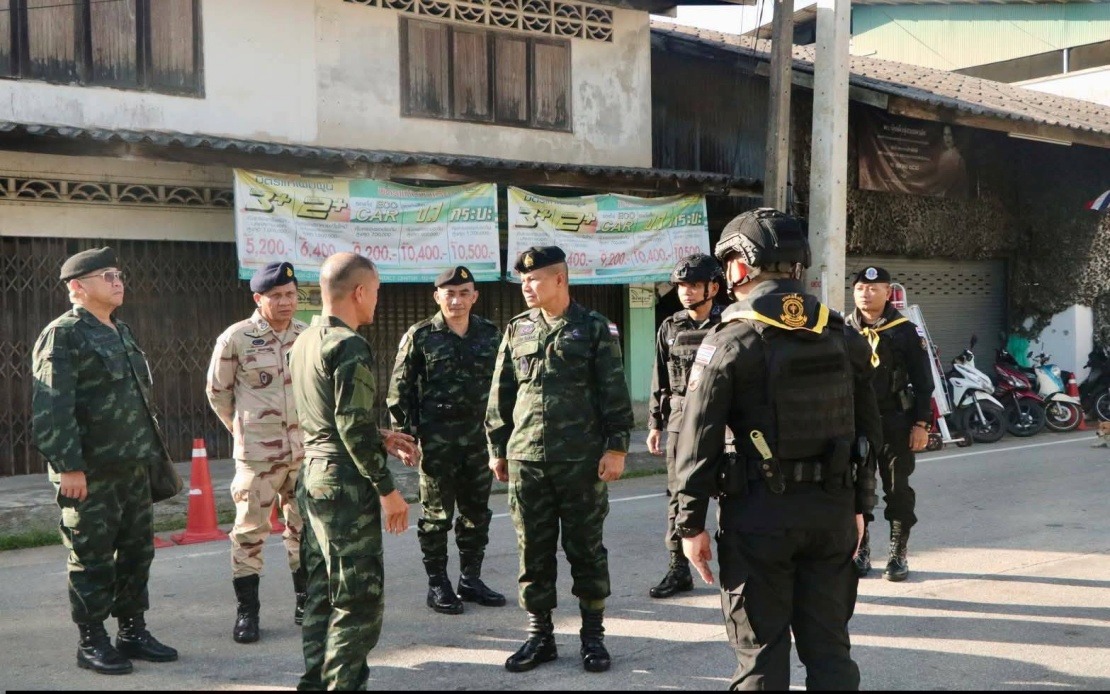
A brazen assault on a military checkpoint in Thailand's southernmost province has claimed the lives of five rangers and left six civilians wounded, intensifying security concerns along one of Southeast Asia's most volatile borders. The attack unfolded around 6.45 pm on Wednesday at the 4509 Ranger Company checkpoint positioned on Sami Hill in Rangae District, Narathiwat, drawing swift responses from both military and civilian authorities who moved to contain the fallout and investigate the incident.
Lieutenant General Norathip Phoyanok, who holds dual responsibility as Fourth Army Region Commander and Director of the Internal Security Operations Command Region 4, visited the scene the following day to assess the situation firsthand. According to his account, the assault involved a coordinated operation in which more than six assailants, their faces obscured and dressed entirely in dark garments, descended upon the checkpoint with overwhelming firepower and explosives. The attackers fired volleys of ammunition while hurling pipe bombs at the security personnel manning the post, a tactic suggesting some degree of tactical planning rather than spontaneous violence.
The casualties reveal the indiscriminate nature of the violence. Among the six civilians injured were a three-year-old girl and an elderly resident, suggesting that the checkpoint's location meant nearby residents became caught in the crossfire. The death toll of five rangers represents a significant loss of personnel and underscores the persistent danger faced by Thailand's security forces operating in the southern region, where armed separatist movements and criminal networks have operated for years despite government counterinsurgency efforts.
After the gunfire and explosions ceased, witnesses reported seeing the attackers flee the scene in a black four-wheel-drive vehicle, providing investigators with a potential lead. However, the hasty departure and apparent coordination of the assault suggest a level of operational sophistication, raising questions about whether the group received intelligence about security arrangements or benefited from local knowledge of escape routes. The vehicle description, while specific, covers thousands of similar vehicles across southern Thailand and neighbouring Malaysia.
The immediate response from provincial administration focused on securing the area and gathering evidence. Narathiwat Governor Boonchuai Hormyamyen ordered all security forces—encompassing police units, military personnel, and civilian administrative staff—to implement enhanced protective measures along the porous Malaysia-Thailand border and across Narathiwat's twelve administrative districts. This comprehensive approach acknowledges that the threat extends beyond a single checkpoint and reflects broader instability throughout the province.
Cordon-and-search operations allowed forensic teams to document the crime scene, collect ballistic evidence, and preserve other physical remnants that might identify the perpetrators or establish connections to known militant groups. Such meticulous investigation is essential in southern Thailand, where multiple actors—ranging from local insurgent organizations to cross-border criminal syndicates—operate in overlapping territories and sometimes coordinate their activities.
The broader context of violence in Narathiwat cannot be separated from Malaysia's strategic proximity. The Malaysia-Thailand border in this region has long served as a porous frontier through which weapons, personnel, and supplies flow in multiple directions. Malaysian authorities maintain heightened vigilance along their side of the boundary, aware that instability in Thailand's southern provinces could generate refugee flows or provide sanctuary for actors hostile to Malaysian interests. For Malaysian readers, such incidents underscore the interconnected nature of security challenges across the region and the potential for cross-border spillover effects.
The attack also reflects persistent challenges within Thailand's southern counterinsurgency strategy. Despite decades of military operations, government investments in development, and peace dialogue initiatives, violence continues to spike unpredictably. The targeting of a ranger company checkpoint suggests either deliberate intent to strike at security infrastructure or, alternatively, opportunistic action against a perceived vulnerability. Either interpretation points to gaps in protective measures or intelligence gathering that authorities must address.
Investigators remain focused on identifying those responsible for planning and executing the assault. Lieutenant General Norathip's reference to ongoing investigation into "masterminds" indicates that officials suspect the checkpoint attack represents a coordinated operation rather than the work of independent militants acting alone. Such hierarchical planning matters significantly for counterterrorism response, as dismantling command structures proves more effective than simply apprehending field operatives.
The incident occurs within a region where ceasefire negotiations have periodically stalled, leaving underlying grievances unresolved and space for militant groups to maintain operational capacity. Thailand's approach has traditionally balanced military pressure with dialogue efforts, yet violence persists despite these attempts. For Malaysian observers, the situation serves as a reminder of how regional instability requires coordinated diplomatic and security responses, particularly given the interconnected demographics and geography of the borderlands.
The security escalation ordered by Governor Boonchuai reflects recognition that individual attacks often presage broader campaigns. By mobilizing police and military resources comprehensively across all twelve Narathiwat districts rather than concentrating solely on the attack site, authorities attempt to prevent copycat operations or follow-up strikes. Whether such reactive measures prove sufficient remains an open question, particularly if the underlying motivations driving such coordinated violence remain unaddressed through political or social mechanisms.
For Malaysia, the incident reinforces the importance of maintaining robust border security and intelligence-sharing arrangements with Thai counterparts. Cross-border coordination has improved significantly over recent years, yet cases like this demonstrate the continued vulnerability of the frontier region. Malaysian security agencies will likely monitor developments carefully, assessing whether the attack signals a shift in militant tactics or represents an isolated incident within broader patterns of southern Thai violence.

