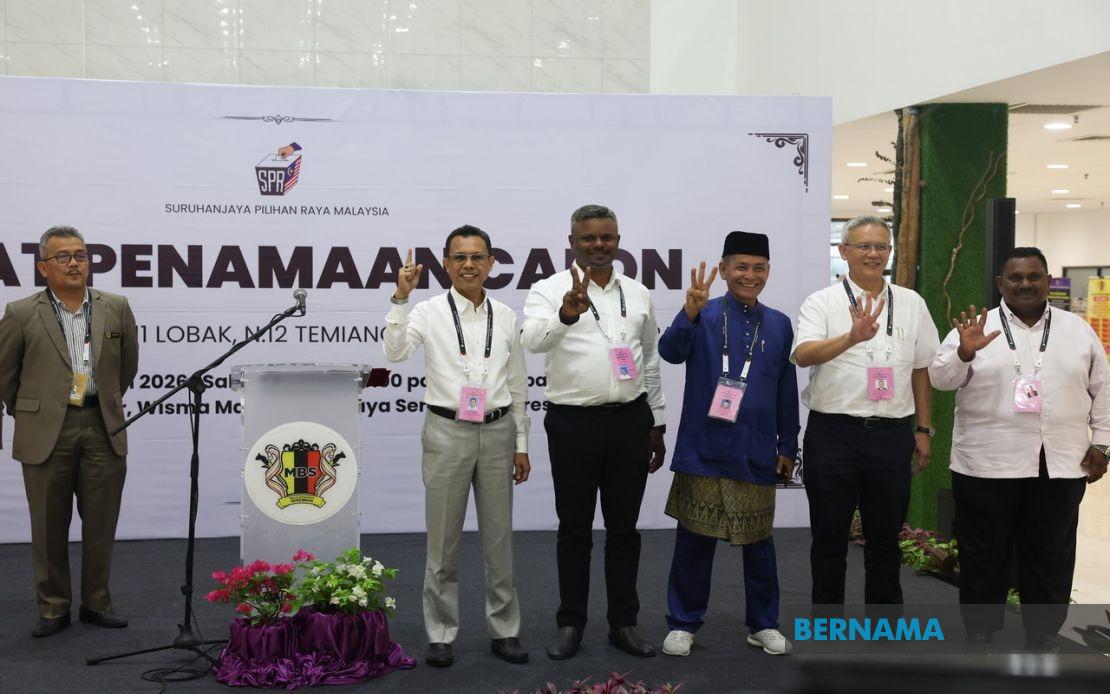
The political contest in Negeri Sembilan's Nilai state seat has crystallised into a fierce five-way scramble following Monday's nomination deadline, with incumbent assemblyman and DAP National vice chairman J. Arul Kumar confronting his most challenging electoral environment yet. The complexity of the race reflects deeper fissures within Malaysia's opposition and ruling blocs, as fragments of the political landscape continue to splinter in the run-up to the August 1 polling day.
Arul Kumar, representing Pakatan Harapan, must now contend with rivals spanning the full spectrum of Malaysian politics. Zamani Ibrahim carries the banner of Berjasa, the smaller Islamic party that has carved out space in Malaysia's increasingly crowded political marketplace. Datuk Lai Chien Kong represents the traditional force of Barisan Nasional, while Datuk V. Saravana Kumar fights for Bersatu, the party that emerged from UMNO's internal divisions and has become kingmaker in multiple state governments. Complicating matters further is independent candidate Omar Mohd Isa, who may siphon votes from multiple camps depending on local sentiment.
The crowding of the Nilai ballot suggests the seat has emerged as genuinely competitive territory, rather than a safe incumbent pocket. For Arul Kumar, who combines his assembly portfolio with significant standing in DAP's national hierarchy, the multiplication of challengers presents a mathematical problem even if his vote share remains stable. In Malaysian electoral contests, particularly at state level where turnout can be volatile, vote fragmentation can punish incumbents regardless of their underlying support.
The broader Negeri Sembilan campaign is shaping up as a complex mosaic of contests, each with its own peculiar configuration. In Sikamat, Nor Azman Mohamad, currently serving as political secretary to the Menteri Besar, carries PH's hopes against Datuk Razali Abu Samah of Perikatan Nasional and Datuk Tun Faisal Ismail Aziz of Bersatu. Notably, independent candidate Bujang Abu withdrew at the eleventh hour, a last-minute withdrawal that underscores the fluidity and uncertainty of candidate registration processes.
Lenggeng presents a three-cornered affair where PH's Zarinna Abu Zarin opposes BN's incumbent Datuk Mohd Asna Amin and Bersatu's Zool Amali Hussin. Meanwhile, the Lobak seat appears set for a cleaner two-candidate race between PH's sitting assemblyman Chew Seh Yong and PN's Dr P. Kumar, offering voters a more straightforward choice in an era when such binary contests have become increasingly rare.
Temiang also attracts three contenders, with Ho Weng Wah, another Pakatan Harapan member with credentials as a political secretary in the federal Transport Ministry, squaring off against BN's Datuk Leaw Kok Chan and Bersatu's Fazly Hamid. The prevalence of political secretaries among candidates from all camps speaks to how bureaucratic positions have become staging posts for electoral ambitions, blurring lines between administrative and political roles.
Ampangan completes this snapshot of contested seats, where Muhammad Nazri Kassim, director of Yayasan Negeri Sembilan, represents PH against PN's Datuk Dr Mohamad Rafie Malek and Bersatu's Noor'azah Harun. The appointment of civil society and semi-public sector figures as candidates reflects parties' attempts to project competence and independence, particularly in three-way contests where ideological differentiation becomes difficult.
The 36-seat Negeri Sembilan state assembly was dissolved on June 5, triggering the election cycle that culminated in Monday's nomination process. The Election Commission's decision to schedule early voting for July 28, with the main polling day on August 1, compresses the campaign period into less than two weeks following nomination, limiting the time for grassroots mobilisation. This condensed timeline may advantage better-resourced parties with established machinery while disadvantaging new or smaller contestants.
For Malaysian voters, the emergence of multiple contested seats across Negeri Sembilan indicates that no single bloc can assume easy victories in state politics. The multiplication of Bersatu candidates across multiple seats—appearing in Sikamat, Lenggeng, Temiang, and Ampangan—suggests the party is attempting to expand beyond its strongholds, though whether these efforts will translate into seats remains uncertain. Similarly, BN's continuing presence across multiple contests reflects its institutional staying power despite national-level setbacks, while PN's involvement signals the volatility of Malaysian coalition politics.
For Arul Kumar specifically, the five-way contest in Nilai demands a recalibration of electoral strategy. In such fragmented contests, winning with even 35-40 percent of the vote becomes possible depending on how opposition votes split. The DAP leader's track record and political machinery will be tested against not just a single challenger but a dispersed field where every vote count matters disproportionately. His party's national profile provides some advantage, yet his status as a non-Malay politician in a predominantly Malay state adds complexity to the electoral calculus.
The Negeri Sembilan election, though a state-level affair, carries wider ramifications for Malaysian politics. Results will signal whether PH can maintain its foothold in states outside its core strongholds, whether BN can arrest its gradual decline, and whether Bersatu and PN can consolidate the electoral support they claim nationally. The August 1 polling will provide early data on voter sentiment before the next federal election cycle potentially opens in 2024 or 2025, making these state contests consequential beyond Selangor's borders.

