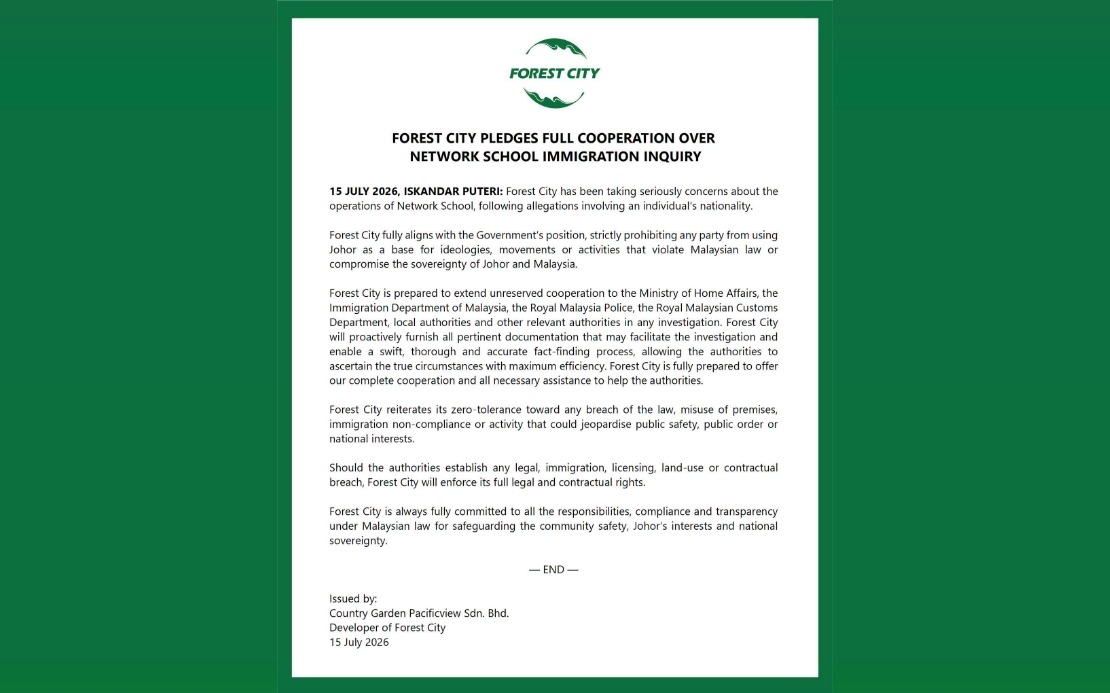
Forest City's developer Country Garden Pacificview Sdn Bhd has signalled its willingness to assist authorities investigating the operations of Network School, which has drawn scrutiny over the alleged involvement of Israeli citizens. The developer issued a statement reaffirming its commitment to supporting government efforts to ensure Johor is not exploited for activities that breach local laws or compromise Malaysia's sovereignty.
The investigation gained momentum after Johor Menteri Besar Datuk Onn Hafiz Ghazi publicly called for the Home Ministry (KDN) and related agencies to examine Network School's operations within the Forest City development. Onn Hafiz raised concerns that individuals involved may have entered Malaysia using alternative passports from other countries to participate in the programme, a practice that triggered heightened public concern about potential security and legal compliance issues.
Country Garden Pacificview emphasised that it takes the matter with considerable seriousness and stands aligned with the government's position that Johor must remain off-limits to any operations contravening Malaysian law or national sovereignty. The developer's commitment extends across multiple government bodies, including the Immigration Department (JIM), the Royal Malaysia Police, the Royal Malaysian Customs Department, and local municipal authorities.
A key undertaking from the developer involves providing comprehensive documentation and records to expedite the investigative process. Country Garden Pacificview stated it would submit all pertinent materials necessary to facilitate thorough, accurate, and effective fact-finding by the relevant agencies. This collaborative stance reflects the developer's recognition that transparent cooperation serves the interests of both the government and the integrity of the Forest City project.
The developer has also articulated a firm zero-tolerance policy regarding any breaches of Malaysian law, misuse of facilities within its development, violations of immigration procedures, and activities that could endanger public safety or social order. This declarative position underscores the company's commitment to maintaining Forest City as a properly regulated and law-abiding commercial and residential zone.
Authorities moved quickly following the Menteri Besar's concerns. Immigration officials conducted an on-site inspection of 266 foreign nationals from 40 different countries residing or present in Forest City during the investigation's initial phase. Preliminary assessments indicated that all individuals examined held valid immigration documentation, though authorities cautioned that comprehensive investigations remain ongoing and conclusions are not yet finalised.
For Malaysia's property and business sectors, this episode illustrates the heightened scrutiny facing large-scale developments, particularly those with significant foreign investment and international clientele. Forest City, as one of Southeast Asia's largest mixed-use developments, operates under considerable public and governmental attention, making compliance and transparency essential operational principles.
The incident also highlights the complexity of managing international communities within Malaysia's regulatory framework. Educational initiatives and professional training programmes that attract foreign participants must navigate multiple regulatory domains simultaneously—immigration law, educational accreditation, security protocols, and local governance requirements. The Network School case underscores how gaps in oversight or documentation can quickly escalate into matters of national concern.
For regional investors and developers, the swift and assertive response from Johor's political leadership and federal authorities sends a clear signal about Malaysia's non-negotiable stance on sovereignty and legal compliance. While the country welcomes foreign investment and international engagement, it maintains firm boundaries regarding activities that could be perceived as circumventing established regulations or compromising national interests.
The cooperation between Country Garden Pacificview and authorities also reflects broader efforts to strengthen the relationship between the private sector and government institutions in upholding the rule of law. When large-scale commercial operations work transparently with enforcement agencies rather than resisting scrutiny, it strengthens public confidence that Malaysia's regulatory mechanisms function effectively.
As the investigation proceeds, the outcome will likely influence how future international educational and professional programmes operate within major Malaysian developments. Tighter protocols around participant documentation, enhanced vetting procedures, and clearer regulatory pathways may become standard practice across similar initiatives in Southeast Asia's most prominent mixed-use zones.
The Forest City episode serves as a reminder that in an increasingly interconnected region, maintaining clear distinctions between legitimate international exchange and activities that skirt legal requirements remains crucial. Malaysia's response demonstrates its commitment to balancing openness to global engagement with unwavering adherence to national law and sovereignty protections.

