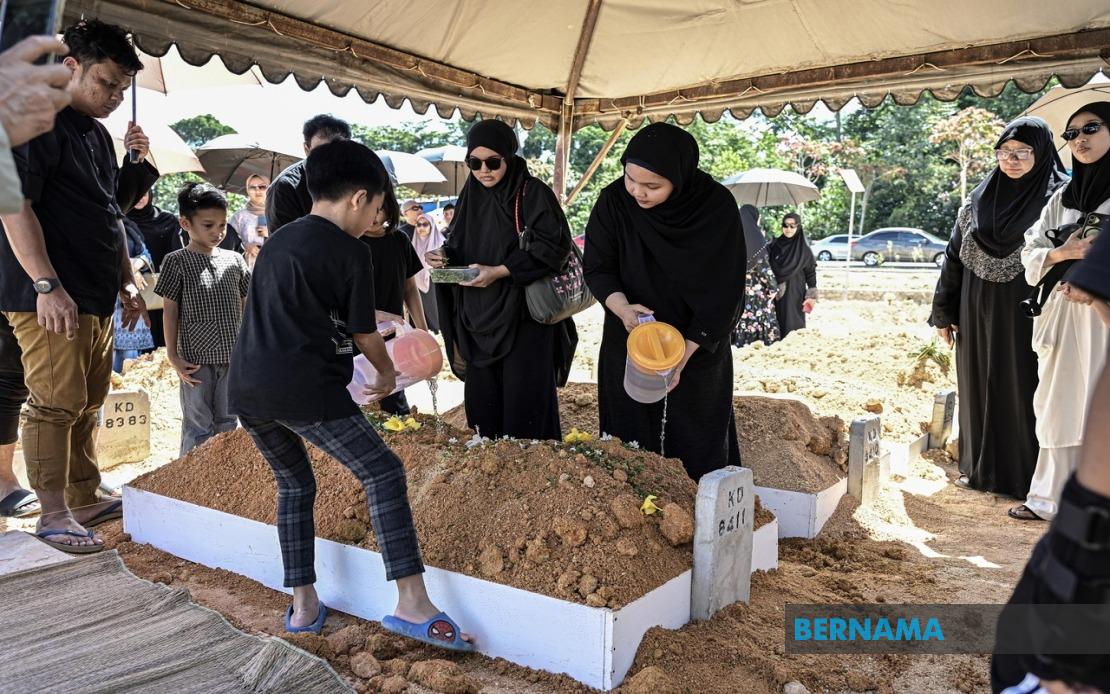
The judicial landmark that was Tun Mohamed Eusoff Chin's legacy concluded on Wednesday afternoon when the 91-year-old former Chief Justice was committed to the ground at Section 9 Muslim Cemetery in Kota Damansara. The burial ceremony took place at 3.30 pm, drawing a gathering of family members, legal professionals, and members of the public who came to honour one of Malaysia's most significant judicial figures. The day's proceedings began with funeral rites at 11.30 am, followed immediately by the funeral prayer at Masjid Al-Hidayah in Kelana Jaya after the Friday congregation had dispersed.
Tun Mohamed Eusoff passed away at 1 am on Wednesday at KPJ Damansara Hospital following a brief illness. His daughters revealed that his health had declined noticeably over the previous two days, with the former Chief Justice becoming increasingly unresponsive and spending most of his time resting. The hospital admission had been prompted by a minor infection, but according to family accounts, there was no serious underlying condition. His children indicated that his passing came peacefully, with all siblings managing to visit during his final days except for one brother who was travelling overseas.
The distinguished jurist served as Malaysia's second Chief Justice for six formative years, holding the position from September 1994 until December 2000. During his tenure, Tun Mohamed Eusoff presided over a critical period in the nation's legal development, when the judiciary was navigating complex constitutional and administrative challenges. His leadership came during a transformative era for Malaysia's legal system, and his decisions and judicial philosophy would influence the trajectory of Malaysian jurisprudence for decades following his retirement.
Zubaidah Mohamed Eusoff, one of his daughters, offered intimate insights into her father's character beyond his formal judicial reputation. She explained that while his Perak origins and commanding demeanour often gave the impression of a stern and austere figure, his private personality was markedly different. Within the family circle, Tun Mohamed Eusoff was known for his humour and playful nature, qualities that those outside his immediate family rarely witnessed. Zubaidah emphasised that her father's professional and personal actions were consistently guided by principles of justice and goodness, and that his primary motivation in all undertakings was the welfare and betterment of his family.
Zubaidah's reflections underscored the contrast between the public perception of judicial figures and their existence beyond the courtroom. A Chief Justice occupies one of the most visible positions in the Malaysian state apparatus, and the formal dignity demanded by the role can obscure the individual beneath. In her father's case, this gap between public persona and private self was particularly pronounced. She noted that her family had achieved a degree of acceptance regarding his passing, drawing strength from the knowledge that her parents had completed 41 years of marriage and that his life had been lived purposefully.
Her younger sister, Zuliana, corroborated the family's account of his final days. She described how Tun Mohamed Eusoff's condition deteriorated gradually, with his responsiveness diminishing and his need for rest increasing substantially. The family had opted for hospital care at KPJ Damansara to manage his minor infection, and the medical team had provided appropriate treatment. Zuliana's description of his passing as peaceful would have provided some comfort to the grieving family, suggesting that his final moments were not marked by suffering or distress.
The cemetery ceremony itself reflected the respect and gravitas accorded to a former Chief Justice. The Section 9 Muslim Cemetery in Kota Damansara filled with mourners representing different segments of Malaysian society—colleagues from the legal profession, government officials, and members of the public who recognised the significance of the occasion. The solemnity of the setting and the composed bearing of the funeral proceedings demonstrated the standing that Tun Mohamed Eusoff maintained within Malaysian institutional circles even in retirement.
Tun Mohamed Eusoff Chin's judicial career spanned a particularly consequential period for Malaysia's development as a nation-state. The 1990s and early 2000s witnessed significant legal and constitutional developments, and as Chief Justice, he occupied a pivotal role in interpreting and shaping the judicial response to the challenges facing the country. His decisions would have touched on matters affecting governance, individual rights, and the balance of power between different branches of government. The corpus of his judicial work remains part of the permanent record of Malaysian legal history.
The passing of senior statesmen and institutional leaders like Tun Mohamed Eusoff Chin serves as a moment for national reflection on the contributions of previous generations to Malaysia's governance structures. While the immediate personal loss is felt most acutely by his family, the broader Malaysian community also registers the departure of those who shaped the nation's institutions during formative periods. The legal profession in particular would have regarded his death as marking the end of an era, as the judges and lawyers who trained under or worked alongside him represent a direct link to the judicial philosophy and practices that characterised his leadership.
The funeral and burial arrangements reflected Islamic observance and family wishes, with the proceedings conducted with appropriate religious solemnity. The gathering at Kota Damansara provided an opportunity for those whose lives and work had intersected with Tun Mohamed Eusoff's to acknowledge his passing and the mark he had left on Malaysian public life. His grandchildren and extended family members participated in the ceremonies, ensuring that the occasion remained rooted in the intimate bonds of kinship even as the larger Malaysian institutional world paid its respects.

