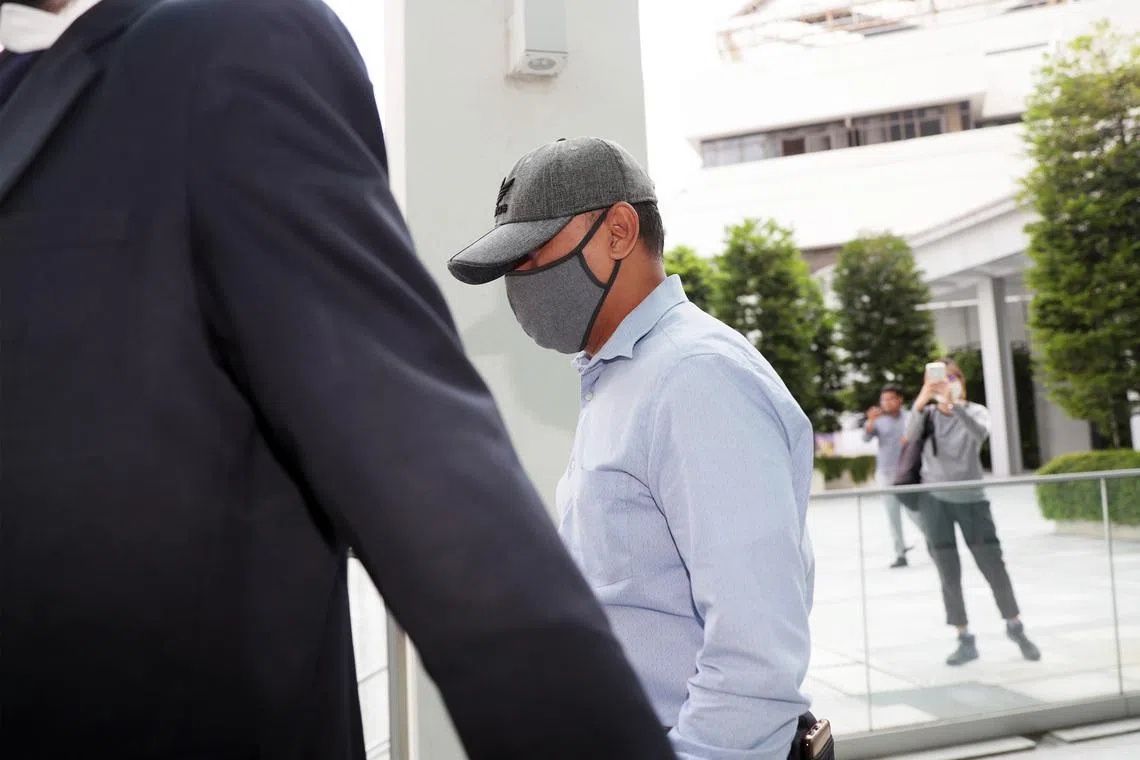
A senior religious administrator in Singapore has received a 14-month prison sentence for providing corrupt assistance that allowed a friend's construction company to secure lucrative contracts worth S$223,000 from two mosques under his oversight. The conviction of Abdul Rahim Mawasi, 59, marks a significant corruption case within Singapore's Islamic institutional framework and underscores the vulnerabilities that can arise when institutional gatekeepers misuse their authority for personal benefit.
Abdul Rahim held the position of executive chairman at both Darul Aman Mosque along Jalan Eunos and Sallim Mattar Mosque in MacPherson. Beyond these roles, he was also a senior officer with the Islamic Religious Council of Singapore, commonly known as MUIS, having joined the organization in 2005. His dual responsibilities placed him in a position of significant influence over procurement decisions affecting both religious institutions, a trust he ultimately betrayed.
The scheme at the heart of his conviction began in mid-2018 when Abdul Rahim proposed to his acquaintance Mohd Mustaqim Kam, then 66, that they establish a joint travel company specializing in pilgrimage tours. Kam, who directed construction firm Zeal-Con Engineering, accepted the proposition with a critical condition: Abdul Rahim would contribute no initial capital to the venture. Instead, his contribution would be securing construction work for Zeal-Con from the mosques, with profits flowing back as capital for their travel business. This arrangement created an immediate conflict of interest that compromised Abdul Rahim's ability to make impartial procurement decisions.
The corruption manifested clearly in the Darul Aman Mosque construction process. When the mosque sought vendors in 2018 for yard renovation work, Zeal-Con submitted an initial quote of S$128,600 in August. By September, the company provided a substantially reduced quote of S$118,000, undercutting the next-closest bid of S$125,500 from a competing firm. Court proceedings revealed that Abdul Rahim had engaged in extensive discussions with Kam regarding appropriate bid pricing and supplied crucial price indications that directly enabled Zeal-Con's successful submission. The mosque management board remained entirely unaware of these behind-the-scenes negotiations, making the decision based on false competitive assumptions.
A similar pattern unfolded at Sallim Mattar Mosque. Zeal-Con initially quoted S$115,700 for renovation work spanning the roof and reception areas. Subsequently, the company lowered its bid to S$105,000 for identical work. Evidence presented during the trial demonstrated that Abdul Rahim had actively encouraged Kam to reduce the company's quote further to ensure contract award. By July 2019, Sallim Mattar Mosque issued contract letters to Zeal-Con based on these artificially suppressed figures.
To conceal his financial interest in the arrangement, Abdul Rahim devised a scheme using his son as a proxy shareholder. In November 2019, Kam converted an existing shell company into Amal Travel and Tour, capitalizing it with S$100,000 and issuing 100,000 shares. He then allotted 25,000 shares valued at S$1 each to Abdul Rahim's son, effectively granting the father an indirect stake in the travel venture without formal disclosure. This deliberate obfuscation demonstrated premeditation in avoiding detection by MUIS leadership and audit mechanisms.
During trial proceedings, Abdul Rahim's legal representation, provided by lawyer Satwant Singh Sarban Singh, maintained that he held no involvement with Amal Travel and Tour and possessed no shareholding in the company. The defense strategy centered on technical denials rather than challenging the substance of the price-fixing conduct. However, the prosecution successfully established through documentary evidence and testimony that Abdul Rahim's son did receive the share allotment, and that the father had arranged this structure precisely to maintain plausible deniability.
Abdul Rahim's associate, Mohd Mustaqim Kam, faced earlier legal proceedings and received a six-month jail sentence in February 2025 for his role in the scheme. The staggered sentencing reflected both the perpetrator's degree of culpability and the prosecution's view that Abdul Rahim, as the institutional insider who breached fiduciary duties, bore greater responsibility for enabling the corruption.
Remarkably, the prosecution acknowledged during sentencing that the two mosques did not sustain substantial financial losses from the arrangement. Zeal-Con completed the contracted work satisfactorily, and the quality of construction met institutional needs. This fact, however, did not diminish the severity of Abdul Rahim's breach. Deputy Public Prosecutor Bryan Wong emphasized that the offense represented serious public sector corruption motivated by personal financial gain, regardless of whether actual economic harm materialized. The principle at stake transcended simple cost considerations—it concerned the integrity of institutional decision-making and the trust placed in administrators of religious organizations.
Abdul Rahim maintained his innocence throughout the trial, though the court ultimately convicted him in April 2025 after hearing all evidence. His defense counsel appealed for leniency, requesting no more than six months' imprisonment and emphasizing the defendant's previously unblemished record. The district judge rejected this appeal, imposing the 14-month sentence as proportionate punishment for deliberate abuse of institutional authority. His bail was set at S$30,000, with sentencing to commence on July 10.
For Malaysian observers, this case carries particular relevance given the region's ongoing concerns about governance standards in religious institutions and vulnerability to insider corruption schemes. The sophistication with which Abdul Rahim concealed his interests through family shareholding proxies mirrors tactics documented in corporate fraud cases across Southeast Asia. The conviction signals Singapore's willingness to prosecute senior religious administrators who abuse trust, establishing a benchmark for institutional accountability that resonates across the region's Islamic administrative structures.

