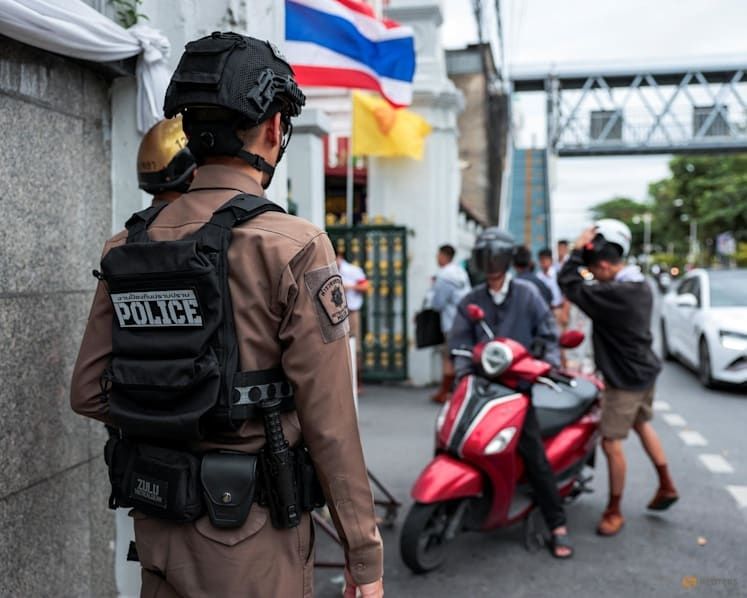
Thai police have arrested a former member of parliament accused of shooting and injuring a local government official and his driver in an alleged incident that underscores the country's ongoing struggles with gun violence. Chalong Riewrang, who previously served as a local MP and belonged to Prime Minister Anutin Charnvirakul's party, was taken into custody on Monday and is being interrogated by Nonthaburi police regarding his possible motives. The alleged shooting occurred in Nonthaburi province, situated just north of Bangkok, where the chairman of the local government administration sustained serious injuries alongside his driver during what authorities are still investigating as either a personal grievance or potentially wider criminal matter.
Nonthaburi police chief Dejrapee Kongdee disclosed that both victims are receiving medical treatment but did not elaborate on the driver's condition beyond confirming he was wounded. The investigation remains in its preliminary stages, with officers working to establish exactly what precipitated the violence. Local news outlets have suggested that the shooting may have stemmed from a private dispute between Chalong and the victims, though the police chief has refrained from confirming this theory at this stage. The incident represents yet another serious gun-related crime in a region that has become increasingly synonymous with firearms violence across Southeast Asia.
The arrest arrives at a particularly sensitive moment for Thailand's gun policy discourse, coming merely days after a catastrophic school shooting in the same province shocked the nation and sparked renewed calls for legislative action. On Friday, a 14-year-old student opened fire at his school after first killing his two grandparents at home in a rampage that claimed eight lives before the teenager turned the weapon on himself. The tragedy exposed deep fractures in Thailand's approach to weapon regulation and has amplified public and political pressure for meaningful reform to prevent such incidents from recurring.
Thailand maintains one of Southeast Asia's highest concentrations of civilian firearms, with an estimated ten million guns circulating throughout the country—a ratio of roughly one firearm per seven inhabitants. This proliferation has created a domestic environment where access to weapons far exceeds what stricter regulatory regimes would allow, and where incidents of gun violence have become disturbingly routine. The scale of firearms ownership reflects decades of lenient licensing standards, weak enforcement mechanisms, and a cultural acceptance of gun ownership that contrasts sharply with neighbouring countries that have implemented more rigorous controls. Government officials have repeatedly acknowledged this problem yet failed to implement lasting solutions.
Following Friday's school shooting, government ministers and law enforcement authorities have once again pledged to introduce tougher gun legislation and stricter licensing procedures. These promises echo numerous previous commitments made after earlier shooting incidents that similarly shocked the public conscience yet ultimately resulted in minimal substantive change. The pattern reveals a troubling disconnect between rhetoric and action, where political will to tackle the issue dissipates once media attention fades and the immediate public outcry subsides. Previous legislative initiatives have stalled in parliament or been watered down through compromises that left the fundamental problems unresolved.
The circumstances surrounding Chalong's alleged attack suggest that individual grievances intersecting with easy weapon access create a volatile combination. His membership in Anutin Charnvirakul's party—a significant coalition partner in Thailand's government—may complicate the investigation politically, though authorities have shown willingness to pursue high-profile cases regardless of political connections. The specific nature of the personal dispute that allegedly motivated the shooting remains unclear, but the incident illustrates how quickly disputes can escalate when firearms are readily available to individuals with grievances.
For Malaysia and other Southeast Asian countries, Thailand's gun violence crisis presents a cautionary narrative about the dangers of permissive firearm policies. Malaysia has maintained relatively restrictive gun ownership standards that require extensive licensing and demonstrate clear public safety benefits compared to Thailand's more lenient approach. The contrast highlights how regulatory frameworks adopted decades ago continue to shape contemporary public safety outcomes. Regional policymakers can draw important lessons from Thailand's struggles when evaluating their own firearms regulations and enforcement mechanisms.
The frequency of shooting incidents in Thailand has intensified scrutiny not just domestically but internationally, with observers questioning whether the government possesses genuine commitment to addressing root causes versus merely responding reactively after tragedies occur. The economic and social consequences of gun violence extend beyond immediate casualties to encompass broader impacts on community safety perceptions, psychological trauma, and loss of public confidence in state institutions. Thailand's tourism industry, a crucial economic pillar, could also face reputational damage if the country becomes perceived as unsafe due to prevalent gun violence.
Investigators will likely scrutinise how Chalong obtained and retained access to firearms, examining whether his weapons were properly registered and legally held under current regulations. Such scrutiny could expose gaps in enforcement and accountability mechanisms that permit individuals to maintain firearm access despite potentially concerning personal or legal histories. The investigation findings may themselves become ammunition in the broader debate over whether existing rules require stricter interpretation or whether new legislation is fundamentally necessary. As police gather evidence and interrogate the former MP, Thai society watches to see whether this latest incident catalyses genuine reform or merely repeats the familiar cycle of outrage followed by legislative inaction.

