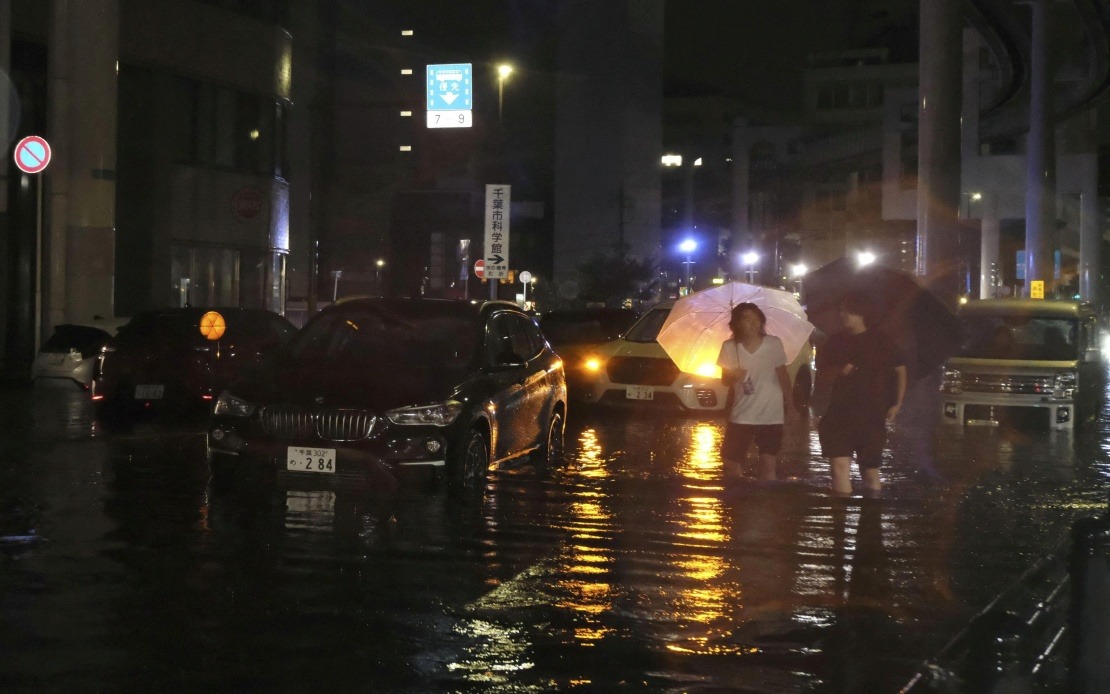
Four residents have died and one remains unresponsive following severe rainstorms that battered the Chiba Prefecture region adjacent to Tokyo throughout Thursday and into Friday morning. The Japan Meteorological Agency declared a Level 5 emergency—its most critical alert tier—for rainfall across more than one-third of Chiba's municipalities, signalling conditions of exceptional danger that demand immediate protective action from residents. Concurrent with these precipitation warnings, authorities raised equivalent landslide alerts for several districts including Chiba and neighbouring Ichihara, though these designations were downgraded by Friday morning as conditions gradually stabilised.
The meteorological circumstances driving this extreme weather stemmed from a collision of warm, moist air masses moving across eastern Japan that encountered colder atmospheric layers above, creating profoundly unstable conditions conducive to torrential downpours. This combination of meteorological factors produced rainfall intensities that tested the region's drainage infrastructure and emergency response systems. In Chiba's Chuo Ward alone, precipitation rates reached 115 millimetres within a single hour Thursday evening—equivalent to the entire typical August monthly rainfall in ordinary years, underscoring the extraordinary nature of the deluge.
Flood damage manifested across the prefecture with widespread inundation of roadways and urban areas. The cities of Chiba and Ichikawa, recognising the acute threat, broadcasted urgent appeals directing residents to implement immediate safety protocols. Some areas experienced water surging from underground utility access points, while pedestrians navigated streets submerged to knee height in their attempts to reach homes before darkness fell. The prefectural government building in Chiba opened its facilities to accommodate approximately 1,800 stranded commuters unable to reach residences due to transport disruption.
Emergency authorities demonstrated the scale of displacement caused by these events through evacuation figures. At the crisis peak, evacuation orders extended to more than 400,000 people across both Chiba and neighbouring Ibaraki Prefecture. By early Friday morning, approximately 126,000 residents maintained mandatory evacuation status across these two prefectures, indicating that substantial portions of the population remained unable to safely return to their homes. Such large-scale displacement places enormous strain on emergency services, accommodation infrastructure, and social support systems across the affected region.
The government activated comprehensive shelter operations to accommodate displaced persons. Over 200 evacuation centres were established across Chiba, Ibaraki, Saitama, and Gunma prefectures, creating makeshift communities where families sheltered together awaiting clearance to return home. These facilities require coordination across prefectural boundaries and demand substantial logistical resources including food supply, medical personnel, sanitation facilities, and psychological support services for traumatised residents.
Infrastructural damage extended to the electrical supply network. At the peak of the emergency, approximately 45,000 households throughout Chiba Prefecture experienced power disruption, according to figures from a Tokyo Electric Power Company Holdings Inc. subsidiary. Such outages compound resident hardship by eliminating refrigeration, lighting, heating, and communication capabilities during an already stressful period, particularly affecting vulnerable populations including elderly residents and those dependent on electrically-powered medical equipment.
The meteorological agency cautioned that unstable atmospheric conditions would persist through Friday, indicating that additional rainfall remained probable across Chiba and surrounding districts. This continued threat meant that evacuation orders could not be lifted hastily, and residents faced extended separation from their homes pending confirmation of stabilised conditions. Emergency coordinators maintained heightened alert status to respond rapidly to any escalation in rainfall intensity or new flood events.
For Malaysian observers, Japan's experience demonstrates the vulnerability of densely populated regions to extreme precipitation events despite advanced infrastructure and warning systems. As Southeast Asian nations face increasing extreme weather patterns linked to climate variability, Japan's rapid deployment of multilevel alert systems, large-scale evacuation protocols, and inter-prefectural emergency coordination offer instructive examples of institutional preparedness. The distinction between Level 5 warnings—reserved for genuinely catastrophic conditions—and lower alert stages reflects sophisticated risk communication designed to prevent both complacency and panic.
The economic and social consequences of such events extend well beyond immediate casualty counts. Regional productivity halts during evacuation periods, businesses suffer inventory damage, transportation networks require restoration, and psychological recovery among traumatised populations demands sustained attention. Japan's approach of establishing hundreds of shelters and maintaining evacuation orders until genuine safety returns represents a precautionary stance that prioritises human life over rapid economic recovery—a principle increasingly relevant as Southeast Asian economies confront similar climate-driven hazards with often less developed institutional responses.
As this particular emergency unfolded, it underscored Japan's established institutional capacity to mobilise resources at scale and communicate risks through standardised warning frameworks. The downgrading of Level 5 alerts by Friday morning signalled that meteorological conditions had transitioned from the most critical phase, though the continuing evacuation of 126,000 residents indicated that ground-level recovery remained incomplete. Regional authorities prepared for the gradual process of allowing residents to return, assessing building safety, restoring utilities, and clearing debris—a recovery trajectory that would extend considerably beyond the acute emergency phase.

