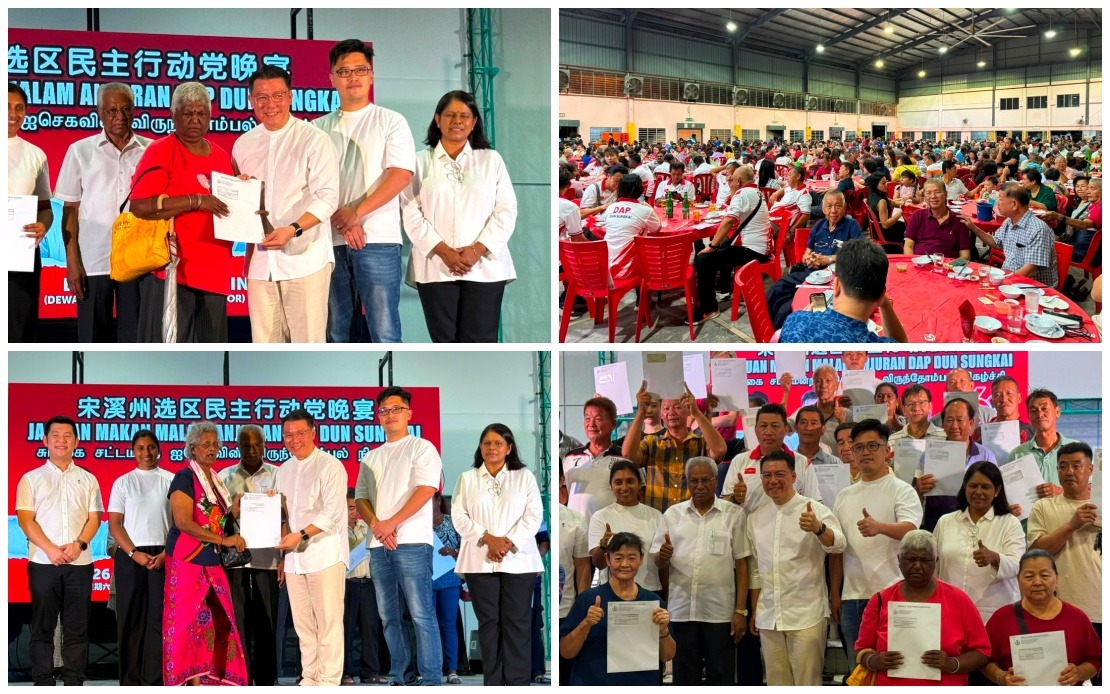
A four-decade struggle for housing security has come to an end for 120 families living in informal settlements around Sungkai and Kuala Bikam in Perak, as the government formally distributed land grants to the recipients on August 8. Housing and Local Government Minister Nga Kor Ming, who oversaw the handover ceremony, characterised the resolution as evidence of the MADANI Government's commitment to ensuring equitable development regardless of race or socioeconomic background.
The distribution of land grants represents far more than bureaucratic paperwork for these families. For residents who have endured decades of tenure insecurity, the grants symbolise permanence, the ability to invest in home improvements, and a foundation upon which to build their children's futures. In the Malaysian context, where informal settlements have historically been concentrated in specific communities, addressing this backlog signals a policy shift toward integrating historically marginalised populations into formal housing systems. The long delay itself underscores how such issues can slip through administrative cracks over generations, particularly when affected communities lack political leverage or media visibility.
Nga, who holds the position of DAP national deputy chairman, framed the resolution within the government's broader "Madani" philosophy—a governance approach emphasising unity and shared prosperity. At a dinner organised by the DAP Sungkai state constituency division that drew over 1,200 attendees from diverse communities, he emphasised that leaving no Malaysian behind represents not merely rhetorical commitment but measurable policy action. The high-profile nature of the event, coupled with the substantial attendance, suggests the government views this resolution as politically significant, particularly given the demographic composition of the beneficiary families.
Beyond the immediate land distribution, the Minister highlighted complementary initiatives targeting the Indian community specifically, an apparent reference to the primary demographic affected by these long-standing settlement issues. The government has allocated RM20 million toward improving Indian settlements more broadly, RM50 million dedicated to Tamil vernacular schools, and increased MITRA (the Malaysian Indian Transformation Unit) funding to RM150 million. These investments, taken together, indicate a strategic approach to addressing historical inequities through multiple levers simultaneously—housing security, educational opportunity, and institutional capacity-building.
The resolution involved sustained coordination between state and federal authorities. Sungkai assemblyman Datuk A. Sivanesan, who chairs the state Human Resources, Health, Indian Community Affairs and National Integration Committee, was credited alongside unnamed civil servants for driving the process to completion. This bureaucratic persistence across administrations suggests that despite Malaysia's often-fractious inter-governmental relations, specific issues can attract sufficient political priority to transcend typical partisan divisions, particularly when they affect concentrated voter populations.
For Malaysian observers tracking housing policy and social inclusion, the Sungkai resolution offers both encouragement and caution. The positive dimension lies in proof that entrenched informal settlement issues, even those spanning 40 years, remain amenable to government intervention. The cautionary aspect involves questioning why resolution took so long and what systemic barriers allowed families to remain in legal and material limbo for four decades. The answer likely combines bureaucratic inertia, limited political incentive structures that historically disadvantaged minority communities, competing budgetary priorities, and the complexity of converting informal land occupancy into formal tenure.
In Southeast Asia's broader context, Malaysia's approach to informal settlement formalisation parallels—though not identically—experiences in Thailand, Indonesia, and the Philippines, where governments have attempted titling programmes and settlement upgrading schemes with mixed results. The Malaysian model of direct land grants to beneficiary families differs from some regional approaches that emphasise public housing relocation or cooperative purchase arrangements. Direct grants maximise beneficiary agency and allow families to remain in established communities where social networks and livelihoods are anchored.
Nga's remarks about assessing government performance rather than being swayed by "racial sentiments" and "politics of perception" carried pointed implication in the contemporary Malaysian political climate. His language suggested pushback against opposition narratives about government prioritisation and suggested that tangible developmental outcomes should outweigh rhetorical claims or historical grievances. Whether such appeals prove persuasive to voters remains empirically uncertain, but the framing reflects official conviction that inclusive policy implementation can reshape political competition away from identity-based appeals toward performance-based evaluation.
The timing of this announcement, coupled with its celebration at a DAP-organised event in a key Perak constituency, indicates strategic political calculation. DAP, as the predominant opposition party in several states and a coalition partner in the federal government, has incentive to highlight such wins both to consolidate support among Indian voters and to demonstrate governing capacity to broader constituencies. The presence of multiple elected representatives—Ipoh Timur MP Howard Lee Chuan How, assemblywomen V. Bavani and M. Thulsi, among others—underscored the multiparty, cross-community nature of the constituency coalition.
For the 120 families receiving grants, immediate practical questions loom: Will grants include sufficient support for home construction or merely land title? What are the tenure conditions, and are families truly free from eviction risk? How will these families navigate municipal services, utility connections, and integration into formal neighbourhood administration? These implementation details, often less celebrated than policy announcement, frequently determine whether such initiatives genuinely transform beneficiary circumstances or represent largely symbolic gestures.
Looking forward, the Sungkai resolution may catalyse attention to similar informal settlements elsewhere in Malaysia. Other states with significant squatter populations—parts of Selangor, Johor, and Sabah, for instance—might reasonably expect government consideration of comparable programmes. If the MADANI administration extends this model systematically, it could materially improve housing security for tens of thousands of families. Alternatively, if Sungkai remains an isolated case driven by localised political calculations, its broader significance as a template for inclusive housing policy would prove limited.
The 40-year timeline itself merits reflection on Malaysian governance capacity and political economy. That families lived in legal precarity for four decades suggests that informal settlement, despite its obvious social costs, does not generate sufficient political urgency absent specific triggering events—in this case, perhaps changing electoral dynamics, coalition reconfiguration, or accumulated institutional pressure. Whether Malaysia can develop more proactive systems to prevent such decades-long delays in future cases remains an open question for policymakers and civil society observers alike.

